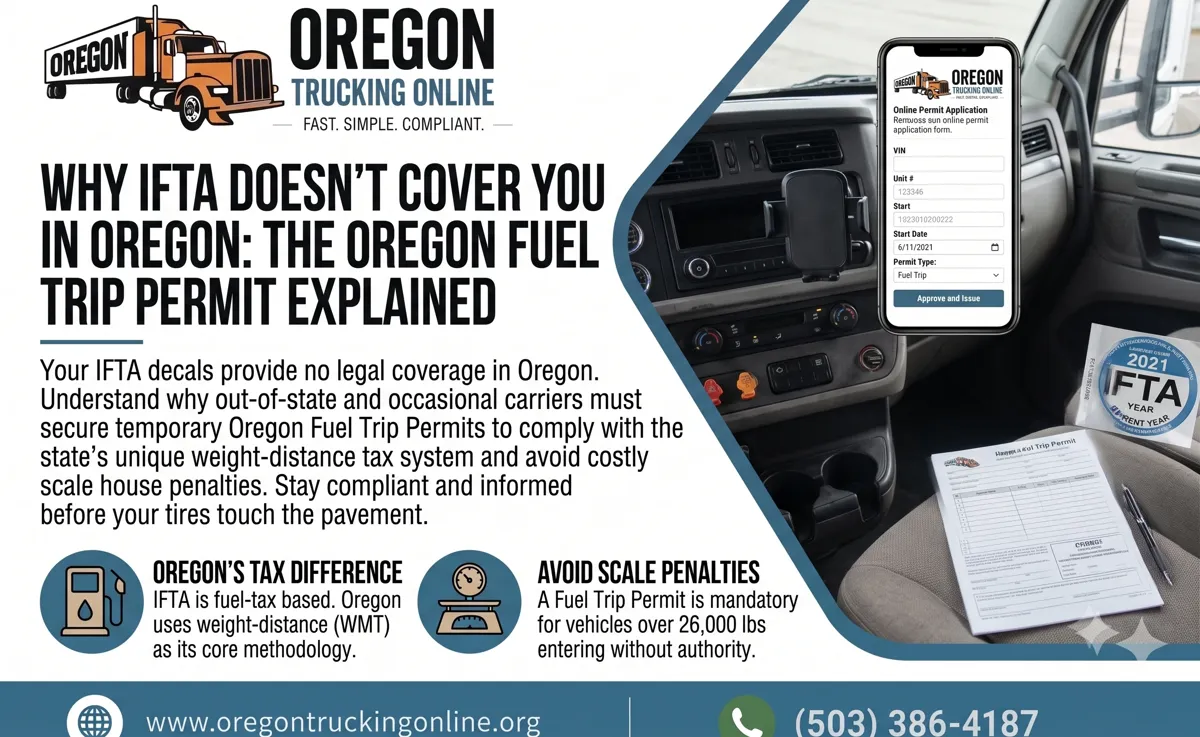
Why IFTA Doesn't Cover You in Oregon: Understanding the Oregon Fuel Trip Permit
Table of Contents
-
Introduction
-
The Crucial Difference: Why Oregon Opts Out of IFTA
-
What Exactly is an Oregon Fuel Trip Permit?
-
Who Needs to Purchase These Permits?
-
How a Fuel Permit Differs from a Standard Trip Permit
-
The Downside of Skipping Your Oregon Fuel Permit
-
Why Many Trucking Companies Choose Us
-
Frequently Asked Questions
Introduction
If you operate a commercial motor vehicle across state lines, you are likely intimately familiar with the International Fuel Tax Agreement (IFTA). You place your decals on the cab, track your fuel purchases, file your quarterly reports, and assume you are legally covered to haul freight through any continental state.
But if your route takes you into the Pacific Northwest, you are in for a surprise.
Oregon does things differently. Despite being surrounded by IFTA-member states, Oregon does not participate in IFTA for diesel-powered commercial vehicles. If you cross the state line, assuming your IFTA decals are your golden ticket, you risk facing heavy fines at the very first scale house.
To keep your fleet running smoothly and legally, you need to understand how the Beaver State tracks road use and why Oregon trip and fuel permits are essential for your business.
The Crucial Difference: Why Oregon Opts Out of IFTA
Almost every state uses fuel taxes collected at the pump managed through IFTA to fund highway construction and repaving. Oregon, however, uses a completely different philosophy.
The state believes that heavier vehicles cause exponentially more wear and tear on roads than lighter passenger cars. Therefore, instead of a standard fuel tax, Oregon utilizes a weight-distance tax system known as the Weight-Mile Tax (WMT).
Because Oregon collects its highway funds based on the weight of your truck and the exact miles you travel on its public roads, it has no use for standard IFTA reporting.
Since your base-state IFTA license does not report to Oregon's weight-mile system, your IFTA credentials do not legally cover you when you cross the border. Instead, you must pay for your road usage through Oregon's specific tax framework.
What Exactly is an Oregon Fuel Trip Permit?
For carriers that drive in Oregon on a daily or weekly basis, enrolling in the permanent annual weight-mile tax program is the most efficient option. But what if you only pass through the state once or twice a year?
That is where the Oregon Temporary Fuel Permit comes in.
This temporary permit acts as a short-term gateway. It allows out-of-state and occasional carriers to legally travel on Oregon public highways and fulfill their fuel/road tax obligations on a per-trip basis without needing to open a permanent, ongoing weight-mile tax account with the state.
Permit Lifespan: Once issued, a temporary Oregon fuel permit is valid for 10 consecutive days.
Who Needs to Purchase These Permits?
The rules for when you must secure temporary Oregon trip and fuel permits are based on physical vehicle specifications. You are legally required to purchase a temporary fuel permit before entering the state if your vehicle meets any of the following criteria and does not have an active Oregon Weight-Mile Tax account:
-
Weight: Your commercial vehicle (or combination of vehicles, such as a truck and trailer) has a gross vehicle weight (GVW) or registered weight of more than 26,000 pounds.
-
Axles: Your power unit has three or more axles, regardless of its total weight.
-
IFTA Status: You are entering the state with a diesel-powered commercial vehicle but do not have an established Oregon road tax agreement.
Whether you are delivering a single load, deadheading empty through the state, or simply passing through on your way to Washington or Idaho, you must have this permit in hand before your tires touch Oregon pavement.
How a Fuel Permit Differs from a Standard Trip Permit
It is incredibly common for fleet managers and owner-operators to confuse "Trip Permits" with "Fuel Permits." While they are often purchased together, they satisfy two entirely different legal requirements:
| Permit Type | What It Covers | The Permanent Equivalent |
| Oregon Trip Permit | Vehicle Registration: Proves your truck is legally registered to operate on the roads (replaces IRP). | International Registration Plan (IRP) Apportioned Plate |
| Oregon Fuel Permit | Road/Fuel Tax Compliance: Satisfies your weight-mile tax obligations for that specific trip. | Oregon Annual Weight-Mile Tax Program Account |
If your truck is not registered under the International Registration Plan (IRP) and you do not have an active Oregon Weight-Mile Tax account, you will need to purchase both permits to travel legally.
The Downside of Skipping Your Oregon Fuel Permit
Enforcement in Oregon is exceptionally tight. The state operates highly active scale houses and ports of entry along major freight corridors like I-5 and I-84.
If you bypass a scale house or get pulled over without a valid temporary fuel permit, the consequences can derail your schedule:
-
Costly Citations: Fines for operating without proper weight-mile authority can easily climb to several hundred dollars.
-
Forced Delays: Your vehicle will be held at the scale house or port of entry until you purchase the necessary permits. This can cause you to miss tight delivery windows.
-
Audit Flags: Operating without temporary permits can flag your USDOT number for future compliance checks and roadside inspections.
Securing your permit online before dispatching your driver is the simplest way to protect your bottom line.
Why Many Trucking Companies Choose Us
Keeping track of different state rules, weight thresholds, and permitting websites takes valuable time away from what you do best: moving freight.
At Oregon Trucking Online, we take the complexity out of Pacific Northwest compliance. We act as your dedicated permitting partner, helping you secure your Oregon trip and fuel permits quickly and accurately.
-
Zero Guesswork: Tell us your truck details, and our experienced team will ensure you get the exact permits you need—no more, no less.
-
Fast Turnaround: We process your applications rapidly so your drivers aren't left idling at the state border waiting on paperwork.
-
Comprehensive Support: Whether you need a one-time 10-day permit or want to set up a permanent, quarterly-reporting weight-mile tax account, we handle the administrative red tape for you.
FAQ
Can I use my IFTA decals to buy fuel in Oregon?
Yes, you can physically purchase fuel at Oregon truck stops. However, because Oregon does not participate in IFTA for diesel trucks over 26,000 lbs, your IFTA decals do not satisfy your road tax obligations. You still must carry a valid Oregon Temporary Fuel Permit or have an active annual weight-mile account.
Do I need a fuel permit if my truck is empty?
Yes. Oregon’s weight-mile tax is based on your vehicle's registered declared weight, not its actual scale weight at that moment. Even if you are deadheading or bobtailing empty, you must have a valid permit.
How long does it take to get an Oregon fuel permit?
When you apply online through our service, permits are typically issued and emailed to you within a matter of hours, allowing you to print them out or send them directly to your driver's smartphone before they reach the state line.