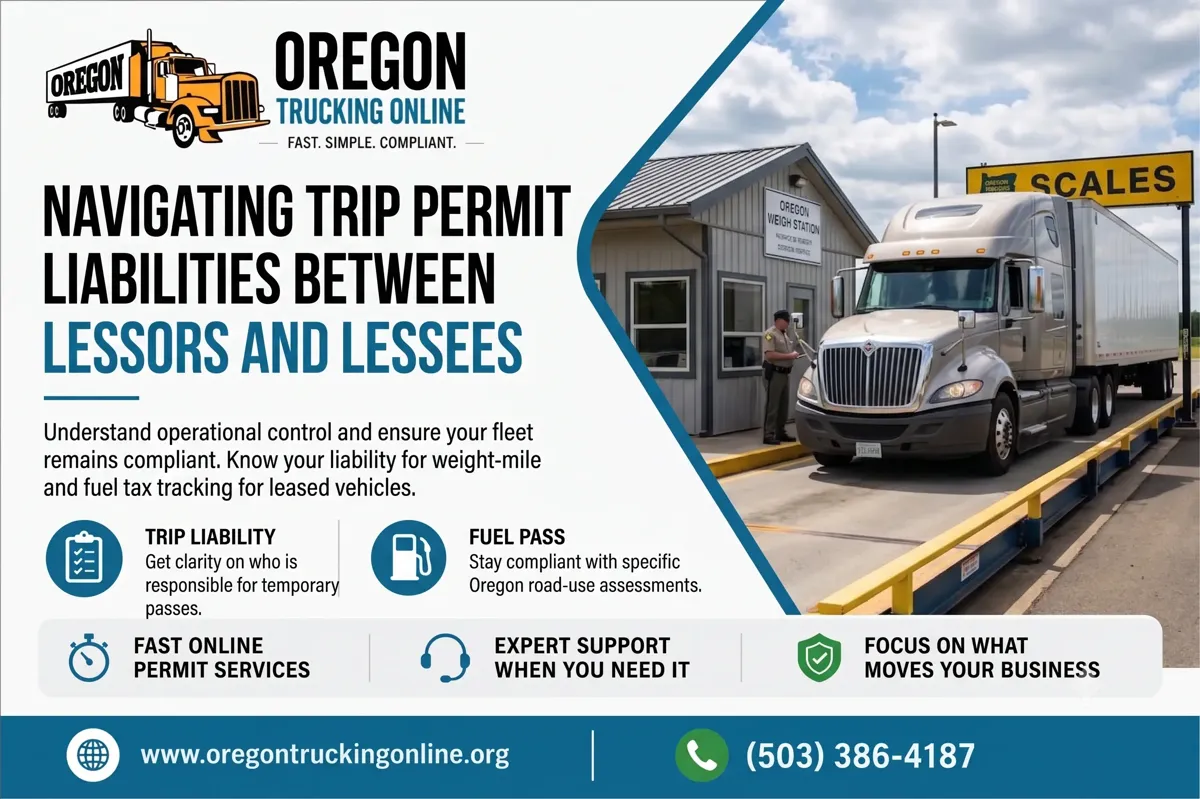
Who Gets Hit with the Fine? Navigating Trip Permit Liabilities Between Lessors and Lessees in Oregon
Table of Contents
-
Introduction
-
What is an Oregon Trip Permit?
-
What is an Oregon Fuel Permit?
-
Why Permits Matter for Interstate Trucking
-
Who Needs a Trip & Fuel Permit in Oregon?
-
How to Coordinate Oregon Permits With Your Route Schedule
-
Why Many Trucking Companies Choose Us
-
Frequently Asked Questions (FAQ)
Introduction
Operating a commercial motor vehicle under a lease agreement introduces a common point of confusion: when a violation occurs, who is legally responsible? In the Pacific Northwest, this question becomes critical when dealing with Oregon trip and fuel permits.
When an out-of-state leased tractor pulls into a weigh station without the proper temporary credentials, enforcement officers look at two entities: the leasing company (lessor) that owns the title and the motor carrier (lessee) operating the truck. An unpermitted run can trigger expensive citations and safety audit flags. Understanding how liability is distributed between lessors and lessees ensures your fleet stays compliant, avoids costly scale-house delays, and keeps your operations running smoothly.
What is an Oregon Trip Permit?
An Oregon trip permit is a temporary regulatory credential issued to commercial vehicles that are not permanently registered in the state. Officially known as a heavy vehicle temporary pass, this document allows a truck to legally travel on state highways for a specific, limited window of time.
Unlike states that rely entirely on standard registration, Oregon utilizes a unique weight-mile tax system. A temporary trip permit in Oregon serves as a short-term registration and tax agreement for carriers making occasional runs through the state. It allows you to declare your vehicle's configuration and combined weight, ensuring the state can track and collect road-use fees without requiring you to undergo full, permanent registration.
What is an Oregon Fuel Permit?
An Oregon fuel permit handles the fuel tax component of an occasional trip. Typically, interstate commercial vehicles track and pay fuel taxes through a cooperative multi-state agreement. However, if a vehicle is not registered under that standard system, it must buy a temporary fuel pass before entering the state boundaries.
It is vital to recognize that this permit operates differently from standard pump taxes. In Oregon, the fuel permit is a flat-fee road-use assessment based on the distance traveled and the weight of the vehicle. Securing an Oregon trip permit online usually combines both the registration and fuel tax requirements into a single, unified process, allowing drivers to remain compliant with both weight-mile and fuel tax tracking obligations seamlessly.
Why Permits Matter for Interstate Trucking
For fleets managing interstate operations, administrative errors can disrupt schedules and drain revenue. If your trucks frequently cross state lines, you are likely accustomed to standard IRP & IFTA credentials (the International Registration Plan and International Fuel Tax Agreement). These programs consolidate your registration and fuel taxes across multiple states.
However, Oregon is an exception to standard IFTA protocols for regular operations due to its weight-mile structure. If your truck is not permanently set up with an Oregon weight-mile tax account, or if you are using a short-term leased vehicle that lacks the state's specific credentials, temporary permits are your safety net. They bridge the gap between your standard home-state registration and Oregon's unique legal requirements, allowing you to cross state lines without risking vehicle impoundment or steep regulatory fines.
Who Needs a Trip & Fuel Permit in Oregon?
A temporary trip permit for Oregon is required for any commercial vehicle, or combination of vehicles, that enters the state under the following conditions:
-
The vehicle is not permanently registered to operate in Oregon.
-
The combined gross vehicle weight (GVW) or declared operating weight exceeds 26,000 pounds.
-
The carrier does not hold an active, valid Oregon weight-mile tax account for that specific truck.
This requirement applies to common carriers, private fleets hauling their own materials, and out-of-state owner-operators. When it comes to leased vehicles, liability typically hinges on the lease contract and the active USDOT number displayed on the truck. If a truck enters a scale house without a permit, enforcement checks who has operational control. Generally, the lessee—the carrier operating the vehicle under their authority—is responsible for securing the permit and faces the fine if it is missing. However, if the lease agreement states the lessor handles state compliance, or if the truck is operating under an Oregon DMV trip permit registered to the owner, the financial liability may shift or cause an administrative audit for both parties.
How to Coordinate Oregon Permits With Your Route Schedule
A temporary trip permit in Oregon is strictly time-sensitive, remaining valid for a maximum of 10 consecutive days. Because the clock begins ticking the moment the permit is issued, timing your purchase alongside your route schedule is essential.
Before your driver departs, check the State of Oregon trip check systems for road closures or weather delays that could impact the journey. If a driver experiences a mechanical breakdown or unexpected delay that pushes the trip past the 10-day window, the permit expires, and a new one must be obtained. Planning your permit acquisition to align precisely with your entry into the Pacific Northwest prevents the costly mistake of paying for expired credentials or entering a scale house with an invalid pass.
Why Many Trucking Companies Choose Us
Managing temporary credentials across various lease agreements can create administrative bottlenecks. At Oregon Trucking Online, we simplify this process by providing a centralized platform that efficiently handles your short-term compliance needs.
Instead of dealing with complex state portals or long delays, you can use our dedicated tools to quickly secure Oregon trip and fuel permits. If you are preparing a driver for an upcoming run, you can view our straightforward guide on how to get a temporary trip permit for trucks in Oregon, or review our comprehensive driver's step-by-step guide to ensure your team knows exactly what paperwork to carry.
Ready to secure your credentials now? Visit our direct permit application page to input your trip details, or sign in to your account to manage multiple vehicles, update lease details, and keep your entire fleet compliant.
Frequently Asked Questions (FAQ)
Can I use my standard IFTA credentials instead of buying an Oregon fuel permit?
No. Because Oregon utilizes a distinct weight-mile road tax rather than a traditional pump-based fuel tax, standard IFTA credentials do not cover your operations here. You must secure a separate temporary fuel pass if you do not have a permanent Oregon tax account.
Does an Oregon temporary registration cover oversize or overweight loads?
No. A standard temporary trip pass only covers legal weights up to 80,000 pounds. If your configuration exceeds standard dimensions or weighs more than 80,000 pounds, you must obtain a specialized Over-Dimension permit from the state.
Can a driver display a digital copy of the permit at the weigh station?
Enforcement requires a verifiable permit upon request. While digital copies are increasingly common, it is highly recommended to print out a physical copy of your temporary pass and place it in the permit book to avoid any communication delays at the scale house.
If a leased truck gets fined, does it impact the carrier's safety record?
Yes. If the vehicle is running under your USDOT number at the time of the violation, the citation will generally impact the lessee’s safety record and compliance history, regardless of who owns the physical truck.