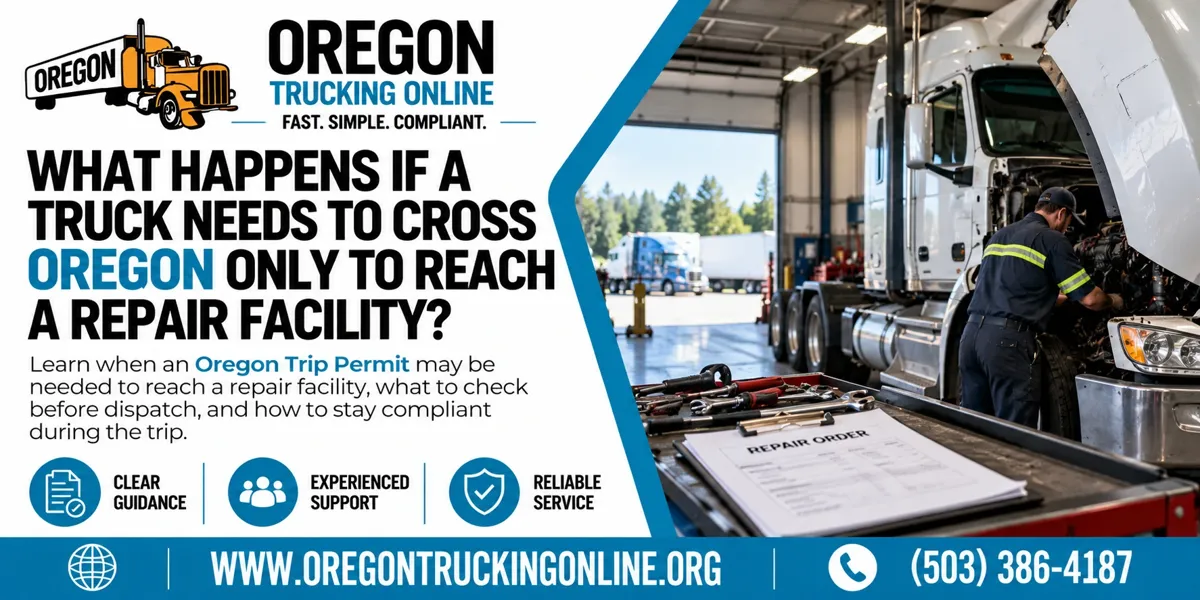
What Happens If a Truck Needs to Cross Oregon Only to Reach a Repair Facility?
Table Of Contents
-
Introduction
-
Does a Repair Trip Change Permit Requirements?
-
Determine Which Credentials The Truck Needs
-
Confirm Registration And Vehicle Details
-
Plan The Route And Repair Appointment
-
What If The Truck Breaks Down On The Way?
-
Keep Records Of The Repair-Related Movement
-
Common Mistakes To Avoid
-
Why Many Trucking Companies Choose Our Service
-
FAQ
Introduction
A truck may need to enter or cross Oregon for a reason that has nothing to do with delivering freight. For example, an out-of-state carrier may need to reach a repair shop for engine work, brake service, tire replacement, or an inspection before continuing its journey.
Even when the repair facility is the only destination, carriers should not assume that the trip is exempt from registration or motor-carrier requirements. Before dispatch, confirm which credentials apply to the truck, its registration status, its weight, and the planned route. An Oregon Trip Permit may be necessary when the vehicle's current registration does not authorize the movement in Oregon.
Does a Repair Trip Change Permit Requirements?
The reason for a trip does not automatically determine whether a permit is required. A truck traveling empty to a repair facility is still operating on public roads, so its registration and applicable motor-carrier tax requirements must be considered.
Oregon distinguishes registration credentials from weight-mile tax credentials. A registration trip permit addresses whether the vehicle's current registration authorizes the movement; a temporary weight-mile tax pass addresses applicable tax obligations. One credential does not automatically replace the other.
A repair appointment, service order, or lack of freight does not by itself authorize a truck to operate without required credentials.
Determine Which Credentials The Truck Needs
Review the truck's registration documents. For heavy vehicles, Oregon's rules refer to vehicles over 26,000 pounds or with three axles, along with registration conditions such as expired or missing registration or Oregon not appearing on the cab card. If the truck meets the applicable criteria, a Heavy Motor Vehicle Trip Permit may be required before entry.
Oregon's Department of Transportation says this permit must be obtained before operation and is valid for 10 days. Confirm your truck's eligibility through official state instructions rather than assuming a repair-only trip creates an exception.
Also check whether a temporary weight-mile tax pass or other motor-carrier credential applies. Requirements can depend on weight, registration, carrier account, and planned operation. Oversized or overweight vehicles may need separate authorization.
Confirm Registration And Vehicle Details
Before applying for an Oregon Trip Permit, verify the plate status, jurisdiction, vehicle identification number, registered weight, and other information required by the state. Application details should match the truck that will make the trip.
Check the travel date and effective period. If the shop reschedules the appointment, verify that the credential still covers the revised movement. For leased equipment or a truck operated for another carrier, clarify who obtains the credentials and ensure the driver has the required documents.
Plan The Route And Repair Appointment
Confirm the repair facility's address and appointment, then plan a route that fits the truck's dimensions and operating limits. If the destination is beyond Oregon, account for the entire Oregon portion of the movement.
Keep the service authorization or work order available. It explains the trip's purpose but does not replace a required permit. If the truck is unsafe to drive, arrange towing or roadside assistance and confirm the requirements for that method of transport.
What If The Truck Breaks Down On The Way?
If a problem develops after entering Oregon, prioritize safety, move to a safe location when possible, and contact roadside assistance. Do not continue driving a vehicle that is unsafe.
If the breakdown changes the destination, route, or timing, check whether the existing credentials remain valid. A repair emergency does not automatically extend a permit. Keep records of the breakdown and service arrangements, and ask the towing company about any requirements for transporting a disabled truck.
Keep Records Of The Repair-Related Movement
Keep a copy of the Oregon Trip Permit and other required credentials in the vehicle, along with registration documents and the repair order.
After the trip, retain the permit, repair invoice, dispatch details, mileage information, and records of any route or date changes. For a fleet vehicle, save these records in its compliance file so the company can document the movement and verify which credentials applied.
Common Mistakes To Avoid
Assuming The Repair Purpose Creates An Exemption: A trip to a repair facility is not automatically exempt from registration or applicable tax requirements.
Confusing Registration With Weight-Mile Tax: Check whether separate credentials apply to the vehicle's registration and weight-mile obligations.
Applying With Incorrect Vehicle Information: Verify the plate, VIN, registered weight, and travel dates before submitting an application.
Driving Beyond The Permit's Terms: Confirm the effective period and covered movement, especially if the appointment or route changes.
Treating A Repair Order As A Permit: A work order explains the purpose of the trip but does not replace required operating credentials.
Why Many Trucking Companies Choose Our Service
Planning a repair-related trip involves more than finding a shop. Trucking companies must review registration details, identify applicable credentials, and make sure the driver has the required documentation before entering Oregon.
Oregon Trucking Online helps carriers organize permit applications, check required vehicle and trip details, and reduce avoidable paperwork problems. This practical assistance can save time and help identify missing information before dispatch.
Carriers arranging an Oregon Trip Permit can also receive guidance and responsive customer support to make the process easier to manage while coordinating repairs and returning the vehicle to service.
FAQ
Does a truck need an Oregon Trip Permit just to reach a repair shop?
It depends on the truck's registration and the planned operation. A repair destination does not automatically exempt the vehicle from applicable requirements.
Does traveling without freight remove Oregon permit requirements?
No. The carrier should still check registration and applicable motor-carrier tax requirements for the empty movement.
Is a registration trip permit the same as a temporary weight-mile tax pass?
No. They address different requirements. Check whether the vehicle needs one or both credentials before operating.
What if the repair appointment is delayed?
Review the credential's effective dates and conditions before travel. Do not assume that a changed appointment or route is covered automatically.
Should the driver carry the repair order?
Yes, it is useful supporting documentation, but it does not replace a required permit or registration document.
For more information, visit the Oregon Department of Transportation.