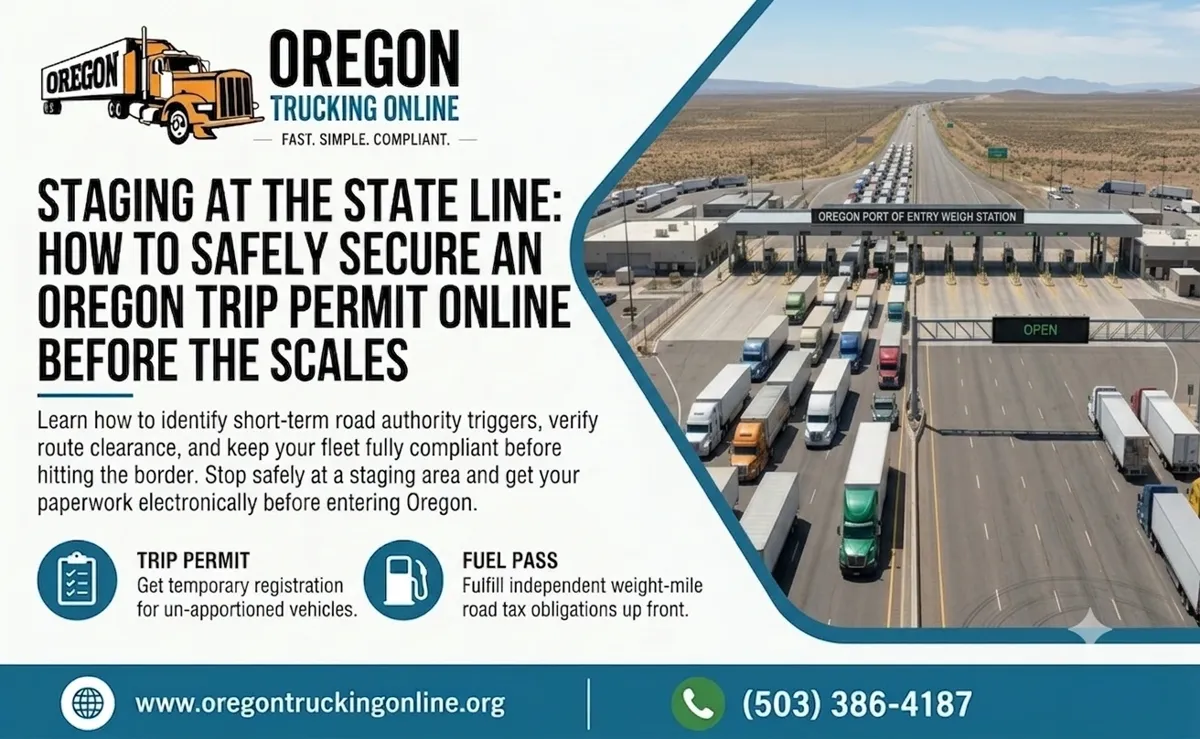
Staging at the State Line: How to Safely Secure an Oregon Trip Permit Online Before the Scales
Table of Contents
-
Introduction
-
Understanding Short-Term Border Requirements
-
What is an Oregon Trip Permit?
-
What is an Oregon Fuel Permit?
-
How Apportioned Accounts Differ from Single Passes
-
Why Many Trucking Companies Choose Us
-
Frequently Asked Questions
Introduction
Driving an interstate commercial truck requires constant attention to changing state rules. When your route takes you toward the Pacific Northwest, the state border brings a very specific set of regulations. Unlike most states that manage heavy vehicle road fees through standard multi-state agreements, Oregon operates on an independent system.
If a truck approaches the state line without the proper structural credentials already on its cab card, the driver faces immediate compliance issues at the upcoming weigh stations. Passing a port of entry without pre-cleared road authority leads to unexpected delays and costly safety holds.
The most efficient way to handle an un-apportioned lane is to stop safely before reaching the border and secure temporary road authority digitally. This guide explains how to identify when you need short-term road credentials, how the state verifies your truck's information, and how to acquire your paperwork smoothly before hitting the scales.
Understanding Short-Term Border Requirements
Every commercial motor vehicle over a certain weight threshold must contribute to the maintenance of the public highways they use. When your truck's permanent home-state registration does not explicitly clear you to operate inside Oregon, the vehicle is considered unapportioned for that specific run. To bridge this gap, carriers must secure short-term credentials that grant temporary legal authority to travel on local roadways.
Rather than navigating a single combined document, the state separates temporary credentials into distinct categories based on registration and fuel tracking. Ensuring your team selects the exact paperwork required for your specific truck configuration prevents minor errors from turning into significant border gate holds. Let’s look closely at the two main types of temporary coverage you will encounter.
What is an Oregon Trip Permit?
An Oregon trip permit functions as a short-term registration document for commercial vehicles that are traveling through the state on an irregular or one-off basis. If your permanent cab card leaves this jurisdiction blank, or if your plate is not permanently apportioned, this temporary registration satisfies the legal requirements enforced at the ports of entry.
This document allows an out-of-state truck or tractor-trailer combination to operate legally within the state borders for a specific, limited window of time. It is tied directly to the vehicle’s identification number (VIN) and declared operating weight. Securing a temporary trip permit Oregon pass ensures that your truck is fully recognized by the state's compliance networks the moment your tires roll onto the weigh station scale ramp. It provides a straightforward path to temporary legal status without forcing your business to undergo full, permanent vehicle registration.
What is an Oregon Fuel Permit?
While the trip authorization handles your basic vehicle registration, mileage, and road use taxes are managed through a separate tracking mechanism. An Oregon fuel permit is specifically designed to cover the state's independent road use tax requirements for heavy commercial vehicles that do not hold a permanent local tax profile or International Fuel Tax Agreement (IFTA) credentials.
Because the state tracks heavy vehicle road usage via an independent distance-and-weight system, standard interstate fuel decals do not clear your truck for local operations. Purchasing a separate temporary fuel pass allows an out-of-state carrier to fulfill its mileage tax obligations upfront for a single continuous movement. Whether you are picking up a single load or simply deadheading through the region, having an active fuel authorization ensures your tax compliance remains perfect at every roadside checkpoint.
How Apportioned Accounts Differ from Single Passes
To keep your fleet running smoothly, it is helpful to understand how these temporary single-use options interact with standard national commercial frameworks like IRP & IFTA. In most parts of the country, carriers use these multi-state agreements to distribute registration fees and fuel taxes through a single centralized office in their home state.
However, because of the distinct way local highway infrastructure is funded, standard multi-state fuel credentials do not automatically grant road authority here. If your permanent apportioned cab card lacks local jurisdiction clearance, a single-use trip permit Oregon pass becomes mandatory.
For busy dispatch offices, logging onto a digital platform to obtain an Oregon trip permit online is the fastest way to protect a driver approaching the border. Processing these credentials electronically updates the state's enforcement databases immediately, allowing your truck to clear automated weigh station checks without being flagged for manual roadside inspections.
Why Many Trucking Companies Choose Us
Trying to navigate different state portals, figure out exact weight brackets, and wait for confirmation messages while a driver is parked at a border truck stop can easily cause missed delivery windows. That is why motor carriers nationwide trust our team to handle their temporary permit management.
At Oregon Trucking Online, we focus on taking the friction out of short-term commercial vehicle compliance. Our direct digital link to the state’s permitting infrastructure ensures that your applications are processed accurately and sent straight to your email without unnecessary delays. We analyze your truck profiles to make sure your temporary registration tiers match your bills of lading perfectly, protecting your business from under-declaration fines. Partnering with our specialized team means your drivers can focus entirely on the road ahead, while we ensure your border documentation is completely secure.
Frequently Asked Questions
-
When does a truck legally require an Oregon DMV trip permit?
An out-of-state commercial vehicle requires a temporary pass if its gross operating weight exceeds 26,000 pounds or if the configuration has three or more axles, and the state is not listed on its permanent apportioned cab card.
-
How long do temporary Oregon trip and fuel permits remain active?
A standard short-term temporary pass is valid for up to 10 consecutive days from your chosen effective date, covering a single continuous trip into, through, or out of the state.
-
Can I verify my truck's active permit status before crossing the border?
Yes. Before your driver rolls past the state line, you can utilize the State of Oregon trip check methods or check online registries to confirm that your newly issued temporary credentials have successfully populated across the state's scale house networks.
-
What information do I need to provide to order an Oregon trip permit online?
To process your paperwork quickly, you will need to provide the vehicle's complete VIN, license plate number, base state registration information, your corporate USDOT or MC number, and the maximum gross weight for the upcoming trip.