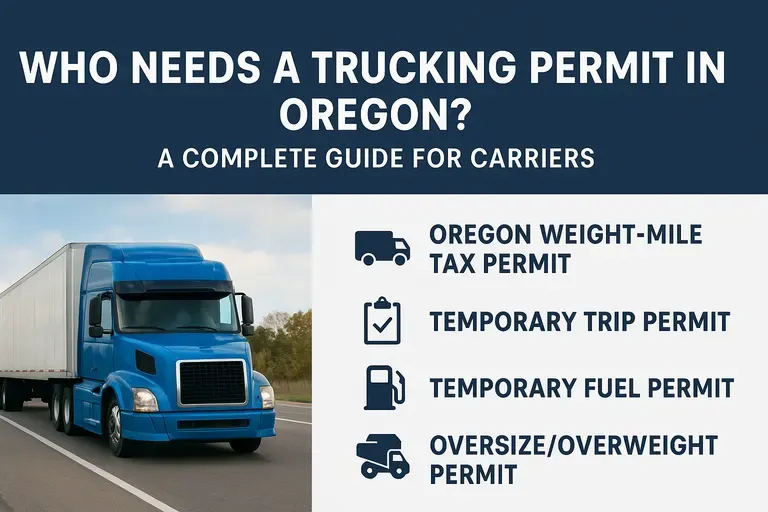
1. The Purpose of Oregon Trucking Permits
Trucking permits exist to:
-
Protect Oregon’s roadway infrastructure from excessive wear and damage.
-
Ensure public safety when large or heavy vehicles operate on public roads.
-
Coordinate route planning, bridge use, and escort requirements for non-standard loads.
If your vehicle or load exceeds legal limits or operates without Oregon registration or fuel credentials, you’ll likely need a state-issued permit.
2. Who Must Obtain an Oregon Trucking Permit
A. Carriers with Oversize or Overweight Vehicles
You need a permit if your vehicle or load exceeds any of Oregon’s standard legal limits:
| Measurement | Legal Limit (Without Permit) |
|---|---|
| Width | 8 feet 6 inches (102 inches) |
| Height | 14 feet |
| Length (single unit) | 45 feet |
| Length (combination) | 75 feet |
| Gross Vehicle Weight | 80,000 lbs (federal standard) |
If your load exceeds any of these limits, you must obtain an Oversize/Overweight (OS/OW) Permit through ODOT’s Motor Carrier Transportation Division (MCTD).
B. Out-of-State Carriers Operating Temporarily in Oregon
If your company is not registered under the International Registration Plan (IRP) or International Fuel Tax Agreement (IFTA), you must get one or more temporary permits:
-
Oregon Trip Permit – Allows unregistered carriers to operate in the state for up to 10 consecutive days.
-
Oregon Fuel Permit – Required if you operate diesel-powered vehicles and do not have an IFTA decal.
Example: A Washington carrier making a single delivery into Portland without Oregon IRP or IFTA registration must purchase both trip and fuel permits before entering the state.
C. Carriers Hauling Special Commodities or Equipment
Oregon issues special-use permits for:
-
Farm equipment and agricultural products
-
Logging and forest products
-
Mobile homes and modular buildings
-
Construction or utility equipment
-
Tow and recovery vehicles
Each permit type has its own rules for weight limits, escort vehicles, and travel times.
D. Carriers Using Specialized or Extended Vehicle Combinations
If you operate:
-
Doubles or triples (LVCs)
-
Extended-length combinations (e.g., 3-trailer setups)
-
Continuous operation loads (e.g., cranes, wind turbine components)
You’ll need an annual or continuous operation permit, often with pre-approved routes and escort requirements.
3. When You Don’t Need a Permit
You may not need a trucking permit if:
-
Your vehicle dimensions and weights are within legal limits.
-
You are not traveling interstate and are fully registered under Oregon IRP/IFTA programs.
-
You’re operating private, intrastate vehicles within standard limits (e.g., local delivery trucks).
Still, it’s always wise to confirm with ODOT — even minor modifications (such as wide mirrors or rear attachments) can change your permit status.
4. Types of Oregon Trucking Permits
| Permit Type | Purpose | Validity |
|---|---|---|
| Single-Trip OS/OW Permit | For one-time oversize or overweight movements | Up to 10 days |
| Annual OS/OW Permit | For repeated moves along approved routes | 1 year |
| Trip Permit | For unregistered out-of-state carriers | 10 days |
| Fuel Permit | For non-IFTA carriers using taxable fuel | 10 days |
| Special Commodity Permits | For logs, farm equipment, mobile homes, etc. | Variable |
5. How to Apply for a Trucking Permit in Oregon
You can apply online through
www.oregontruckingonline.org
Or, for one-time moves:
-
Call 503-386-4187
You’ll need:
-
USDOT number
-
VIN or plate number
-
Vehicle weight and dimensions
-
Origin/destination
-
Preferred route
6. Penalties for Operating Without a Permit
Operating without the proper Oregon trucking permit can lead to:
-
Fines up to $5,000 per violation
-
Out-of-service orders
-
Mandatory offloading or load reduction
-
Route suspension or revocation of permit privileges
Pro Tip: Always keep a digital or printed copy of your permit in the cab — enforcement officers can verify it electronically but may still request documentation.
7. Final Thoughts
In Oregon, most carriers that operate oversize, overweight, or unregistered vehicles need a trucking permit. The state’s system is comprehensive but efficient, especially through www.oregontruckingonline.org
Whether you’re hauling timber, machinery, or oversized freight through the Pacific Northwest, getting your permit right the first time ensures smooth operations — and keeps your trucks moving without costly delays or violations.