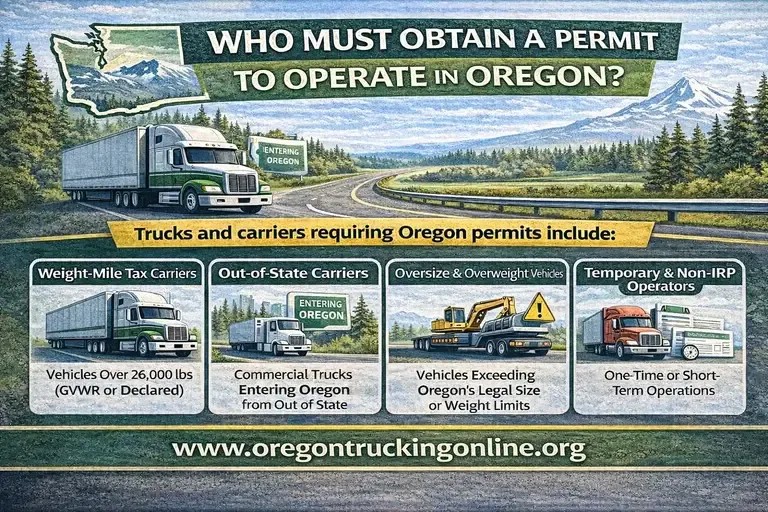
Permits can be obtained through https://www.oregontruckingonline.org/
1. Carriers Subject to Oregon Weight-Mile Tax
Oregon requires most heavy commercial vehicles to either:
-
Pay the Oregon Weight-Mile Tax, or
-
Purchase a temporary pass/permit before operating in the state.
You must obtain a permit or temporary pass if your vehicle:
-
Has a gross vehicle weight rating (GVWR) over 26,000 pounds, or
-
Is operating at a declared weight over 26,000 pounds on Oregon highways.
This applies to both Oregon-based and out-of-state carriers.
2. Out-of-State Carriers
Out-of-state trucks entering Oregon must obtain proper credentials if they:
-
Are not registered under Oregon’s Weight-Mile Tax program
-
Are not enrolled in the International Registration Plan (IRP) but plan to operate commercially
-
Need temporary authority for short-term operations
Most out-of-state carriers will either:
-
Establish a permanent Oregon account, or
-
Purchase a temporary pass for short-term travel.
3. Oversize & Overweight Vehicles
A permit is required if your vehicle exceeds Oregon’s legal limits for:
-
Width
-
Height
-
Length
-
Weight
This includes:
-
Heavy equipment haulers
-
Logging trucks
-
Construction vehicles
-
Specialized freight carriers
Oversize and overweight loads require route-specific permits, and in some cases, escort vehicles.
4. Carriers Transporting Certain Commodities
Additional permits may be required for:
-
Hazardous materials (Hazmat)
-
Superloads
-
Agricultural or specialized equipment
-
Over-dimensional manufactured structures
Each category may involve separate compliance requirements.
5. Non-IRP and Temporary Operators
If your vehicle is not registered under IRP and you plan to operate in Oregon, you may need:
-
A Trip Permit
-
A Temporary Pass
-
Temporary registration credentials
Short-term permits are commonly used by:
-
Owner-operators
-
Seasonal operators
-
Carriers making one-time deliveries
When a Permit Is NOT Required
Generally, permits are not required for:
-
Light vehicles under 26,000 pounds
-
Properly registered passenger vehicles
-
Certain exempt agricultural vehicles (with restrictions)
However, exemptions vary based on use and vehicle type.
Penalties for Operating Without a Permit
Failure to obtain required permits in Oregon can result in:
-
Citations and fines
-
Delays at ports of entry
-
Vehicle impoundment in serious cases
-
Assessment of back taxes and penalties
Oregon actively enforces commercial vehicle compliance at ports of entry and roadside inspections.
Summary
You must obtain a permit to operate in Oregon if you:
-
Operate a commercial vehicle over 26,000 lbs
-
Are an out-of-state carrier without Oregon credentials
-
Haul oversize or overweight loads
-
Transport regulated commodities
-
Operate temporarily without full registration
Because Oregon uses a Weight-Mile Tax system instead of traditional fuel tax reporting, permit compliance is especially important for interstate carriers.