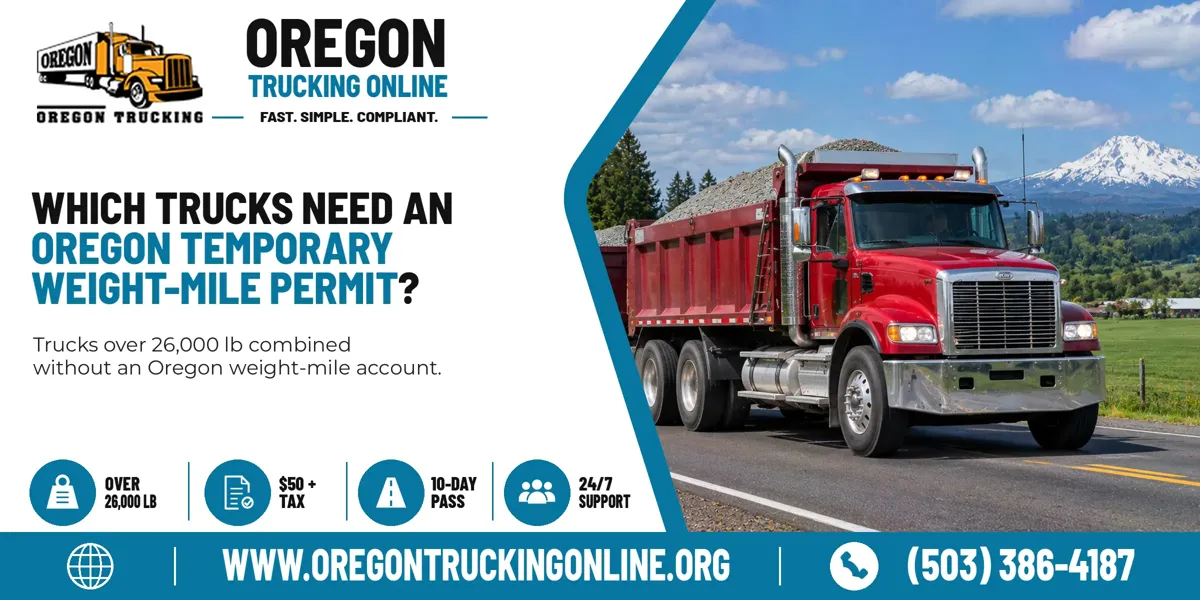
Which Trucks Need an Oregon Temporary Weight-Mile Permit?
Table Of Contents
-
Introduction
-
The Short Answer
-
What Oregon Law Says
-
The 26,000-Pound Line
-
How Declared Weight Works
-
Out-of-State Trucks
-
IRP Trucks Still Need It
-
Trucks That Usually Don't Need One
-
Very Heavy Loads
-
Real-World Examples
-
Quick Checklist
-
Common Mistakes to Avoid
-
Why Many Trucking Companies Choose Our Service
-
FAQ
Introduction
Oregon doesn't use a fuel tax for most heavy trucks. Instead, it charges a weight-mile tax for every mile a heavy truck drives on Oregon roads. Carriers that run in Oregon all the time open a weight-mile tax account and file reports. Carriers that only come in now and then can use an Oregon Temporary Weight-Mile Permit, also called the temporary pass.
The question most new carriers ask is simple: does my truck need one? This guide explains which trucks need an Oregon Temporary Weight-Mile Permit, which ones usually don't, and how weight decides most cases.
The Short Answer
A truck needs an Oregon Temporary Weight-Mile Permit when:
-
Its combined weight (truck, trailer and load) is over 26,000 pounds,
-
It will drive on Oregon public roads, and
-
The carrier doesn't have an Oregon weight-mile tax account for that truck.
If all three are true, the truck needs the pass before it enters Oregon.
What Oregon Law Says
Oregon's weight-mile tax rules are in ORS Chapter 825. The tax applies to motor vehicles with a combined weight over 26,000 pounds operating on Oregon highways.
ORS 825.470 lets carriers that don't hold an account pay the tax through a temporary pass for a single trip or short operation. ODOT's Commerce and Compliance Division says the pass is valid for 10 days or the miles purchased, whichever comes first, and it can be bought up to 10 days before its start date.
Running without a required pass can bring a civil penalty of up to $100 per day.
The 26,000-Pound Line
Weight is the first test, and it decides most cases.
-
Over 26,000 pounds combined: weight-mile tax applies, so the truck needs an account or an Oregon Temporary Weight-Mile Permit.
-
26,000 pounds or less: the truck isn't subject to weight-mile tax. It pays Oregon's regular fuel tax at the pump instead.
The weight that counts is the combined weight of the power unit, any trailer and the load, not the weight of the tractor alone.
How Declared Weight Works
When you order an Oregon Temporary Weight-Mile Permit, you declare the highest combined weight the truck will run at in Oregon. That declared weight sets the tax rate for every mile.
-
The rate rises with weight, and over 80,000 pounds it also depends on the number of axles.
-
Empty miles still count. If the truck is declared over 26,000 pounds, the return trip is taxed too.
-
Declaring too low can lead to penalties if the truck is weighed heavier.
Plan the declared weight around the heaviest point of the trip.
Out-of-State Trucks
The Oregon Temporary Weight-Mile Permit is built for carriers that don't run in Oregon regularly:
-
Out-of-state carriers making an occasional delivery or pickup in Oregon
-
Seasonal carriers, such as harvest or construction haulers
-
One-time moves, like hauling equipment to a job site
-
New carriers that haven't set up an Oregon account yet
If a truck runs in Oregon every month, a permanent weight-mile tax account is usually cheaper and easier than buying passes again and again.
IRP Trucks Still Need It
Many carriers assume that IRP plates with Oregon on the cab card cover everything. They don't.
-
IRP covers registration.
-
IFTA doesn't cover Oregon's weight-mile tax at all.
-
The weight-mile tax is separate.
An IRP truck over 26,000 pounds still needs a weight-mile tax account or an Oregon Temporary Weight-Mile Permit. A truck without Oregon on its cab card needs an Oregon trip permit too.
Trucks That Usually Don't Need One
These trucks usually don't need an Oregon Temporary Weight-Mile Permit:
-
Light trucks at 26,000 pounds combined or less
-
Trucks with an active Oregon weight-mile tax account, which report the miles instead
-
Government-owned vehicles and certain other vehicles listed as exempt in ORS Chapter 825
-
Trucks that stay off Oregon public roads
Exemptions are narrow. If you aren't sure whether a truck qualifies, check before the trip instead of after a stop.
Very Heavy Loads
Loads that run over 105,500 pounds on an Oregon oversize or overweight permit are handled differently. Those moves usually pay a road use assessment fee tied to the variance permit instead of the regular weight-mile rate.
For most loads up to 105,500 pounds, the normal Oregon Temporary Weight-Mile Permit applies, and an oversize load may need both an oversize permit and the pass.
Real-World Examples
-
A tractor-trailer at 80,000 pounds from Idaho delivering to Portland: needs the pass.
-
A 24,000-pound box truck from Washington: doesn't need it, and pays fuel tax at the pump.
-
A dump truck at 54,000 pounds from California for a one-week job: needs the pass.
-
An Oregon-based fleet truck with an account: reports its miles instead.
Quick Checklist
-
Is the Combined Weight Over 26,000 Pounds? If not, no pass is needed.
-
Will the Truck Drive on Oregon Public Roads? If yes, keep going.
-
Does the Carrier Have an Oregon Weight-Mile Account? If yes, report the miles.
-
No Account? Get an Oregon Temporary Weight-Mile Permit before entering.
-
Is Oregon on the Cab Card? If not, add an Oregon trip permit.
-
Over 105,500 Pounds? Check the oversize permit and road use assessment fee.
Common Mistakes to Avoid
-
Counting only the tractor's weight. The combined weight decides.
-
Thinking IRP or IFTA covers it. Weight-mile tax is separate.
-
Declaring too low. The declared weight sets the rate for every mile.
-
Buying too few miles. The pass ends when the miles run out.
-
Waiting until the border. Buy the pass before the truck enters Oregon.
Why Many Trucking Companies Choose Our Service
Oregon Trucking Online helps carriers find out whether a truck needs an Oregon Temporary Weight-Mile Permit and gets it issued with the right declared weight and enough miles for the trip.
-
Oregon Temporary Pass: $50 plus weight-mile tax
-
Oregon Trip Permit: $105
We provide support 24/7 and also work weekends and holidays.
or
FAQ
Which trucks need an Oregon Temporary Weight-Mile Permit?
Trucks over 26,000 pounds combined that drive on Oregon roads and don't have an Oregon weight-mile tax account.
Does a 26,000-pound truck need one?
No. The tax applies only over 26,000 pounds.
Do IRP trucks need the pass?
Yes, unless they have an Oregon weight-mile tax account. IRP covers registration only.
How long is the pass valid?
10 days or the miles purchased, whichever comes first.
Do empty miles count?
Yes. The declared weight applies to every mile, loaded or empty.
For more information, visit the Oregon Department of Transportation Commerce and Compliance Division.