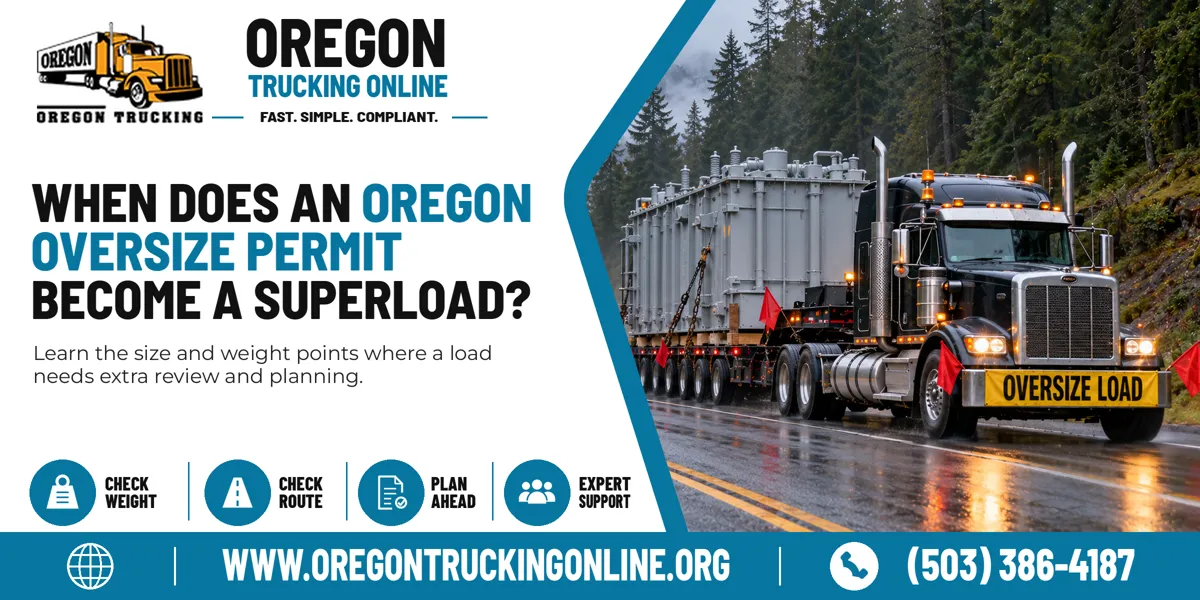
When Does an Oregon Oversize Permit Become a Superload?
Table Of Contents
-
Introduction
-
The Short Answer
-
Oregon Legal Size Limits
-
The Superload Thresholds
-
Why Road Type Matters for Width
-
What Changes When Your Load Is a Superload
-
How to Plan a Superload Move
-
Common Mistakes to Avoid
-
Why Many Trucking Companies Choose Our Service
-
FAQ
Introduction
Most oversized loads in Oregon move on a standard Oregon Oversize Permit. But once a load gets wide enough, tall enough, or long enough, it crosses a line. At that point, ODOT treats it as a superload, and the permit process becomes more detailed.
Knowing exactly where that line sits helps you quote jobs correctly, plan routes early, and avoid delays on the day of the move. This guide explains the superload thresholds and what changes when your load goes over them.
The Short Answer
According to the ODOT Over-Dimension Permit Unit, an Oregon Oversize Permit becomes a superload permit when the load is:
-
More than 14 feet wide on a two-lane state highway
-
More than 16 feet wide on the Interstate
-
More than 17 feet high
-
More than 150 feet long
If your load meets any one of these, it is a superload. Superload moves are handled with ODOT's superload attachment (Attachment SL) and get a closer review than a standard oversize move.
Oregon Legal Size Limits
Before a load reaches superload size, it first has to go over Oregon's legal limits. A load that goes over any of these needs an Oregon Oversize Permit:
-
Width: 8 feet 6 inches
-
Height: 14 feet
-
Length: limits depend on the vehicle combination and the route
Between the legal limit and the superload line is the range a standard Oregon Oversize Permit covers. For example, a 12-foot-wide load on a two-lane state highway needs a permit, but it is not a superload.
The Superload Thresholds
Width. Width is where most carriers cross the line. The threshold is 14 feet on a two-lane state highway and 16 feet on the Interstate. A 15-foot-wide load can be a standard oversize move on the Interstate but a superload on a two-lane highway.
Height. Any load more than 17 feet high is a superload. Tall loads need a careful check of bridges, overpasses, signs, signals, and power lines along the whole route.
Length. Any load more than 150 feet long is a superload. Very long loads, such as wind blades, bridge beams, and long poles, often reach this length.
Only one dimension has to go over the line. A load that is 10 feet wide but 155 feet long is still a superload.
Why Road Type Matters for Width
Interstates have wider lanes, wider shoulders, and divided traffic. Two-lane state highways have oncoming traffic only a few feet away, tighter curves, and narrower bridges. That is why ODOT allows a wider load on the Interstate before treating it as a superload.
If your route uses both types of road, plan for the lower threshold. A 15-foot-wide load that leaves the Interstate for a two-lane highway becomes a superload on that part of the trip.
What Changes When Your Load Is a Superload
A superload is still moved under an Oregon Oversize Permit, but the process is more involved:
-
More information is required. ODOT asks for details on the load, the vehicles, the axle spacing, and the planned route on the superload attachment.
-
Route review takes longer. ODOT checks bridges, clearances, and road work along the route before approving it.
-
More pilot vehicles may be needed. Larger loads usually need more pilot cars, and some routes may need traffic control or police escorts.
-
Travel times can be limited. Superloads may be restricted to certain hours or days to keep traffic moving.
Because of this extra review, superload permits are not something to request at the last minute.
How to Plan a Superload Move
-
Measure the loaded vehicle, not just the cargo. Width, height, and length include the trailer and anything that sticks out.
-
Check every road on the route. The width threshold changes between the Interstate and two-lane highways.
-
Apply early. Give ODOT time to review the route and request more details if needed.
-
Line up pilot cars in advance. Make sure you have enough certified pilot vehicles for the size of the load.
-
Have a backup plan. Weather, road work, or a clearance problem can force a route change.
Common Mistakes to Avoid
-
Measuring only the cargo. The fully loaded dimensions decide whether a load is a superload.
-
Using the Interstate width limit on a two-lane highway. The two-lane threshold is lower.
-
Forgetting about length. Long loads can become superloads even when they are not wide or tall.
-
Waiting until the last day. Superload reviews take more time than standard permits.
-
Changing the load after the permit is issued. If the size changes, the permit must be updated.
Why Many Trucking Companies Choose Our Service
Carriers trust Oregon Trucking Online to handle their Oregon Oversize Permit requests from start to finish. We check your dimensions, tell you whether your load is a standard oversize move or a superload, and prepare the paperwork so ODOT has what it needs the first time.
Our Oregon Oversize Permit service is $97. We provide support 24/7 and also work weekends and holidays.
or
FAQ
When does an Oregon Oversize Permit become a superload?
When the load is over 14 feet wide on a two-lane state highway, over 16 feet wide on the Interstate, over 17 feet high, or over 150 feet long.
Do I need a different permit for a superload?
It is still an Oregon oversized permit, but it requires ODOT's superload attachment and a more detailed review.
Does only one dimension need to go over the limit?
Yes. A load that goes over any one superload threshold is a superload.
Why is the width limit lower on two-lane highways?
Two-lane highways have oncoming traffic, narrower lanes, and tighter bridges, so ODOT reviews wide loads there more closely.
How early should I apply for a superload permit?
As early as possible, because route reviews for superloads take longer than standard permits.
For more information, visit the Oregon Department of Transportation, Over-Dimension Permit Unit.