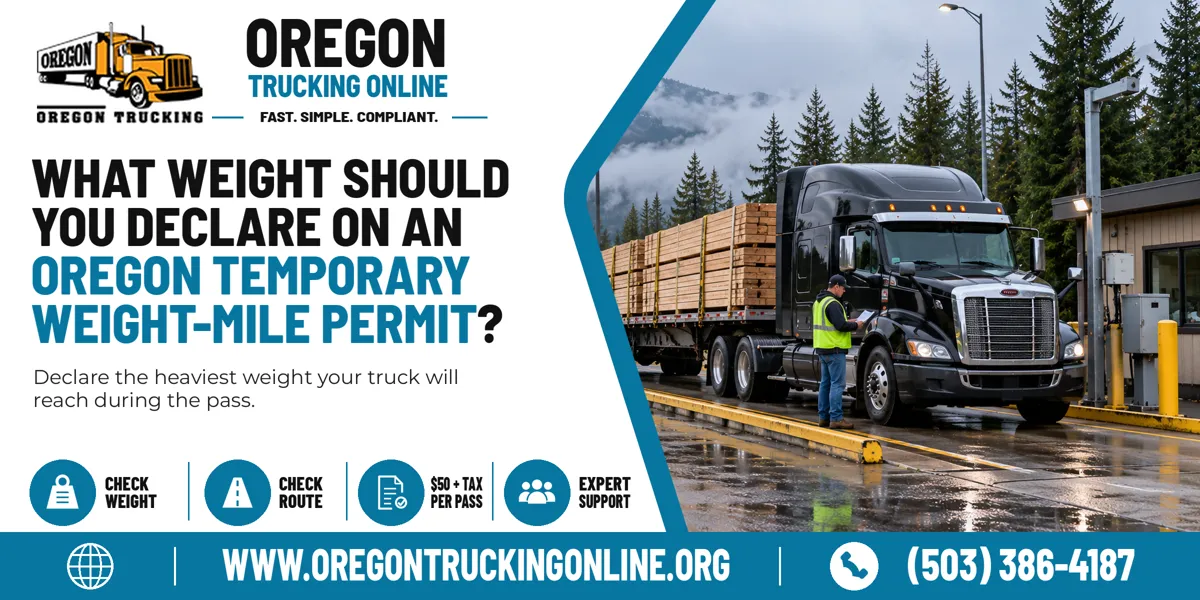
What Weight Should You Declare on an Oregon Temporary Weight-Mile Permit?
Table Of Contents
-
Introduction
-
The Short Answer
-
Registered Weight vs. Operating Weight
-
Why the Declared Weight Matters
-
How to Find Your Heaviest Operating Weight
-
What If You Run Empty Part of the Trip?
-
What If You Operate Over Your Registered Weight?
-
Examples
-
Common Mistakes to Avoid
-
Why Many Trucking Companies Choose Our Service
-
FAQ
Introduction
When you order an Oregon Temporary Weight-Mile Permit, the Oregon Department of Transportation (ODOT) asks for two weights: your registered weight and your operating weight. Many carriers aren't sure which number to use, especially when a truck runs loaded one way and empty the other.
Picking the wrong weight can mean paying the wrong tax or running with a pass that doesn't match your truck. This guide explains what to declare and why.
The Short Answer
Declare the heaviest weight your truck, trailer, and load will reach at any point during the pass. ODOT's Weight Mile Temporary Tax Pass page defines operating weight as "the heaviest weight at which the vehicle will operate during the 10 day permit."
You also give ODOT your registered weight, the weight shown on your registration or apportioned cab card.
Registered Weight vs. Operating Weight
These two numbers are not the same:
-
Registered weight is the weight your truck is licensed for. You'll find it on your registration or apportioned cab card.
-
Operating weight is the actual combined weight of the truck, trailer, and load. For the pass, it is the heaviest combined weight the truck will reach during the pass period.
ODOT asks for both, along with your apportioned cab card and registration, when you order an Oregon Temporary Weight-Mile Permit.
Why the Declared Weight Matters
Oregon's weight-mile tax is charged per mile, and the rate per mile depends on weight. Under the carrier tax tables in ORS 825.476, heavier weights pay a higher rate per mile. For combined weights over 80,000 pounds, the rate also depends on the number of axles.
So the weight you declare sets the tax rate for every Oregon mile on the pass. Declare too low, and you haven't paid enough tax for the way the truck actually ran. Declare too high, and you pay more than you need to.
The pass is required when the combined gross weight of the truck, trailer, and load exceeds 26,000 pounds.
How to Find Your Heaviest Operating Weight
-
Start With the Load. Get the load weight from the bill of lading or shipper.
-
Add the Truck and Trailer. Use scale tickets or known empty weights for the tractor and trailer.
-
Check Every Leg. If the truck picks up a heavier load later in the 10 days, use that weight.
-
Use the Highest Number. Your declared operating weight is the highest combined weight on any leg in Oregon.
-
Count Your Axles. For weights over 80,000 pounds, have the axle count ready.
A certified scale ticket is the most reliable way to confirm your weight.
What If You Run Empty on Part of the Trip?
Many trucks enter Oregon loaded and leave empty, or the other way around. ODOT's definition doesn't change: the operating weight is the heaviest weight during the pass period.
If the heaviest leg is 78,000 pounds and the empty return is 32,000 pounds, you declare 78,000 pounds.
What If You Operate Over Your Registered Weight?
Your operating weight shouldn't be higher than your registered weight. If a load will push the truck over the weight on its registration or cab card, the weight-mile pass alone doesn't fix that.
ODOT offers a separate credential, the Temporary Registration Weight Increase, valid for 10 days, for this situation. It is handled case by case, so contact ODOT before the trip.
The tax tables in ORS 825.476 go up to 105,500 pounds. Loads heavier than that are moved under a single-trip permit, which carries its own road use assessment fees.
Examples
| Situation | Weight to Declare |
|---|---|
| Loaded at 76,000 lbs into Oregon, empty at 34,000 lbs on the way out | 76,000 lbs |
| Empty at 33,000 lbs into Oregon, loaded at 79,500 lbs on the way out | 79,500 lbs |
| Two loads in 10 days at 62,000 lbs and 71,000 lbs | 71,000 lbs |
| Box truck with load at 24,000 lbs | Under 26,001 lbs, so no pass is needed |
Common Mistakes to Avoid
-
Declaring the empty weight. Use the heaviest weight, not the lightest.
-
Using the registered weight by default. Declare what the truck will actually weigh.
-
Forgetting a second pickup. A heavier load later in the 10 days changes the number.
-
Ignoring the axle count. Over 80,000 pounds, axles affect the rate.
-
Running over registered weight. That needs a separate registration weight increase.
Why Many Trucking Companies Choose Our Service
Oregon Trucking Online helps carriers declare the right weight on every Oregon Temporary Weight-Mile Permit, so you pay the correct tax and avoid problems on the road. Our temporary weight-mile permit service is $50 plus weight-mile tax. We review your registration, load, and route before ordering.
We provide support 24/7 and also work weekends and holidays.
or
FAQ
-
What weight do I declare on an Oregon Temporary Weight-Mile Permit?
The heaviest combined weight of the truck, trailer, and load during the pass period.
-
Should I declare my registered weight?
ODOT asks for your registered weight separately. The operating weight is your actual heaviest weight.
-
Does the declared weight change the cost?
Yes. Oregon's weight-mile tax rate per mile goes up with weight, and over 80,000 pounds, it also depends on axles.
-
What if my truck runs empty on the return trip?
You still declare the heaviest weight during the pass.
-
Do trucks under 26,000 pounds need the pass?
No. It applies when the combined weight exceeds 26,000 pounds.
For more information, visit the Oregon Department of Transportation Commerce and Compliance Division.