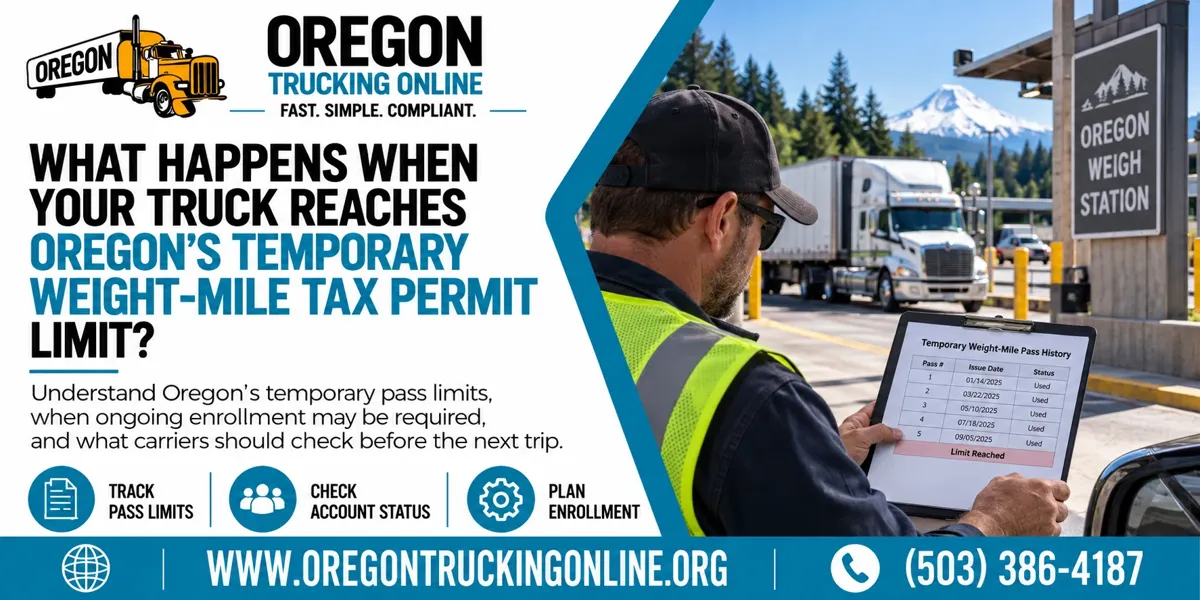
What Happens When Your Truck Reaches Oregon's Temporary Weight-Mile Permit Limit?
Table Of Contents
-
Introduction
-
Understanding Oregon's Temporary Pass Limits
-
What Happens When You Reach the Limit?
-
Moving From Temporary Passes to an Oregon Account
-
What to Do Before Your Next Trip
-
Mistakes to Avoid
-
Why Many Trucking Companies Choose Our Service
-
FAQ
Introduction
Temporary passes can help trucking companies make occasional trips through Oregon without immediately setting up an ongoing account. However, this option has limits. If your truck has used several temporary passes, or your company is arranging frequent Oregon trips, you need to track how many have been issued.
An Oregon Temporary Weight-Mile Tax Permit is not an unlimited substitute for ongoing registration and tax enrollment. Understanding the pass limits early helps prevent dispatch delays and gives your company time to arrange the correct credentials before the next trip.
Understanding Oregon's Temporary Pass Limits
Oregon limits temporary weight-mile tax passes to five for an individual vehicle and 35 for a carrier account during a rolling 12-month period. These limits are designed for temporary or occasional operations, not repeated trips indefinitely.
Keep a record of passes purchased for every power unit and track the account total as well. A new calendar year does not automatically reset a rolling 12-month count.
Each pass has its own validity conditions. A temporary pass generally covers up to 10 days or the number of Oregon miles purchased, whichever is reached first. The carrier pays the required pass fee and weight-mile tax in advance.
What Happens When You Reach the Limit?
When one vehicle has used its five temporary passes, do not assume that another pass will be available for that truck. Likewise, when the company approaches the 35-pass account limit, review the fleet's plans before buying more temporary credentials.
Oregon requires a motor carrier to establish an account when any one vehicle exceeds five temporary passes or the carrier account exceeds 35 temporary passes within a 12-month period. In practical terms, carriers should treat these limits as a signal to move away from repeated temporary passes and arrange the appropriate ongoing registration and weight-mile tax setup.
Do not wait until a truck is at the state line to solve the problem. If the vehicle needs to operate in Oregon, confirm its status with the Oregon Department of Transportation's Commerce and Compliance Division (CCD) and determine what enrollment is required before dispatch.
Moving From Temporary Passes to an Oregon Account
For carriers that regularly operate in Oregon, the next step may be to establish a motor carrier account and enroll qualifying vehicles in Oregon's Weight-Mile Tax Program. Enrollment requirements depend on the operation and vehicle.
Once enrolled, carriers must follow ongoing program requirements, which may include declaring vehicle weight, maintaining mileage records, filing required tax reports, and paying taxes due.
Review the following before transitioning:
-
Vehicle Information: Confirm the power unit's plate, VIN, registration, and ownership or lease details.
-
Operating Weight: Verify the heaviest weight at which the vehicle will operate under the applicable rules.
-
Mileage Records: Set up a reliable way to record Oregon highway miles and preserve supporting trip information.
-
Filing Responsibilities: Understand reporting deadlines and payment procedures for enrolled vehicles.
Do not treat account setup as simply replacing one piece of paper with another. It changes how the carrier manages weight-mile tax compliance over time.
What to Do Before Your Next Trip
Start by checking the vehicle's temporary-pass history and the number of passes your account has used in the rolling 12-month period. Include passes for all relevant units, not just the truck being dispatched next.
If your truck is approaching the five-pass limit or your account is nearing 35, contact CCD or your permit provider to confirm the next steps. Ask whether an account must be established, which vehicles need enrollment, and what records are required before the next Oregon operation.
Allow time for registration and enrollment to be completed. Verify that the truck has the correct credentials before it enters Oregon, and ensure the driver can produce the required documentation in a legible paper or electronic form. Keep dispatch, accounting, and fleet management aligned so a last-minute load assignment does not exceed the available temporary-pass allowance.
Mistakes to Avoid
Do not assume the limits reset on January 1. The account limit is based on a rolling 12-month period. Do not track only fleet totals while overlooking the individual vehicle limit, or track individual trucks without checking the company total.
Also, do not confuse a temporary pass count with the validity period or miles purchased for a single pass. A pass may expire or its purchased miles may be used before the pass-count limit is reached. Conversely, staying within the duration and mileage of a pass does not remove the limit on how many temporary passes may be used.
Finally, do not assume that a registration trip permit or an oversize permit replaces weight-mile tax authorization. Different credentials serve different purposes, and the vehicle may need more than one document to operate legally.
Why Many Trucking Companies Choose Our Service
Oregon Trucking Online helps carriers navigate permit applications and organize the vehicle and trip information needed for Oregon operations. Clear records and accurate applications can save time, reduce paperwork confusion, and help prevent avoidable delays.
Our service provides practical permit assistance and customer support for carriers preparing to travel. When temporary-pass use becomes frequent, reviewing the applicable requirements early can help your company plan the transition to ongoing enrollment.
FAQ
1. How many temporary weight-mile tax passes can one truck use in Oregon?
Oregon limits temporary passes to five for an individual vehicle during the applicable period. Plan for ongoing enrollment before relying on another pass.
2. What is the account limit for temporary passes?
The limit is 35 passes per carrier account in a rolling 12-month period.
3. Does the temporary-pass limit reset at the start of the calendar year?
No. The account limit is measured over a rolling 12-month period, so check the dates of previous passes.
4. What should I do when my truck reaches the temporary-pass limit?
Contact the Oregon Department of Transportation's Commerce and Compliance Division or your permit provider to confirm account and vehicle-enrollment requirements before the next trip.
5. Is the pass-count limit the same as a pass's validity period?
No. A pass generally covers up to 10 days or the number of Oregon miles purchased, whichever occurs first. The pass-count limit is separate.
For more information, visit the Oregon Department of Transportation.