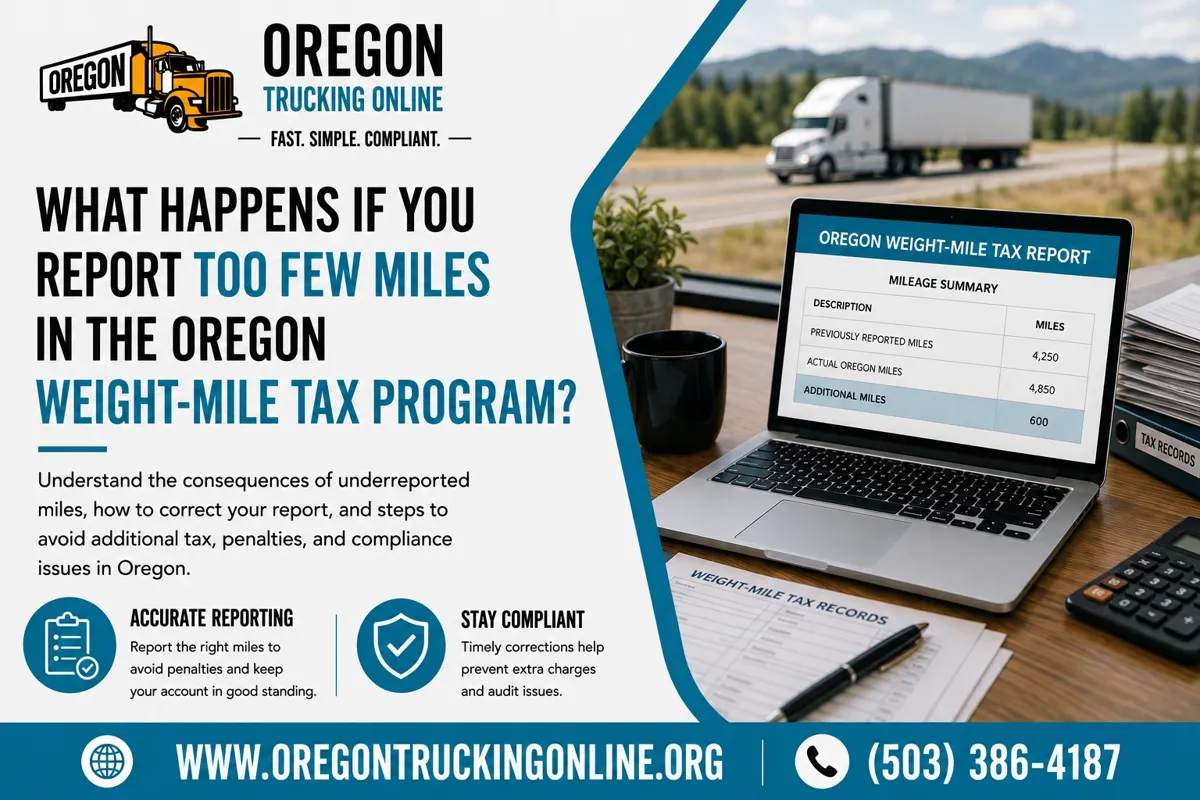
What Happens If You Report Too Few Miles in the Oregon Weight-Mile Tax Program?
Table Of Contents
-
Introduction
-
Why Accurate Mileage Matters
-
What Happens If You Report Too Few Miles?
-
How To Correct Underreported Oregon Miles
-
What Happens When Additional Tax Is Due?
-
What Records Should You Review?
-
How To Prevent Underreported Mileage
-
Why Many Trucking Companies Choose Our Service
-
FAQ
Introduction
Accurate mileage reporting is an important part of participating in the Oregon Weight-Mile Tax Program. When a trucking company files a mileage tax report, the reported Oregon miles help determine the amount of tax due for the reporting period.
Sometimes, however, a company may discover that fewer Oregon miles were reported than the vehicle actually traveled. This can happen because of incomplete mileage records, an incorrect odometer reading, missed trips, dispatch changes, route changes, or a simple calculation mistake.
Reporting too few miles can result in the trucking company paying less Weight-Mile Tax than was actually due. When an error is discovered after a report has already been filed, the company should address it rather than leaving the incorrect mileage on the account.
Oregon provides a process for correcting errors on previously filed Weight-Mile Tax reports. Understanding what to do when miles were underreported can help trucking companies correct the record and handle any additional tax that may be due.
Why Accurate Mileage Matters
The Oregon Weight-Mile Tax Program uses mileage information as part of determining a carrier's tax liability. For carriers enrolled in the program, Oregon requires mileage tax reports for the applicable reporting periods, and the reports must reflect the carrier's operations accurately.
Mileage records should provide enough information to support the miles reported. Oregon's recordkeeping requirements include information such as trip origins and destinations, Oregon entry and exit points, actual Oregon miles, routes, trip dates, and daily beginning and ending odometer or other mileage-recording device readings.
This means that mileage should not be estimated simply to complete a report. Trucking companies should use their available operational records to determine the actual Oregon mileage that should have been reported.
When the reported mileage is too low, the tax calculated from that report may also be too low. Correcting the error helps bring the company's records and tax reporting back into alignment.
What Happens If You Report Too Few Miles?
If a trucking company discovers that it reported fewer Oregon miles than it actually traveled, the company should review the affected report and determine the correct mileage.
For example, a dispatcher may have reported 4,500 Oregon miles for a reporting period when the company's records later show that the vehicles actually traveled 4,800 miles. The additional 300 miles may affect the amount of Weight-Mile Tax that should have been reported and paid.
The company should not simply add the missing miles to a future reporting period. Instead, it should review the original report and follow the appropriate process for correcting the previous filing.
Oregon's guidance states that when an error on a previous Weight-Mile Tax report results in additional tax being due, the correction should be made on a separate report form and labeled as an amended report.
Correcting the issue promptly is important because the longer an underreported amount remains unresolved, the more difficult it may become to reconstruct the mileage and supporting documentation.
How To Correct Underreported Oregon Miles
The first step is to identify the reporting period in which the mileage was underreported.
The trucking company should then compare the original Weight-Mile Tax report with its supporting records. This review can help determine exactly how many Oregon miles were originally reported and what the correct mileage should have been.
When correcting the report, the company should:
-
Identify the reporting period containing the error.
-
Review the original mileage reported.
-
Determine the correct Oregon mileage.
-
Calculate the additional miles that were omitted.
-
Recalculate the applicable tax.
-
Prepare a separate amended report.
-
Clearly label the correction as an amended report.
-
Include the additional tax and applicable charges.
-
Keep copies of the original and amended reports.
The Oregon Motor Carrier Education Manual specifically states that when additional taxes are due because of an error on a previous report, the correction should be made on a separate report form and labeled “AMENDED” with the applicable month and year.
Keeping the original report and the correction together can also make future recordkeeping much easier.
What Happens When Additional Tax Is Due?
Underreporting mileage can result in additional Weight-Mile Tax being owed because the original report did not include all of the taxable miles.
Oregon states that additional taxes not paid on time are subject to a 10% late payment charge. The state's guidance also explains that additional charges identified during an audit can be subject to applicable late payment, penalty, and interest charges.
For this reason, trucking companies should not ignore an underreported mileage error after discovering it.
The amount of additional tax will depend on the mileage that was omitted and the applicable tax rate for the vehicle and operation. The company should review its records carefully before preparing the amendment so that the corrected report does not introduce another mileage or calculation error.
If the additional amount is significant or the company is uncertain about how to prepare the correction, getting professional assistance can help make the process more manageable.
What Records Should You Review?
Before correcting an underreported mileage report, trucking companies should gather the records that can establish how many Oregon miles the vehicle actually traveled.
Useful records may include:
-
Original Weight-Mile Tax reports
-
Driver trip records
-
Beginning and ending odometer readings
-
GPS or electronic mileage records
-
Oregon entry and exit information
-
Dispatch records
-
Pickup and delivery information
-
Route records
-
Trip dates
-
Vehicle records
-
Previous tax calculations
-
Payment records
Oregon allows electronic tracking systems to support mileage records when the records meet applicable requirements. This can be particularly useful for trucking companies managing several vehicles and multiple routes.
Comparing several sources can also help confirm that the corrected mileage is accurate. If the odometer, dispatch records, and electronic tracking information do not match, the company should investigate the difference before submitting an amendment.
How To Prevent Underreported Mileage
Preventing mileage errors is easier than correcting them after a report has already been filed.
Trucking companies should maintain mileage records throughout each reporting period instead of trying to reconstruct every Oregon trip immediately before the filing deadline.
Dispatch and accounting teams should also communicate when routes change. A driver may take a different route, make an additional delivery, enter Oregon more than once, or travel additional miles that were not included in the original mileage calculation.
Before filing a Weight-Mile Tax report, review the mileage for each enrolled vehicle and compare the totals with the company's supporting records.
A final review should confirm:
-
All Oregon trips were included.
-
Oregon miles were calculated correctly.
-
Vehicle information is accurate.
-
The reporting period is correct.
-
The tax calculation matches the reported mileage.
-
Supporting records are available.
Building this review into the normal reporting process can reduce the chance of discovering an underreported mileage problem later.
Why Many Trucking Companies Choose Our Service
Many trucking companies choose Oregon Trucking Online because managing Weight-Mile Tax reporting and other Oregon trucking requirements can take valuable time away from running a business. Our experienced permit specialists provide fast processing, 24/7 customer support, weekend and holiday availability, secure online applications, competitive pricing, and knowledgeable assistance.
Accurate information and timely reporting are important when managing Oregon trucking requirements, especially when a company discovers an error that needs to be addressed. Our team helps make the process more convenient by providing experienced assistance and a secure online service.
Apply with Oregon Trucking Online today.
FAQ
What Happens If I Report Too Few Miles in the Oregon Weight-Mile Tax Program?
If you discover that fewer Oregon miles were reported than actually traveled, you should review the affected report and correct the error through the appropriate amendment process.
Do Underreported Miles Result in Additional Oregon Weight-Mile Tax?
They can. If the corrected mileage increases the amount of tax that should have been reported, additional Weight-Mile Tax will be due.
How Do I Correct Underreported Oregon Miles?
Review the original report, determine the correct mileage, calculate the additional tax, and prepare a separate amended report following Oregon's correction requirements.
Is There a Late Charge on Additional Weight-Mile Tax?
Oregon states that a 10% late payment charge applies to additional taxes that were not paid on time. Other penalties and interest may also apply in certain circumstances.
What Records Can Help Prove the Correct Oregon Mileage?
Mileage records can include trip information, Oregon entry and exit points, routes, dates, odometer readings, GPS records, dispatch information, and other supporting trip documentation.
Can GPS And Electronic Records Help With Mileage Reporting?
Yes. Electronic tracking systems can support mileage records when they meet Oregon's applicable recordkeeping requirements.
How Can Trucking Companies Avoid Reporting Too Few Miles?
Maintain mileage records throughout the reporting period, communicate route changes between dispatch and accounting, and review the final mileage totals against supporting records before filing.
For more information, visit the Oregon Department of Transportation.