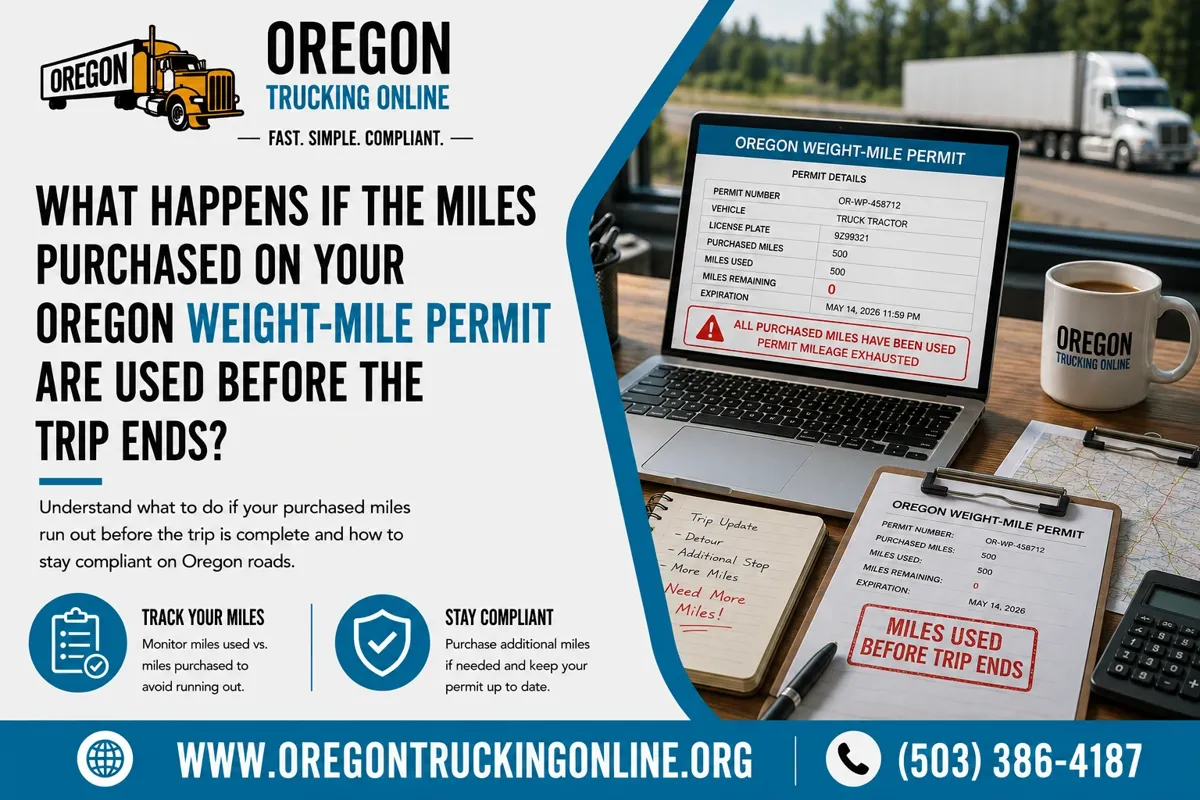
What Happens If The Miles Purchased On Your Oregon Weight-Mile Permit Are Used Before The Trip Ends?
Table Of Contents
-
Introduction
-
How Purchased Miles Work
-
What Happens When The Miles Are Used?
-
Can You Continue Driving?
-
What Should Dispatch Do?
-
How To Prevent Running Out Of Miles
-
Why Many Trucking Companies Choose Our Service
-
FAQ
Introduction
When a trucking company purchases an Oregon Temporary Weight-Mile Tax Permit for a trip, the company must estimate how many miles the vehicle will operate in Oregon. This matters because the temporary pass requires the weight-mile tax to be paid up front based on the miles purchased.
Problems can arise when the actual trip is longer than expected. A detour, additional pickup, changed destination, or inaccurate mileage estimate can cause the truck to use all of the purchased Oregon miles before the trip is finished.
When that happens, the carrier should not assume that the original permit automatically covers the remaining miles. Oregon's temporary pass is valid for 10 days or through the operation of the miles purchased, so the mileage purchased is an important part of the credential.
How Purchased Miles Work
The Oregon Temporary Weight-Mile Tax Permit is designed for qualifying temporary operations. Before operating in Oregon, a carrier without a registered CCD account must purchase a temporary pass and pay the applicable weight-mile tax in advance.
When applying, the carrier provides the route traveled or the number of Oregon miles needed to be purchased. Oregon Trucking Online instructions require the mileage to be entered in whole miles and rounded up.
This means carriers should estimate the complete Oregon portion of the planned movement, not just the distance to the first delivery point. Pickups, deliveries, detours, and other Oregon travel should be considered when calculating the miles needed.
The permit's 10-day duration does not mean the carrier can operate indefinitely during those 10 days. The temporary pass also ends through operation of the miles purchased.
What Happens When The Miles Are Used?
If the vehicle reaches the mileage purchased on the temporary pass before the trip is complete, the carrier has a problem that should be addressed before additional Oregon miles are operated.
For example, a carrier may purchase 300 Oregon miles but later discover that a route change will require another 50 miles. The original mileage estimate no longer covers the entire planned operation.
The carrier should review the actual route and remaining travel before continuing. The company should determine what additional temporary credential or tax payment is required for the remaining miles.
It is important to avoid treating the unused portion of the 10-day period as permission to continue after the purchased mileage has been exhausted. The mileage amount and the validity period both matter.
Can You Continue Driving?
A carrier should not simply continue operating in Oregon after the miles purchased on the temporary pass have been exhausted.
The driver should contact dispatch, and dispatch should verify the vehicle's current location, actual Oregon mileage, remaining distance, and temporary-pass information.
If the company discovers that the original mileage estimate was too low, it should take the appropriate steps to obtain the needed temporary tax credential or otherwise establish the proper tax coverage before continuing.
The carrier should also keep records explaining why the additional mileage was necessary. This can help the company maintain an accurate trip record and review its mileage-estimation process later.
What Should Dispatch Do?
When dispatch learns that the vehicle may exceed the mileage purchased, it should first compare the original estimate with the actual trip.
Check:
-
Original miles purchased
-
Miles already traveled in Oregon
-
Remaining Oregon distance
-
Current route
-
Updated destination
-
Added pickups or deliveries
-
Detours or other route changes
-
Temporary-pass information
The carrier should then determine the appropriate way to cover the additional Oregon operation. Oregon allows eligible carriers to purchase temporary passes through Oregon Trucking Online.
Dispatch should also communicate the updated plan to the driver and make sure the driver has the current documentation needed for the remainder of the trip.
How To Prevent Running Out Of Miles
The easiest way to avoid this problem is to estimate Oregon mileage carefully before the temporary pass is purchased.
Use the planned route and include Oregon pickups, deliveries, and other expected travel. Oregon's Trucking Online guidance specifically asks carriers to report how many miles the vehicle will operate in Oregon, and those miles must be entered in whole miles and rounded up.
Companies should also review their route whenever a customer changes the destination, another stop is added, or a detour becomes necessary.
It can help to maintain a mileage record for each temporary pass showing the miles purchased, miles traveled, and remaining expected distance.
A small amount of extra planning can help prevent the driver from reaching the end of the purchased mileage before the trip is finished.
Why Many Trucking Companies Choose Our Service
Many trucking companies choose Oregon Trucking Online because managing temporary weight-mile tax credentials can become difficult when routes change or trips do not go exactly as planned. Our service provides experienced permit specialists, fast processing, secure online applications, 24/7 customer support, and weekend and holiday availability.
Our team can help trucking companies review their temporary credential needs and handle permit paperwork more conveniently when a trip requires additional attention.
The goal is to make the process easier so trucking companies can spend less time dealing with paperwork and more time keeping their operations moving.
Apply with Oregon Trucking Online today.
FAQ
What Happens If I Use All The Miles Purchased On My Oregon Weight-Mile Permit?
The carrier should address the additional Oregon mileage before continuing. The original temporary pass should not automatically be treated as covering miles beyond those purchased.
Does The 10-Day Validity Period Cover Additional Miles?
Not automatically. Oregon states that the temporary pass is valid for 10 days or through the operation of the miles purchased, so both the time period and purchased mileage matter.
Can I Continue Driving If I Still Have Days Left On The Permit?
Remaining days do not necessarily cover mileage that exceeds the amount purchased. The carrier should resolve the additional mileage before continuing.
What Can Cause A Carrier To Run Out Of Purchased Miles?
Detours, additional deliveries, changed destinations, inaccurate estimates, and other unexpected Oregon travel can increase actual mileage.
How Should Dispatch Handle Additional Miles?
Dispatch should compare actual mileage with the original purchase, review the updated route, and determine the appropriate temporary tax credential for the remaining operation.
How Can Trucking Companies Prevent This Problem?
Estimate the full Oregon route carefully, include expected stops, round up the mileage, and review the estimate whenever the trip changes.
For more information, visit the Oregon Department of Transportation.