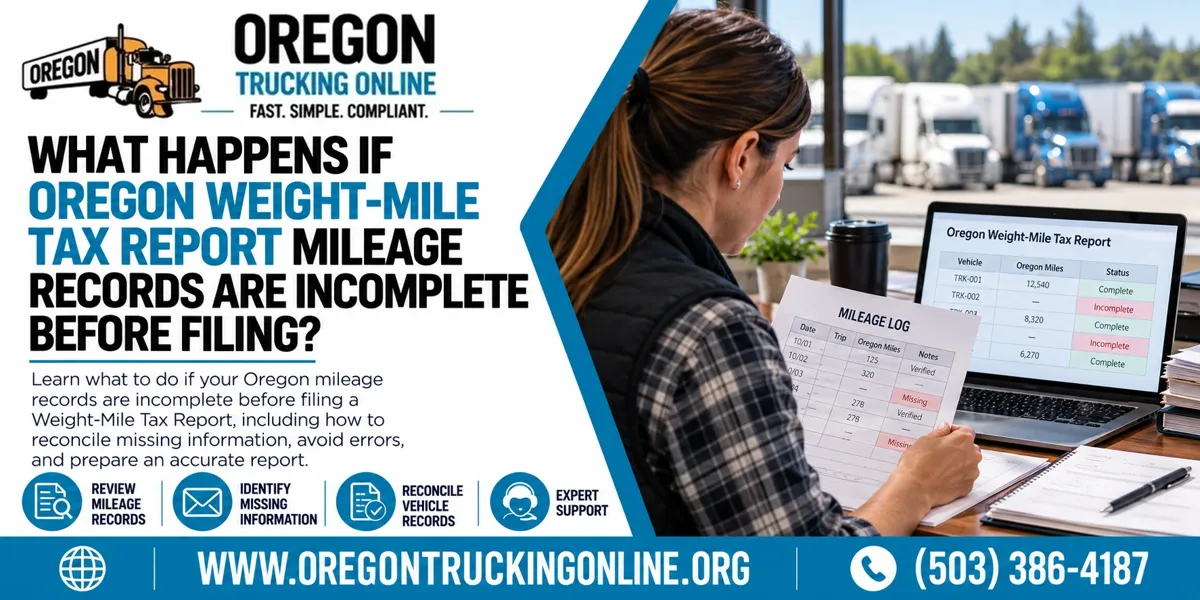
What Happens If Oregon Mileage Records Are Incomplete Before Filing A Weight-Mile Tax Report?
Table Of Contents
-
Introduction
-
Why Complete Mileage Records Matter
-
Identify What Information Is Missing
-
Reconcile The Available Mileage Records
-
Do Not File Using Guesswork
-
What If The Deadline Is Approaching?
-
Review Vehicle-Level Records
-
Correct Missing Records Before Submission
-
Keep Documentation For The Report
-
Prevent Incomplete Records In Future Quarters
-
Common Mistakes To Avoid
-
Why Many Trucking Companies Choose Our Service
-
FAQ
Introduction
Preparing an Oregon Weight-Mile Tax Report requires accurate mileage information for the reporting period. Problems can arise when a carrier reaches the filing stage but discovers that some trip records, mileage logs, odometer readings, or vehicle information are missing.
Incomplete records can make it difficult to determine the correct Oregon mileage and tax amount. Instead of estimating or submitting incomplete information, carriers should identify what is missing, reconcile the available records, and resolve the problem before filing whenever possible.
Why Complete Mileage Records Matter
Mileage records provide the information needed to prepare an accurate Oregon Weight-Mile Tax Report. Missing trips can lead to underreported mileage, while duplicated or incorrectly assigned records can produce a different error.
Records should allow the carrier to understand which vehicle traveled in Oregon, when the trip occurred, and how many miles should be included in the reporting period.
A complete set of records also makes it easier to explain the figures later if the carrier needs to review or correct the report.
Identify What Information Is Missing
Start by determining exactly what is incomplete.
A carrier may be missing a driver's mileage log, a trip sheet, beginning or ending odometer readings, GPS information, fuel records, or documentation for one particular vehicle.
Do not treat all missing information as the same problem. Identify the specific trips, dates, vehicles, or mileage figures that cannot currently be verified.
Creating a short list of missing records gives the accounting or compliance team a clear starting point for reconciliation.
Reconcile The Available Mileage Records
Once the missing information is identified, compare the records that are available.
Review trip sheets, dispatch records, odometer information, electronic logs, GPS records, fuel documentation, and other company records that can help establish the actual movement.
Look for gaps, duplicate entries, unusual mileage totals, and records assigned to the wrong vehicle.
The goal is to build the most complete and consistent mileage history possible before preparing the Oregon Weight-Mile Tax Report.
Do Not File Using Guesswork
A carrier should not rely on unsupported estimates simply because the filing deadline is approaching.
Guessing at missing mileage can create a report that does not accurately reflect the company's Oregon operations. It can also make later reconciliation more difficult because the carrier may have to determine which figures were estimated and which were supported by records.
When information is incomplete, pause and investigate the missing data rather than treating an assumption as a verified mileage figure.
What If The Deadline Is Approaching?
A nearing deadline makes organization even more important.
Prioritize the missing records that could materially affect the report. Contact drivers, dispatch personnel, accounting staff, or other internal sources that may have the missing information.
If records cannot be recovered immediately, document what is missing and what steps are being taken to resolve it. Avoid waiting until the final hour to discover that several vehicles still have unresolved mileage gaps.
Review Vehicle-Level Records
Incomplete mileage is often easier to find when records are reviewed by vehicle rather than only by total fleet mileage.
Check each vehicle separately and compare its reported Oregon travel with available logs and trip records.
This can reveal a truck that has no mileage entered, a trip assigned to another vehicle, or a total that does not make sense compared with the vehicle's activity during the quarter.
Vehicle-level review can also help prevent one truck's records from being accidentally included in another truck's report.
Correct Missing Records Before Submission
When missing information is recovered, update the mileage records before submitting the report.
Recalculate the affected totals and review the full reporting period again. Do not change only one number without checking whether the correction affects the total mileage or tax calculation.
A final review should confirm that the records now form a consistent picture of the carrier's Oregon activity.
Keep Documentation For The Report
Keep the records used to prepare the Oregon Weight-Mile Tax Report.
Maintain mileage logs, trip records, odometer information, GPS or electronic records, dispatch documentation, and calculations supporting the reported figures.
Organized documentation makes it easier to explain how the mileage was determined and helps the carrier prepare future reports more efficiently.
Prevent Incomplete Records In Future Quarters
Carriers can reduce missing-record problems by using a standard mileage collection process throughout the reporting period.
Require drivers and dispatch staff to submit records consistently, and review mileage before the quarter closes rather than waiting until filing time.
It can also help to keep separate folders or digital records for each vehicle and reporting period. Regular reconciliation can identify missing trips while the information is still easy to recover.
Common Mistakes To Avoid
Filing With Unverified Estimates: Do not treat guessed mileage as confirmed records.
Checking Only Total Fleet Mileage: Review each vehicle and trip for missing information.
Waiting Until The Deadline: Start reconciling records before the reporting period closes.
Ignoring Small Gaps: Several small omissions can materially affect the final total.
Mixing Vehicles: Make sure each trip belongs to the correct vehicle.
Discarding Supporting Records: Keep the documentation used to prepare the report.
Why Many Trucking Companies Choose Our Service
Many trucking companies choose Oregon Trucking Online because incomplete mileage records can make weight-mile tax reporting more time-consuming.
Our service helps carriers save time by simplifying Oregon Weight-Mile Tax Report preparation, reducing paperwork issues, and providing practical assistance when mileage records need to be reviewed or organized. Fast processing and dedicated customer support can help carriers identify reporting problems before they create larger administrative delays.
Reliable filing assistance can also help accounting and dispatch teams maintain clearer records and prepare future reports with greater confidence.
FAQ
What Should I Do If Some Oregon Mileage Records Are Missing?
Identify the missing trips, dates, vehicles, or mileage figures and reconcile them using the records that are still available.
Should I Estimate Missing Mileage?
Avoid unsupported estimates. Work to recover records and verify the actual mileage before submitting the report.
Can Dispatch Records Help Reconstruct Missing Mileage?
Yes. Dispatch records, trip sheets, odometer readings, GPS information, and other business records may help establish the missing travel details.
Should I Review Each Vehicle Separately?
Yes. Vehicle-level review can reveal missing trips, duplicate entries, or mileage assigned to the wrong truck.
What If The Filing Deadline Is Near?
Prioritize the records that affect the report most and resolve missing information as quickly as possible. Do not wait until the final moment to begin reconciliation.
What Records Should Be Kept After Filing?
Keep mileage logs, trip records, odometer information, electronic or GPS records, calculations, and other documentation used to prepare the report.
For more information, visit the Oregon Department of Transportation.