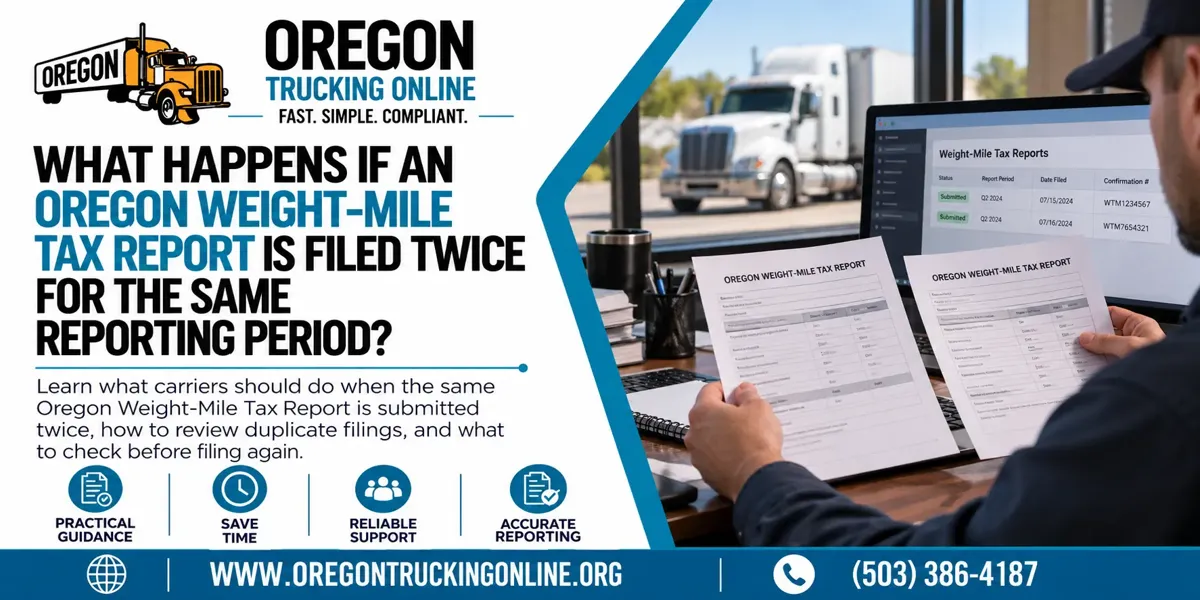
What Happens If An Oregon Weight-Mile Tax Report Is Filed Twice For The Same Reporting Period?
Table Of Contents
-
Introduction
-
What An Oregon Weight-Mile Tax Report Covers
-
What Happens If A Report Is Filed Twice?
-
Does The Second Report Replace The First?
-
What Carriers Should Check After A Duplicate Filing
-
How To Correct An Oregon Weight-Mile Tax Report
-
How To Prevent Duplicate Report Problems
-
Why Many Trucking Companies Choose Our Service
-
FAQ
Introduction
Filing an Oregon Weight-Mile Tax Report is an important part of maintaining accurate mileage-tax records. Carriers must report their applicable Oregon operations for each required reporting period, even when there are no taxable miles or no tax due.
A duplicate filing can happen when someone submits a report and later submits another report for the same period without realizing that the original was already processed. It can also happen when more than one person handles tax reporting for the same carrier account.
When this occurs, carriers should not assume that the second filing automatically replaces the first one. The company should review its account, compare the two submissions, and make sure the state's records reflect the correct mileage and tax information.
What An Oregon Weight-Mile Tax Report Covers
An Oregon Weight-Mile Tax Report is used to report applicable Oregon mileage and calculate the weight-mile tax associated with the carrier's operations.
Depending on the carrier's reporting schedule, reports may be filed monthly or quarterly. The applicable reporting period covers a defined range of operations, and the carrier is responsible for submitting the required report and payment when tax is due.
Mileage information should be supported by the carrier's records. Companies should maintain documentation that allows them to verify the miles reported, the vehicles involved, the applicable weights, and other information used to calculate the tax.
Because each report represents a specific reporting period, submitting the same period more than once can create an account-reconciliation issue that should be addressed rather than ignored.
What Happens If A Report Is Filed Twice?
If an Oregon Weight-Mile Tax Report is accidentally filed twice for the same reporting period, the carrier should review both submissions before taking further action.
The most important question is whether the second filing is an accidental duplicate or whether it contains corrections to the original report.
A true duplicate may contain the same mileage, vehicles, and tax information as the first submission. Another situation may involve different numbers because someone attempted to correct the original report by submitting another standard report.
Those situations should not automatically be treated the same way.
Carriers should keep records of both submissions and compare the reporting period, mileage, vehicle information, declared weights, and tax calculation. The company should then determine whether the original report was correct and whether the second submission was intended as a correction.
Does The Second Report Replace The First?
Carriers should not assume that submitting another report automatically replaces an earlier Oregon Weight-Mile Tax Report.
When information on a previously filed report needs to be corrected, Oregon provides an amendment process. Corrections are handled through an amended report rather than simply treating another ordinary filing as a replacement.
This distinction is important because a duplicate filing can otherwise make it difficult for the carrier to determine which information should be reflected in its records.
For example, suppose a carrier submits a report for June and later realizes that several mileage entries were missing. Instead of submitting an entirely new ordinary June report, the carrier should follow the applicable amendment process for correcting the previously filed report.
A carrier that accidentally submitted the same correct report twice should also avoid making additional filings simply to cancel out the duplicate. The account should first be reviewed so the company knows how the submissions were recorded.
What Carriers Should Check After A Duplicate Filing
After discovering a duplicate Oregon Weight-Mile Tax Report, carriers should compare the two submissions carefully.
Check:
-
Reporting period
-
Date each report was submitted
-
Vehicle information
-
Oregon taxable miles
-
Applicable declared weight
-
Tax calculation
-
Payment information
-
Confirmation or filing records
If both reports contain identical information, the carrier should retain documentation showing that the duplicate submission was accidental.
If the second report contains different mileage or tax information, determine which figures are correct before attempting another correction.
Carriers should also review their Oregon account records and avoid assuming that a second submission automatically resolves the first report or changes the account balance in the intended way.
How To Correct An Oregon Weight-Mile Tax Report
When an Oregon Weight-Mile Tax Report contains an error, Oregon's reporting process provides for amendments.
An amendment should be used when the previously filed information needs to be corrected. The carrier should determine exactly what changed and maintain the supporting mileage and vehicle records used to establish the correct figures.
This is particularly important when the correction changes the amount of tax due. Additional tax may be subject to applicable late charges when the correction is made after the original payment deadline.
Carriers should therefore avoid using repeated standard filings as a substitute for properly correcting a previously filed report.
If the company is unsure how a duplicate submission affected its account, it should review the filing history and contact the appropriate Oregon authority before submitting additional reports. Keeping multiple uncoordinated filings active can make reconciliation more difficult.
How To Prevent Duplicate Report Problems
Duplicate filing is easier to prevent than to correct.
Trucking companies should establish a single reporting process and designate who is responsible for submitting each Oregon Weight-Mile Tax Report.
Before filing, verify:
-
The reporting period
-
Whether a report has already been submitted
-
The vehicles included in the report
-
Mileage records
-
Weight information
-
Tax calculation
-
Payment status
Keep the filing confirmation and supporting records together after submission. A simple reporting calendar can also help accounting and compliance personnel see which reports have already been completed.
When more than one employee or service provider handles tax paperwork, communication becomes especially important. Everyone working on the account should know whether the report for the current period has already been submitted.
Why Many Trucking Companies Choose Our Service
Oregon Trucking Online gives trucking companies a straightforward way to manage permit and compliance applications without handling every administrative step on their own. Our service helps carriers save time, simplify processing, reduce paperwork, and avoid unnecessary delays when dealing with Oregon trucking requirements.
With fast processing, accurate assistance, and dedicated customer support, Oregon Trucking Online makes administrative tasks more convenient. Carriers can spend less time working through paperwork and more time focusing on drivers, vehicles, schedules, and daily transportation operations.
FAQ
What should I do if I accidentally file an Oregon Weight-Mile Tax Report twice?
Review both submissions, compare the information, and determine whether the second filing was a duplicate or an attempted correction.
Does a second Oregon Weight-Mile Tax Report automatically replace the first one?
Carriers should not assume that it does. Corrections to a previously filed report should be handled through the applicable amendment process.
What if both reports contain exactly the same information?
Keep the submission records and review the carrier account to determine how the duplicate filing was recorded. Avoid submitting additional reports simply to offset the duplicate without first reviewing the account.
What if the second report contains corrected mileage?
Determine which figures are correct and use the appropriate amendment process to correct the original report rather than relying on another ordinary filing as a replacement.
Can duplicate filing affect the amount of tax shown on my account?
It can create an account-reconciliation issue, particularly when the two submissions contain different mileage or tax information. Review the filing and payment records carefully.
How can I prevent duplicate filings?
Use one centralized reporting process, keep filing confirmations, and verify that the reporting period has not already been submitted before sending a new report.
For more information, visit the Oregon Department of Transportation.