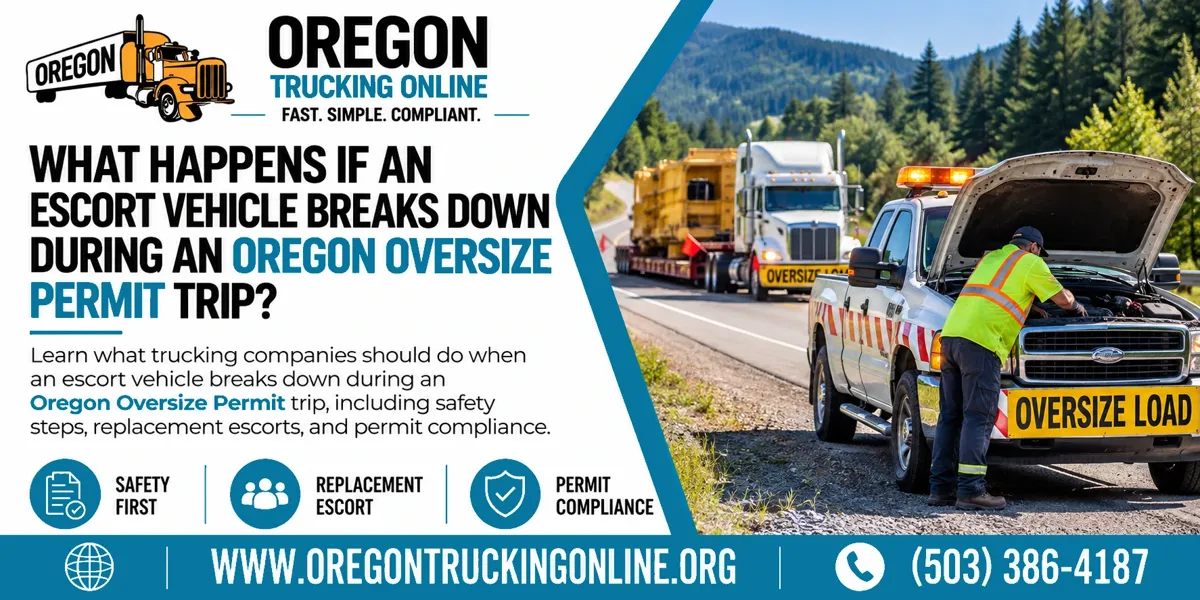
What Happens If an Escort Vehicle Breaks Down During an Oregon Oversize Permit Trip?
Table Of Contents
-
Introduction
-
Why Escort Vehicles Matter
-
What to Do Immediately
-
Arranging a Replacement Escort
-
Checking Permit Conditions Before Restarting
-
Preventing Escort-Related Delays
-
Mistakes to Avoid
-
Why Many Trucking Companies Choose Our Service
-
FAQ
Introduction
An escort vehicle helps an oversize load travel safely by warning motorists and helping the driver identify route hazards. A flat tire, engine problem, or electrical failure can leave a pilot car unable to continue.
If this happens during an Oregon Oversize Permit trip, the carrier must protect road users and follow the permit conditions. Whether the truck can continue depends on the escort coverage required for that movement and route.
Why Escort Vehicles Matter
Oregon may require one or more pilot vehicles depending on load width, height, length, overhang, and the highway. The permit and route requirements determine the required arrangement.
An escort may warn approaching traffic, help identify clearance concerns, or support movement through constrained areas. Some trips require a height pole or certified flaggers.
If a required escort becomes disabled, the movement may no longer meet permit conditions. A valid permit does not authorize travel without required pilot coverage.
What to Do Immediately
When an escort breaks down, prioritize safety and communication.
1. Stop Safely. If required coverage is no longer available, stop at a suitable location as soon as it is safe. Avoid active lanes, blind curves, and hazardous shoulders.
2. Notify Dispatch. Share the location, problem, and immediate roadside concerns.
3. Contact the Escort Provider. Ask whether the vehicle can be repaired or a replacement is needed. Request an estimated arrival time.
4. Review the Permit. Check the required number and placement of escorts, route restrictions, and special instructions.
5. Protect the Scene. Follow safety procedures and instructions from officials. Request help if the disabled vehicle creates a traffic hazard.
6. Record the Incident. Note the time, location, communications, and actions taken.
Arranging a Replacement Escort
If the original pilot car cannot continue, contact an escort provider that can supply a suitable replacement. Explain the load dimensions, route, and special requirements.
Check the replacement vehicle’s warning signs, communications equipment, and any required qualifications or specialized equipment. If a height pole is required, confirm that it is available.
The replacement driver should understand the route, load dimensions, position relative to the truck, and communication procedures. Do not resume simply because another pilot car arrives. Confirm that the replacement arrangement meets the permit conditions.
Checking Permit Conditions Before Restarting
Before moving again, review the Oregon Oversize Permit and its attachments. Confirm required escort coverage, vehicle placement, route, and special instructions.
If the permit requires multiple pilot vehicles, wait until the full required arrangement is available. Do not skip flaggers, height-pole coverage, or other required safety measures.
If requirements are unclear, contact the Oregon Department of Transportation’s Commerce and Compliance Division or your permit provider. Recheck road conditions and travel restrictions if the delay changes the planned departure time.
Resume only when the required escort support is available and all permit conditions can be met.
Preventing Escort-Related Delays
Preparation can reduce disruption, even though mechanical problems cannot always be prevented.
-
Inspect equipment. Check tires, lights, warning signs, radios, and any specialized equipment.
-
Confirm the assignment. Verify route, schedule, meeting points, and escort availability.
-
Set communication procedures. Ensure drivers and dispatch know how to contact one another if communication fails.
-
Plan safe stops. Identify suitable places to pull over and keep the escort provider’s contact details available.
Mistakes to Avoid
Do not continue without required escort coverage, assume any substitute vehicle will qualify, or ignore route restrictions to make up lost time.
Tell the replacement provider about the load’s dimensions and equipment needs. While waiting, monitor road conditions and confirm the route remains suitable before restarting.
Why Many Trucking Companies Choose Our Service
Oregon Trucking Online helps carriers navigate permit applications and organize information for permitted movements. Accurate application details can reduce paperwork confusion and delays caused by incomplete information.
Our service provides practical permit assistance and customer support. An escort breakdown still requires coordination with the escort provider and compliance with official instructions, but organized permit information helps carriers review the conditions that apply to the trip.
FAQ
Can a truck continue if its required escort vehicle breaks down in Oregon?
It should not continue if the movement no longer meets required escort conditions. Arrange appropriate replacement coverage and verify compliance before resuming.
Does every Oregon oversize load require an escort?
No. Requirements depend on factors such as load dimensions, route, and permit conditions. Check the issued permit and applicable requirements.
Can another escort company provide a replacement pilot car?
A replacement may be used if the vehicle, equipment, placement, and any required qualifications meet the movement’s conditions. Coordinate the change before restarting.
Should dispatch contact the permit authority after an escort breakdown?
Contact the appropriate authority or permit provider if requirements are unclear or a proposed change could affect compliance. Keep a record of the instructions received.
How can carriers reduce delays caused by escort breakdowns?
Inspect equipment, confirm availability before departure, establish communication procedures, and identify safe stopping locations along the route.
For more information, visit the Oregon Department of Transportation.