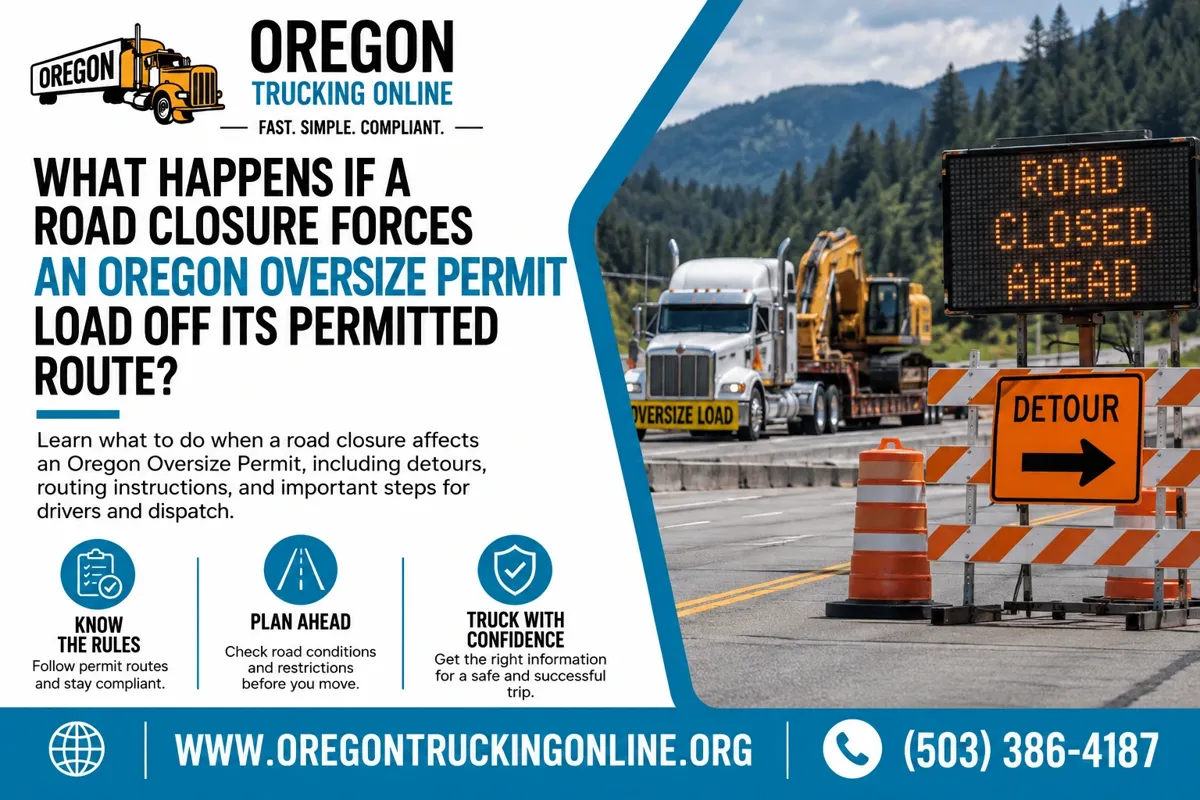
What Happens If A Road Closure Forces An Oregon Oversize Load Off Its Permitted Route?
Table Of Contents
-
Introduction
-
Why A Road Closure Can Affect An Oregon Oversize Permit
-
Do Not Assume An Alternate Route Is Automatically Allowed
-
What The Driver Should Do When A Closure Occurs
-
How Dispatch Should Respond
-
What If The Truck Is Already Near The Closure?
-
What About Emergency Detours?
-
How To Prepare For Unexpected Road Restrictions
-
Why Many Trucking Companies Choose Our Service
-
FAQ
Introduction
An Oregon Oversize Permit authorizes an over-dimension movement subject to the route, travel conditions, and other requirements shown on the permit. A closure can create a difficult situation when the permitted route is suddenly unavailable because of construction, wildfire, a landslide, severe weather, a crash, or another event.
When a closure occurs, the driver should not assume that the nearest alternate road can automatically be used. Oregon guidance states that carriers must follow the routing shown on the permit or contact the Commerce and Compliance Division for safe routing instructions for an over-dimension load.
Stop and verify the route instructions before making a detour.
Why A Road Closure Can Affect An Oregon Oversize Permit
Oversize loads cannot always use the same roads as ordinary traffic. An alternate highway may have a lower bridge weight limit, narrow sections, low clearance, difficult turns, or another restriction that makes it unsuitable for the permitted vehicle and load.
Oregon identifies construction, weather, wildfires, landslides, bridge restrictions, and other events as circumstances that can affect over-dimension travel. Conditions can therefore change after a permit is issued.
A road closure should be treated as a permit-routing issue, not simply a navigation problem.
Do Not Assume An Alternate Route Is Automatically Allowed
A GPS route is not a substitute for an approved oversize route. The fact that a road is open to regular traffic does not necessarily mean it can accommodate an oversize or overweight combination.
Oregon's route maps are reference information, while carriers are instructed to follow the routing on the permit or contact the appropriate division for safe routing instructions.
Before using an alternate road, the carrier should confirm whether the proposed detour is authorized for the specific vehicle, dimensions, weight, and movement. Review the permit attachments and current restriction information as well.
What The Driver Should Do When A Closure Occurs
Safety comes first. If the route ahead is closed, the driver should move to a safe location where possible and avoid entering a restricted road simply to stay on schedule.
Next, notify dispatch and provide the exact location, direction of travel, road name or highway number, and information about the closure. Photos or official closure information can help dispatch.
The carrier should then contact the appropriate Oregon permit authority for routing instructions when required. Keep the permit and all attachments available because they may contain restrictions or conditions affecting the movement.
Do not cross barricades, ignore law enforcement instructions, or improvise a route around a closure.
How Dispatch Should Respond
Dispatch should verify the closure through current Oregon road information and compare it with the permitted route. ODOT identifies TripCheck as an important source for day-of-travel conditions and recommends checking current restrictions before an over-dimension movement.
Determine whether an approved alternate route is already identified or whether specific routing instructions are needed.
Dispatch should document the time the closure was discovered, the location, communications with the driver, and any routing instructions received. This creates a useful trip record.
What If The Truck Is Already Near The Closure?
A closure discovered after a truck has traveled most of the permitted route can be especially difficult. The driver may have limited safe space to turn around, park, or wait.
The driver should avoid making a sudden maneuver that creates a safety hazard. If law enforcement or road personnel are directing traffic, follow their instructions.
Dispatch should provide the truck's exact location to the permit authority and explain the load's dimensions, weight, configuration, and current route. This information helps determine appropriate routing options.
A nearby county road or return route is not automatically permitted.
What About Emergency Detours?
An emergency may require an immediate change in travel conditions, but an emergency does not automatically make every road suitable for an oversize movement.
Some Oregon over-dimension guidance addresses alternate routes created by road construction or other constraints. However, the existence of an alternate-route guideline does not mean every closure can be handled by choosing any available road.
Distinguish between a published alternate route or specific instruction and an improvised detour. When there is uncertainty, obtain routing guidance before continuing.
How To Prepare For Unexpected Road Restrictions
Carriers can reduce disruption by checking current restrictions before departure and again on the day of travel. Review the permit, attachments, route information, and current road conditions.
Dispatch should give the driver the permit and supporting documents and establish a procedure for reporting closures.
Keeping the permit authority's contact information readily available can save time. Drivers should know where they can safely stop.
Preparation does not eliminate unexpected closures, but it can make the response more organized.
Why Many Trucking Companies Choose Our Service
Many trucking companies choose Oregon Trucking Online because oversize moves depend on accurate permit information, route details, and timely preparation. Our service provides a convenient way to handle Oregon permit needs and keep important trip information organized before a load gets on the road.
When a road closure affects an active movement, having the correct permit details available helps the carrier communicate clearly with dispatch and the appropriate authority. Preparation also makes it easier to review route requirements and respond when conditions change.
FAQ
What should a driver do if a road on the permitted route is closed?
Move to a safe location when possible, notify dispatch, and verify the proper routing instructions before taking an alternate road.
Can a driver simply follow GPS around the closure?
No. GPS navigation does not establish that an alternate route is authorized for an oversize movement.
Who should a carrier contact for safe routing instructions?
The carrier should contact the Oregon Commerce and Compliance Division or the appropriate permit authority for routing guidance.
What information should dispatch provide?
Provide the truck's current location, route, dimensions, weight, configuration, and details about the closure.
Should the driver keep the Oregon Oversize Permit with the truck?
Yes. The driver should have the permit and required attachments available during the permitted movement.
Can a county road automatically be used as a detour?
No. The road must be appropriate and authorized for the specific movement. Carriers should verify the detour before proceeding.
How can a carrier prepare for closures?
Check current restrictions and road conditions before departure and on the day of travel, and maintain a procedure for communicating unexpected route changes.
For more information, visit the Oregon Department of Transportation.