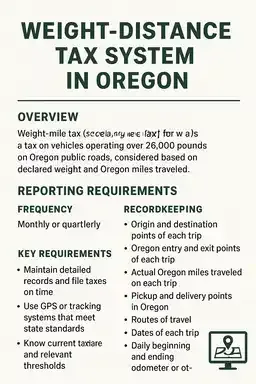
Overview: What Is Oregon’s Weight-Mile Tax
-
Oregon’s weight-mile tax (sometimes called “highway use tax” or “mileage tax”) applies to commercial vehicles operating on Oregon public roads with registered weight over 26,000 pounds.
It is based on two main factors:
-
Declared weight (or registered/permit-based weight). For heavier trucks, especially above certain thresholds (e.g. 80,000 pounds), different tax tables apply.
-
Oregon miles traveled (i.e. miles driven within Oregon) — including both loaded and empty travel, subject to how you declare configuration, weight, etc.
-
There is also a Road Use Assessment Fee (RUAF) which comes into play for non-divisible loads over certain weights (e.g. gross weights more than 98,000 pounds). For such loads, the RUAF replaces the weight-mile tax for the loaded portion.
Key Reporting / Recordkeeping Requirements
To comply, carriers must maintain detailed records and regularly file reports. Here are the specifics:
-
Which Reports, When, and How Often
-
Carriers with vehicles subject to the weight-mile tax must file monthly or quarterly mileage tax reports.
-
There’s a form for monthly mileage tax reporting (Form 9002) and a quarterly option (Form 9002t), plus continuation sheets where needed.
-
Carriers that qualify (based on history, compliance, etc.) can apply to switch from monthly to quarterly filing.
-
-
What Records Must Be Kept
Under Oregon Administrative Rule 740-055-0120, the “Weight-Mile Tax Records Requirements,” carriers are required to keep evidence including:
-
Origin and destination points of each trip.
-
Oregon entry and exit points of each trip.
-
Actual Oregon miles traveled on each trip.
-
Pickup and delivery points in Oregon.
-
Routes of travel.
-
Dates of each trip.
-
Daily beginning and ending odometer or other mileage-recording device readings for each vehicle.
-
-
Use of GPS / Tracking Systems
-
Oregon allows vehicle-tracking or GPS-based systems to be used in place of manual/traditional recordkeeping, provided the electronic records still satisfy all of the above requirements.
-
If using GPS or similar, the system must capture latitude & longitude to at least five decimal places, timestamps (date & time, at least every 15 minutes and when certain “significant events” occur, such as crossing state lines or turning engine on/off) to validate the mileage.
-
-
Special Rules for Heavier / Overweight or Permit Loads
-
Carriers with weights above certain thresholds (e.g. over 80,000 lbs) need to declare maximum operating weights for each vehicle configuration. Multiple configurations may require distinct declared weights.
-
If traveling with a configuration that requires a raised weight permit, or changes occur (e.g. configuration changes, actual loaded weight changes cross a threshold) then the tax rate and reporting must align with that declared weight/configuration.
-
For non-divisible loads exceeding certain weights, the RUAF applies instead of the normal weight-mile tax for the loaded portion.
-
-
Retention & Inspection
-
Records must be stored at the carrier’s principal place of business.
-
Records must be available for inspection by ODOT or its representatives.
-
Records must be retained for three years unless otherwise authorized.
-
Unique or Notable Features in Oregon vs Other States
-
Oregon’s system requires weight-specific declared weights per vehicle configuration. Some states just base tax on “class” or “registered weight,” but Oregon requires more precision, especially as configuration changes.
-
The RUAF for very heavy non-divisible loads is a special regime. Not all states have a similar fee / permit structure exclusively for non-divisible loads over very high weights.
-
The GPS / latitude-longitude requirement (with precise decimal places) and tight timestamping (every 15 minutes, and for certain events) is relatively strict compared to some states that may allow simpler odometer logs.
Penalties & Miscellaneous Requirements
-
Reports must be legible and readable; illegible or unreadable reports may be returned and treated as unfiled, possibly leading to penalties.
-
Late filing or late payment results in penalties (for example, 10% late fee if not post-marked by the deadline).
-
If the underlying data or supporting records are insufficient or missing (e.g. missing origin/destination, odometer readings, etc.), credits or claimed items may be disallowed during audits.
Practical Tips for Carriers Operating in Oregon
-
Always declare appropriate weight(s) for each configuration you use. If you run regularly with a trailer, drop-deck, etc., ensure you have declared weight for each.
-
Use GPS or electronic tracking tools that meet Oregon’s standards (coordinate precision; timestamping; capture state-entry/exit).
-
Maintain both physical backup (bills of lading, load tickets) and electronic records.
-
Make sure odometer / hubodometer readings are collected and stored for each trip.
-
Know when your reporting due dates are (monthly or quarterly). Don’t assume the same as other states.
-
If doing non-divisible loads over thresholds (98,000 lbs etc.), ensure you understand the RUAF regime (permits, fees, reporting).