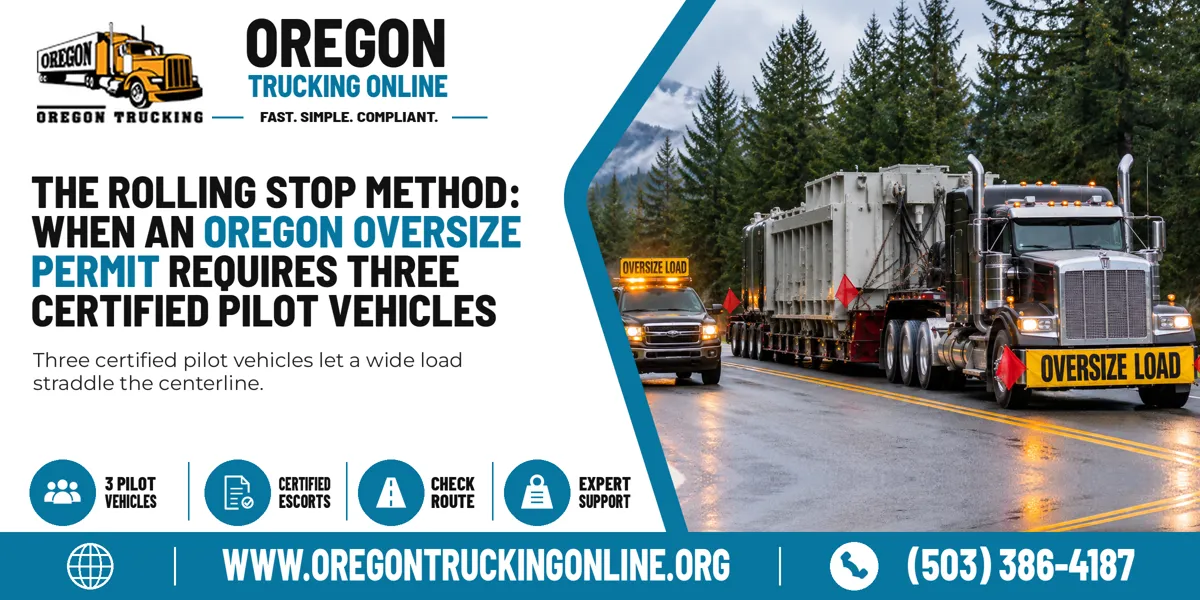
The Rolling Stop Method: When an Oregon Oversize Permit Requires Three Certified Pilot Vehicles
Table Of Contents
-
Introduction
-
The Short Answer
-
What the Rolling Stop Method Is
-
Why Oregon Uses Three Pilot Vehicles
-
When a Load May Need a Rolling Stop
-
What Certification Means for Pilot Vehicles
-
How to Prepare for a Rolling Stop Move
-
Common Mistakes to Avoid
-
Why Many Trucking Companies Choose Our Service
-
FAQ
Introduction
Some loads are so wide that they cannot stay in a single lane, even with careful driving. Bridges, narrow two-lane highways, and tight curves can force the truck to use part of the oncoming lane. Oregon allows this in certain cases, but only with a strict traffic control plan.
That plan is called the rolling stop method. If your Oregon Oversize Permit calls for it, you will need three pilot vehicles that are certified in the method. This guide explains how it works, why the state requires it, and how to get ready before the move.
The Short Answer
When an Oregon Oversize Permit requires a rolling stop, the move must use three pilot vehicles certified in the rolling stop method. According to the Oregon Department of Transportation (ODOT), the rolling stop method uses three pilot vehicles to allow the motor carrier to straddle the centerline.
Regular pilot cars are not enough. Every pilot vehicle in the rolling stop must be certified for this method.
What the Rolling Stop Method Is
A rolling stop is a way to briefly slow and hold traffic so an oversize load can safely use more than its own lane. Instead of closing the road, the pilot vehicles control traffic while everyone keeps moving at a reduced pace or pauses for a short time.
Here is the basic idea:
-
The load straddles the centerline. The truck uses part of the opposite lane to clear a narrow section.
-
Pilot vehicles manage traffic. They keep oncoming and following vehicles away from the load while it crosses the centerline.
-
The move stays short and controlled. Once the narrow section is cleared, the load returns to its lane and traffic flows normally.
The method protects the public, the driver, and the load, while avoiding a full road closure.
Why Oregon Uses Three Pilot Vehicles
Straddling the centerline means the load is in the path of oncoming traffic. One or two escorts cannot safely control both directions and watch the load at the same time. That is why ODOT's rolling stop method uses three pilot vehicles.
With three vehicles, the team can:
-
Warn and slow oncoming traffic before it reaches the load.
-
Protect the rear so following traffic does not try to pass.
-
Stay in contact and adjust as the load moves through the narrow section.
The exact positioning and procedures are part of the rolling stop certification, which is why ODOT requires certified pilot vehicles for this method.
When a Load May Need a Rolling Stop
ODOT says pilot vehicles may be required based on a vehicle's or load's width, height, overall length, and overhang. The specific requirements are set by ODOT's route maps and permit attachments, and they appear on your permit.
A rolling stop is most likely to come up when:
-
The load is very wide. ODOT's Route Map 2 is used to determine pilot vehicles for overwidth loads on multi-lane and two-lane highways.
-
The route uses narrow two-lane highways. There may not be room to stay in one lane.
-
The route crosses tight bridges or curves. The load may need the whole roadway for a short distance.
-
The load is near the superload size. ODOT treats loads over 14 feet wide on any state two-lane highway, or over 16 feet wide on the Interstate, as superloads with extra review.
Always read the pilot vehicle section of your Oregon Oversize Permit. If it lists a rolling stop, the three-vehicle requirement applies.
What Certification Means for Pilot Vehicles
ODOT states that to perform a rolling stop, pilot vehicles must be certified in the rolling stop method. A pilot car operator who is certified for regular escort work is not automatically certified for rolling stops.
Before the move, confirm that:
-
All three pilot vehicles have operators certified in the rolling stop method.
-
Certification is current and can be shown if an officer asks.
-
The team understands the route and knows where the rolling stops will happen.
If certified flaggers are also required by the permit, ODOT says the Certified Flagger Attachment must accompany the permit.
How to Prepare for a Rolling Stop Move
-
Read the Permit Carefully. Check the pilot vehicle requirements, route, and any attachments on your Oregon Oversize Permit.
-
Book Certified Pilot Vehicles Early. Rolling stop certified operators can be harder to find, so schedule all three ahead of time.
-
Review the Route Together. Go over narrow sections, bridges, and curves with the pilot team before the move.
-
Check Travel Restrictions. Confirm hauling hours, holiday rules, and weather conditions for the travel day.
-
Keep Paperwork in the Cab. Carry the permit, attachments, and any required certifications during the move.
Common Mistakes to Avoid
-
Using regular pilot cars. Pilot vehicles must be certified in the rolling stop method.
-
Bringing only two escorts. The method uses three pilot vehicles.
-
Skipping the route review. The team needs to know where the load will cross the centerline.
-
Booking pilot cars at the last minute. Certified operators may not be available on short notice.
-
Ignoring permit attachments. Pilot vehicle and flagger requirements are often listed there.
Why Many Trucking Companies Choose Our Service
Oregon Trucking Online helps carriers read their Oregon Oversize Permit requirements before the move, including pilot vehicle and rolling stop rules, so the load is ready to roll on schedule.
-
State admin fee (OS/OW permit): about $80 per permit
-
County admin fee: up to about $80 per county
-
Annual oversize permit: about $800 to $1,000+, depending on the load
-
Road use and weight fees: vary by weight and axles
We provide support 24/7 and also work weekends and holidays.
or
FAQ
What is the rolling stop method in Oregon?
It is a traffic control method that uses three pilot vehicles so an oversize load can straddle the centerline.
How many pilot vehicles does a rolling stop require?
Three. ODOT's rolling stop method uses three pilot vehicles.
Do pilot vehicles need special certification for a rolling stop?
Yes. Pilot vehicles must be certified in the rolling stop method.
How do I know if my load needs a rolling stop?
Check the pilot vehicle requirements on your Oregon Oversize Permit. They are based on width, height, length, overhang, and route.
Are certified flaggers ever required too?
Yes, on some permits. When they are, the Certified Flagger Attachment must accompany the permit.
For more information, visit the Oregon Department of Transportation.