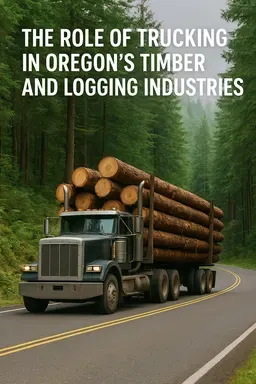
The Role of Trucking in Oregon’s Timber and Logging Industries
1. Overview of Oregon’s Timber Industry
-
Oregon is one of the leading timber-producing states in the U.S., accounting for nearly 10% of the nation’s total lumber output.
-
Major timber-producing regions include the Coast Range, Cascade Mountains, and Southern Oregon.
-
The industry supplies logs, lumber, plywood, and wood chips to mills, paper plants, and export terminals — all of which depend heavily on trucking for transportation.
2. Why Trucking is Essential
-
Trucks are the backbone of Oregon’s timber logistics chain, connecting remote forest operations with processing and export hubs.
-
Logging sites are often deep in forested or mountainous areas, where rail access is limited or nonexistent, making trucks the only feasible mode of transport.
-
Logging trucks handle:
-
Raw log transport from forests to sawmills.
-
Chip and biomass hauling to paper and energy facilities.
-
Finished product delivery to ports (e.g., Coos Bay, Portland) or interstate markets.
-
3. Specialized Logging Trucks and Equipment
-
Oregon trucking companies use specialized vehicles designed for heavy loads and rough terrain, including:
-
Log trucks (pole or mule trains) — equipped with bunks and bolsters to secure logs.
-
Self-loading trucks — featuring hydraulic booms for on-site loading.
-
Chip vans and flatbeds — used for wood byproducts and finished lumber.
-
-
Vehicles often require enhanced braking systems, low gearing, and off-road tires for steep grades and gravel roads.
4. Regulatory Environment
-
The Oregon Department of Transportation (ODOT) enforces strict weight and safety standards for logging trucks.
-
Operators must comply with:
-
Oregon Weight-Mile Tax (WMT)
-
Bridge formula weight limits
-
Load securement and covering rules
-
Forest access permits for state and federal lands
-
-
Seasonal road restrictions also apply, especially during spring thaw when soft roads can’t support heavy loads.
5. Economic Impact
-
Trucking supports thousands of jobs in Oregon’s rural communities — including drivers, mechanics, dispatchers, and log yard staff.
-
The reliability of trucking ensures steady operations for mills and wood processors, which in turn sustain local economies.
-
Any trucking disruptions (weather, fuel costs, or driver shortages) can halt mill production and impact exports.
6. Environmental and Sustainability Considerations
-
Modern logging fleets are investing in cleaner engines to meet Oregon’s air quality standards.
-
Trucking efficiency helps reduce idle time and unnecessary trips, minimizing emissions.
-
Some companies are exploring electric and hybrid log trucks, particularly for short hauls near mills.
-
Sustainable forestry certifications (e.g., FSC, SFI) often require documentation of responsible transportation practices.
7. Challenges in Timber Trucking
-
Weather and Terrain: Rain, snow, and steep grades make rural routes hazardous.
-
Maintenance Costs: Trucks face heavy wear from unpaved roads and large payloads.
-
Driver Shortages: Younger drivers are less likely to enter this physically demanding niche.
-
Market Volatility: Timber demand fluctuates with housing markets and export policies.
8. Future Outlook
-
Oregon’s timber trucking sector is evolving with:
-
Improved telematics and GPS tracking for load management.
-
Automated weigh-in systems to streamline mill entry.
-
Investment in cleaner engines and alternative fuels.
-
-
As sustainable forestry grows, the demand for efficient, low-impact trucking will increase, solidifying trucking’s role as a key partner in the future of Oregon’s forest economy.
9. Key Takeaway
Trucking is the lifeline of Oregon’s timber and logging industries — bridging forests and markets, powering rural jobs, and enabling the state’s longstanding connection between natural resources and commerce. Without trucking, Oregon’s forestry economy simply couldn’t function.