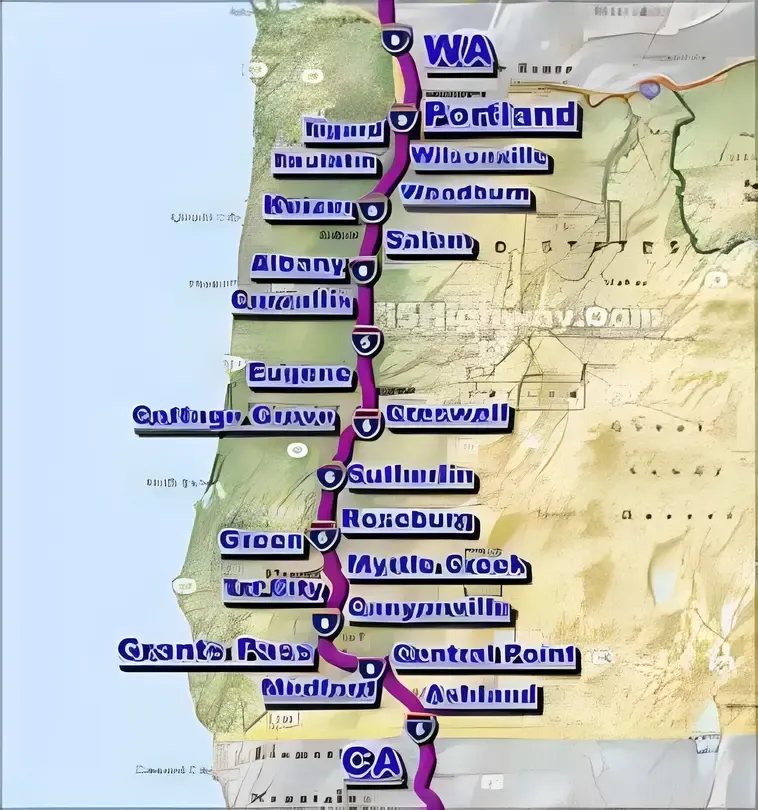
Trucking is the backbone of Oregon’s freight transportation system, and two major interstate highways — Interstate 5 (I-5) and Interstate 84 (I-84) — form the state’s most critical supply chain corridors. Together, they connect Oregon’s ports, manufacturers, farms, and consumers with markets throughout the western United States and beyond.
2. I-5 Corridor: Oregon’s North–South Freight Artery
Route: Runs from the California border through Medford, Eugene, Salem, and Portland, into Washington.
Key Roles:
-
Regional Connectivity: Links major population and economic centers within Oregon.
-
Interstate Trade: Serves as the primary north–south freight corridor for the entire U.S. West Coast, connecting Mexico to Canada.
-
Industrial Support: Supports transport of Oregon’s manufactured goods (electronics, lumber, paper, and food products) to distribution centers and ports.
-
Port Access: Connects directly to the Port of Portland and nearby intermodal hubs, facilitating export and import activity.
-
E-commerce & Distribution: Warehouses and logistics centers along the I-5 corridor (especially around Portland and Wilsonville) rely heavily on trucking for “last-mile” delivery.
Key Challenges:
-
Congestion: Especially between Portland and Vancouver, WA — one of the most congested freight segments in the Pacific Northwest.
-
Infrastructure Aging: Bridges and interchanges need modernization to accommodate high truck volumes.
-
Weather Impacts: Heavy rain and occasional snow in southern sections can disrupt logistics.
3. I-84 Corridor: The East–West Freight Gateway
Route: Runs from Portland through the Columbia River Gorge to Pendleton, La Grande, and Ontario, linking to Idaho and points east.
Key Roles:
-
Interstate Trade & Distribution: Connects Oregon’s Willamette Valley to the Mountain West and Midwest markets.
-
Agricultural Transport: Moves products from eastern Oregon farms (grains, potatoes, livestock feed) to processing facilities and export terminals.
-
Energy & Industrial Goods: Transports equipment and materials for Oregon’s renewable energy and construction industries.
-
Access to the Columbia River Ports: Complements river and rail transport for multimodal logistics.
Key Challenges:
-
Severe Weather: The Columbia River Gorge and mountain passes (especially near Pendleton and Cabbage Hill) frequently experience snow, ice, and wind closures.
-
Geographic Constraints: Steep grades and limited passing lanes can delay heavy trucks.
-
Infrastructure Resilience: Landslides and weather-related road closures occasionally disrupt freight movement.
4. Strategic Importance for Oregon’s Supply Chain
-
Economic Lifeline: Nearly all goods consumed or exported from Oregon travel on these corridors at some point.
-
Freight Volume: Over 75% of Oregon’s truck freight (by tonnage) uses I-5 or I-84.
-
Employment: Supports thousands of trucking, warehousing, and logistics jobs.
-
Multimodal Integration: Both corridors connect to major rail lines, ports, and airports, enabling flexible and resilient supply chain operations.
-
Disaster & Emergency Logistics: Serve as critical routes for emergency supplies, fuel distribution, and disaster response.
5. Modern Developments and Future Planning
-
Infrastructure Investment: ODOT and regional partners are planning improvements like the I-5 Rose Quarter Project and I-84 modernization to ease bottlenecks.
-
Freight Technology: Increasing use of weigh-in-motion systems, freight performance monitoring, and intelligent transportation systems (ITS) to enhance efficiency.
-
Sustainability Goals: Transition to cleaner diesel, renewable fuels, and eventual electrification of truck fleets along these corridors.
-
Resilience & Climate Adaptation: Focus on maintaining reliability amid wildfire risks, landslides, and flooding events.
6. Conclusion
The I-5 and I-84 trucking corridors are vital arteries of Oregon’s economy, linking its industries, ports, and consumers with national and global markets. Efficient operation of these routes ensures that Oregon’s supply chains remain competitive, resilient, and sustainable. Maintaining and modernizing these corridors is essential to the state’s long-term economic and environmental goals.