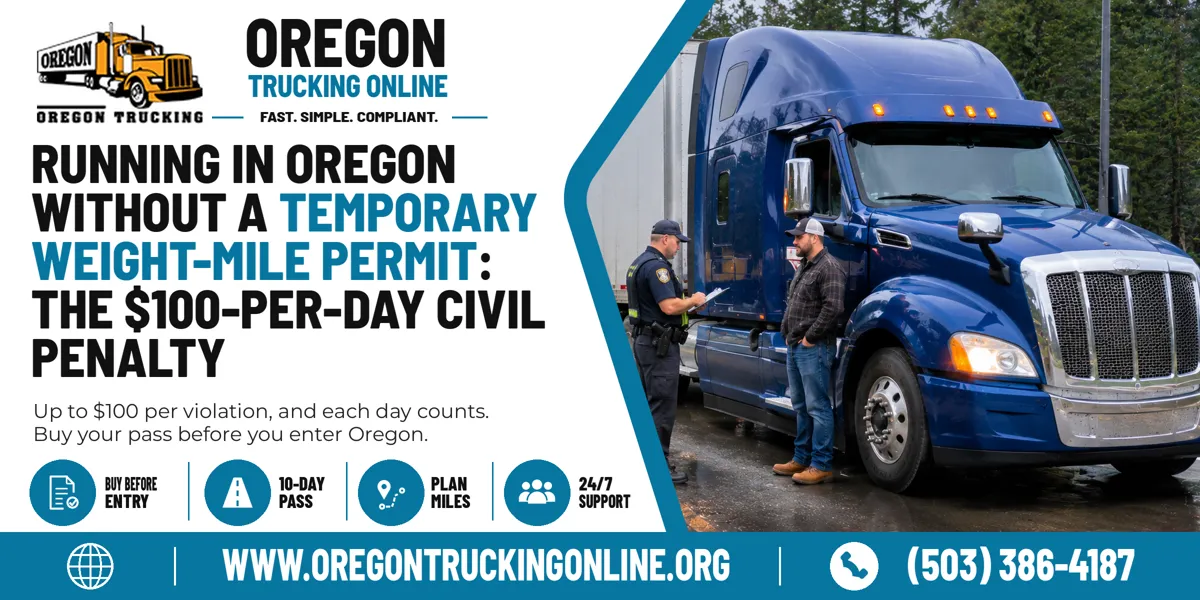
Running in Oregon Without a Temporary Weight-Mile Permit: The $100-Per-Day Civil Penalty
Table Of Contents
-
Introduction
-
The Short Answer
-
Who Needs an Oregon Temporary Weight-Mile Permit
-
What Oregon Law Says About the Penalty
-
How the Penalty Can Add Up
-
The Tax Is Still Owed
-
Other Problems You Can Run Into
-
Common Situations That Lead to a Violation
-
How to Stay Covered
-
Why Many Trucking Companies Choose Our Service
-
FAQ
Introduction
Oregon is one of the few states that charges heavy trucks a weight-mile tax instead of a diesel fuel tax at the pump. Carriers that run in Oregon all the time report that tax through an account with the Oregon Department of Transportation (ODOT). Carriers that only come in now and then use a temporary pass instead.
Some drivers assume they can enter first and sort out the paperwork later. In Oregon, that can be an expensive mistake. This guide explains when you need an Oregon Temporary Weight-Mile Permit, what the civil penalty is for running without one, and how to make sure every trip is covered.
The Short Answer
ODOT says that before operating in Oregon, a motor carrier without a registered CCD account must purchase and carry a temporary pass. Running without one is a violation of Oregon's motor carrier law.
Under ORS 825.950, a person who violates the chapter or ODOT's rules shall incur a civil penalty of not more than $100 for every such violation, and each day of a continuing violation is a separate violation. That means the penalty can grow day by day while the truck keeps running without an Oregon Temporary Weight-Mile Permit.
Who Needs an Oregon Temporary Weight-Mile Permit
According to ODOT's Commerce and Compliance Division (CCD), a temporary pass is needed when:
-
The carrier does not have a registered CCD account, and
-
The combined gross weight of the truck, trailer, and load is over 26,000 pounds.
The pass is valid for 10 days or through the operation of the miles purchased, and it can be bought up to 10 days before its effective date. Under ORS 825.470, the temporary pass is meant for a single trip or short-time operation not exceeding 10 days.
The driver must be able to produce a legible paper or electronic copy of the pass.
What Oregon Law Says About the Penalty
ORS 825.950(1)(a) says that every person who violates, or who procures, aids, or abets in the violation of, any provision of chapter 825 or any order, rule, or decision of ODOT shall incur a civil penalty of not more than $100 for every such violation.
Under ORS 825.950(2):
-
Each violation is a separate offense.
-
Each day of a continuing violation counts as a separate violation.
Civil penalties are imposed under ORS 183.745, Oregon's procedure for civil penalties.
How the Penalty Can Add Up
Because each day counts on its own, a single mistake can turn into several penalties. Here is a simple example of the maximum amounts:
-
1 day without a pass: up to $100
-
3 days without a pass: up to $300
-
7 days without a pass: up to $700
These are maximums, not fixed amounts. But the lesson is clear: the longer a truck runs without an Oregon Temporary Weight-Mile Permit, the more it can cost.
The Tax Is Still Owed
A penalty does not replace the tax. The temporary pass is issued when valid payment of the weight-mile tax is received up front, along with the pass fee.
If a truck runs without a pass, the weight-mile tax for the Oregon miles is still owed. So the carrier can end up paying:
-
The weight-mile tax for the miles driven,
-
The civil penalty, and
-
The cost of lost time while the problem is fixed.
Other Problems You Can Run Into
Missing a pass can also cause trouble beyond the penalty:
-
Delays at a port of entry while the paperwork is sorted out.
-
Missed delivery times and unhappy customers.
-
More scrutiny on future trips into Oregon.
-
Extra paperwork to settle the tax owed.
Common Situations That Lead to a Violation
-
Entering Oregon before the pass is issued. ODOT says the pass must be bought before operating.
-
Letting a pass expire mid-trip. It ends after 10 days or once the purchased miles are used.
-
Running more miles than purchased. A longer route can use up the pass early.
-
Using the wrong vehicle. The pass identifies a specific motor vehicle.
-
Not carrying a copy. The driver must be able to produce a legible paper or electronic copy.
How to Stay Covered
-
Order Before the Trip. You can buy the pass up to 10 days before its effective date.
-
Plan Your Oregon Miles. Order enough miles for the whole route, including any detours.
-
Check the Dates. Make sure the pass covers every day the truck will be in Oregon.
-
Confirm the Vehicle Details. The VIN, plate, and weights must match the truck.
-
Keep a Copy in the Cab. A legible paper or electronic copy works.
-
Consider an Account. If you run in Oregon often, a CCD weight-mile tax account may be a better fit.
Why Many Trucking Companies Choose Our Service
Oregon Trucking Online helps carriers get an Oregon Temporary Weight-Mile Permit before the truck reaches the state line, so there's no risk of running without one. We check your vehicle details, dates, and Oregon miles before the order is placed.
- Oregon Temporary Weight-Mile Permit: $50 plus weight-mile tax
We provide support 24/7 and also work weekends and holidays.
or
FAQ
What is the penalty for running in Oregon without a temporary weight-mile permit?
Under ORS 825.950, a civil penalty of up to $100 for every violation, and each day of a continuing violation is a separate violation.
Do I still owe the weight-mile tax if I'm penalized?
Yes. The tax for the Oregon miles is still owed.
When do I need an Oregon Temporary Weight-Mile Permit?
When you don't have a registered CCD account and the combined gross weight is over 26,000 pounds.
Can I buy the permit after I enter Oregon?
No. ODOT says it must be bought before operating in Oregon.
How much does your Oregon Temporary Weight-Mile Permit service cost?
Our service is $50 plus weight-mile tax.
For more information, visit the Oregon Department of Transportation Commerce and Compliance Division.