1. Overview
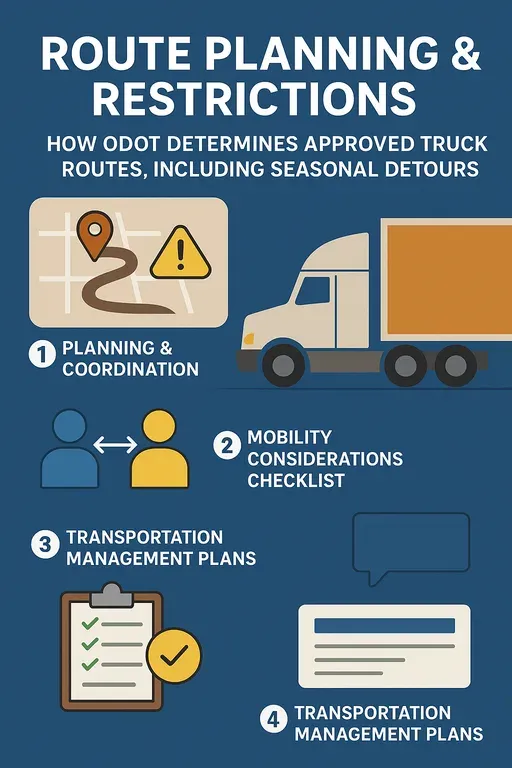
Oregon’s road network is managed by the ODOT Motor Carrier Transportation Division (MCTD), which regulates where, when, and how commercial vehicles—especially oversize and overweight (OS/OW) loads—can travel.
The goal is to balance freight mobility with road safety, infrastructure protection, and environmental concerns.
2. Truck Route Classification
ODOT divides highways into designated truck route classifications, which determine the maximum legal vehicle size and weight allowed on each road segment.
Common route categories include:
-
Green Routes – State-approved for standard commercial vehicles (up to legal size and weight).
-
Red Routes / Restricted Routes – Limited by bridge weight, narrow lanes, steep grades, or sharp curves.
-
Designated Freight Routes (DFRs) – Major corridors intended for heavy freight, often connecting ports, interstates, and industrial zones.
-
Local Access Routes – Low-volume or residential areas where truck access may be limited to deliveries only.
ODOT provides interactive maps through the Oregon Truck Route Map and TripCheck websites for route planning.
3. Oversize/Overweight Vehicle Route Determination
For loads exceeding legal size or weight limits, ODOT requires a special permit and conducts a route analysis before approval.
ODOT considers:
-
Bridge and pavement load ratings (to prevent damage)
-
Lane and shoulder width
-
Clearances (height, width, overhead power lines)
-
Roadway curvature and grade
-
Construction zones and detours
-
Traffic volume and time of day (some routes restrict movement during peak hours)
Permitted routes are customized for each load type, and pilot or escort vehicles may be required depending on size or weight.
4. Seasonal Weight Restrictions & Detours
During certain times of the year—especially in late winter and early spring—ODOT imposes seasonal load restrictions to protect weakened road surfaces.
Seasonal restrictions include:
-
Spring Thaw Restrictions – When soil beneath the pavement softens, ODOT limits axle weights to prevent cracking or rutting.
-
Winter Chain-Up Requirements – Certain mountain passes (like Siskiyou Summit or Cabbage Hill) require tire chains for traction.
-
Seasonal Detours – Alternative routes are designated when roads close due to flooding, slides, or weather damage.
Drivers can find active restrictions via:
-
ODOT’s TripCheck (updated daily)
-
Motor Carrier Transportation Division Alerts
-
Local county or city public works announcements
5. Permitting & Pre-Trip Compliance
Before hauling, carriers must:
-
Obtain applicable oversize/overweight permits through ODOT’s CCS (Commerce and Compliance System).
-
Verify route status and restrictions using TripCheck’s truck tool.
-
Plan alternate routes in case of temporary closures.
-
Carry a copy of the permit and route map in the cab for inspection.
Failure to comply with permit conditions or posted restrictions can result in:
-
Citations and fines
-
Permit suspension or revocation
-
Liability for infrastructure damage
6. Local Jurisdiction Coordination
Although ODOT manages state highways, counties and cities control their local roads and may have additional truck restrictions, such as:
-
Weight limits on local bridges or culverts
-
Time-of-day delivery restrictions in city centers
-
Designated truck parking zones
Carriers must coordinate with both ODOT and local jurisdictions to ensure full compliance.
7. Best Practices for Truck Route Planning in Oregon
✅ Check TripCheck before every haul.
✅ Review ODOT’s Route Map and Bridge Vertical Clearance List.
✅ Monitor seasonal restriction notices (especially February–April).
✅ Maintain accurate GPS and permit documentation in the cab.
✅ Communicate with dispatch and local authorities about detours.