1. Motor Carrier Registration & Operating Authority
-
If you operate a commercial vehicle in Oregon, your business often must register with ODOT’s Oregon Department of Transportation Commerce & Compliance Division (CCD) as a motor carrier.
-
You’ll need a legal business entity, and if you are Oregon-based you must show: an established place of business in Oregon, an Oregon driver’s license (for principal) or vehicle titled in Oregon, etc.
-
For out-of-state carriers operating in Oregon, registration and proper tax/permit obligations may apply.
-
If your vehicle(s) exceed 26,000 pounds or you haul for-hire (even with lighter trucks) you likely must register.
2. Commercial Driver’s License (CDL) & Driver-Related Licenses
-
Drivers operating commercial motor vehicles generally need a CDL per federal and state rules (for larger vehicles, certain endorsements, etc.).
-
Keep informed: for example, Oregon recently suspended issuance of non-domiciled CDLs/CLPs to comply with federal rules.
-
Make sure your CDL endorsements (hazmat, tanker, etc) are current and valid for the loads you haul.
3. Registration, Weight-Mile Tax & Fuel-Tax Programs
-
Your commercial vehicles must be registered properly in Oregon (or in your base state if apportioned).
-
Oregon uses a weight-mile tax for some operations — you’ll need to enroll, report, pay the tax if applicable.
-
If you haul across states, you may need to comply with the International Fuel Tax Agreement (IFTA) and the International Registration Plan (IRP) for registration and fuel use.
4. Oversize / Over‐Dimension & Overweight Permits
-
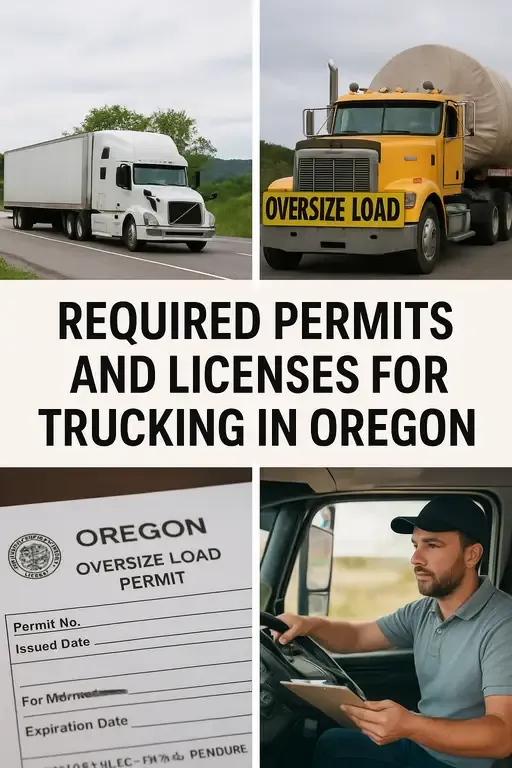
When your vehicle or load exceeds the standard legal size/weight limits in Oregon, you must obtain a special permit from ODOT.
-
Types of permits: Single‐trip permits (for one movement) and Annual permits (for regular oversized/overweight operations).
-
For example, loads over width, height or length limits, or combinations exceeding legal gross weight.
-
Permit issuance can require route planning, pilot vehicles, specialized signage, adherence to specific load movement conditions.
-
There is also a “Self-Issue Permit Program” for carriers who meet strict criteria, allowing them to issue certain permits themselves.
5. Trip Permits & Temporary Passes
-
For certain vehicles or operations not fully registered or when you enter Oregon temporarily, you may need a “Trip Permit” or “Temporary Pass”. For example, companies buying credentials for limited use.
-
Make sure you carry the permit in the vehicle while valid.
6. Permits for Special Situations
-
If you haul radioactive materials, you may need a dedicated permit under Oregon rules.
-
If you haul agricultural vehicles or farm-certified vehicles, there are certifications and special plates (e.g., farm plates) required.
-
If your load moves through city or county roads (not just state highways) you may need local permits in addition to state ones, especially for oversize/overweight loads.
7. Insurance & Surety Bond Requirements
-
For for-hire carriers based in Oregon, you must file proof of minimum liability insurance and possibly a surety bond.
-
Make sure the insurance covers the operations (intrastate or interstate) and meets state and federal standards.
8. Compliance, Record-Keeping & Safety Requirements
-
Maintain records for weight-mile tax, IFTA, IRP, oversize movements — in many cases for several years.
-
Carriers must ensure safety ratings, driver qualifications, vehicle maintenance, and other FMCSA/ODOT enforcement matters.
-
Failure to obtain required permits or licenses can result in fines, denied movement, or other penalties.
9. Steps to Getting Permits & Licenses (Simplified)
-
Establish your business entity (legal name, address, place of business).
-
Register your vehicles (or enroll in weight-mile tax/IRP/IFTA as applicable).
-
Obtain CDL(s) for drivers with required endorsements.
-
If your loads exceed standard limits, apply for oversize/overweight permits via ODOT (ORION system or via agents).
-
For temporary operations or out-of-state carriers, obtain trip permits or temporary passes as needed.
-
File insurance, bond, and other compliance documents with ODOT.
-
Maintain records and remain compliant with route restrictions, load requirements, and permit conditions.
10. Why This Matters
-
Ensures legal operation of commercial vehicles in Oregon — protects carrier from liability and fines.
-
Helps protect Oregon’s highways and infrastructure by controlling oversized/overweight loads.
-
Ensures driver safety, public safety, and gives state agencies data for enforcement and tax compliance.
-
For carriers, being compliant saves risk of being shut down, delayed, or fined — and improves operating predictability.