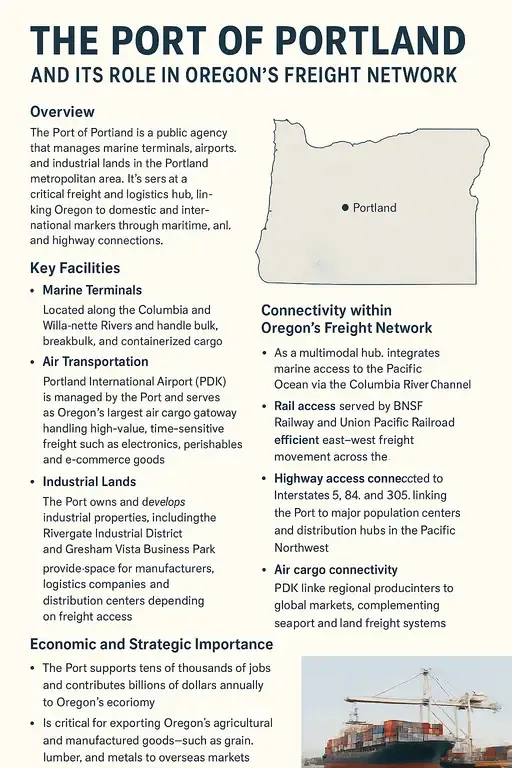
1. Port Facilities and Terminals
The Port manages four marine terminals and the Portland International Airport (PDX), making it a multimodal logistics hub:
-
Terminal 2: Bulk and breakbulk cargo
-
Terminal 4: Industrial and barge services
-
Terminal 5: Petroleum and dry bulk handling
-
Terminal 6: Container and auto import/export terminal
These facilities are connected directly to I-5, I-84, and I-205, and supported by Union Pacific (UP) and BNSF rail lines.
2. Trucking’s Critical Role
-
Trucks handle short-haul and last-mile distribution for most freight entering or leaving the port.
-
Local carriers connect the port to distribution centers in Portland, Salem, Eugene, and Vancouver (WA).
-
The port’s design allows efficient drayage operations between marine terminals and warehouses.
3. Key Commodities Moved
-
Automobiles: The Port of Portland is one of the largest auto import centers on the U.S. West Coast.
-
Bulk commodities: Grains, fertilizers, and minerals dominate exports.
-
Consumer goods: Electronics, apparel, and manufactured items arrive via container shipments.
4. Infrastructure and Connectivity
-
Direct access to major interstate corridors (I-5 and I-84).
-
Columbia River navigation channel allows ships to reach inland ports.
-
Intermodal terminals provide seamless truck–rail transfers, reducing congestion and emissions.
-
Advanced logistics technology supports cargo tracking and scheduling to minimize idle time for trucks.
5. Sustainability and Environmental Efforts
-
The Port’s Clean Truck Program encourages use of low-emission engines.
-
Shore power at marine terminals reduces ship emissions while docked.
-
Expansion plans emphasize electric drayage trucks and renewable fuels.
6. Economic Impact
-
Supports over 27,000 jobs in the Portland region.
-
Contributes more than $1.5 billion in wages and local business activity.
-
Drives Oregon’s export economy, especially in agriculture, timber, and manufacturing.
7. Future Outlook
-
Plans to expand Terminal 6 container operations to attract new shipping lines.
-
Infrastructure upgrades under the Oregon Connect Initiative to improve truck access routes.
-
Focus on sustainability and digital logistics integration to boost competitiveness.
Summary
The Port of Portland serves as the linchpin of Oregon’s freight ecosystem, linking local industries to global markets through a coordinated network of highways, rail lines, and marine terminals. Its continued modernization ensures Oregon remains a major hub for international trade and sustainable logistics.