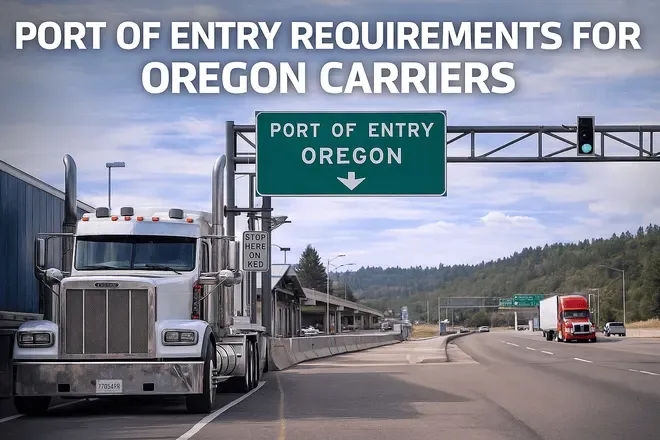
What Is an Oregon Port of Entry?
Oregon Ports of Entry act as enforcement hubs operated by the Oregon Department of Transportation (ODOT) and the Motor Carrier Transportation Division (MCTD). Officers verify that commercial trucks are properly credentialed, permitted, and operating within legal size and weight limits.
POEs are typically located along major highways at state borders or important freight corridors. Oregon also uses weigh stations, electronic screening systems, and the Green Light preclearance program to streamline checks.
Who Must Stop at an Oregon Port of Entry?
In Oregon, all commercial vehicles with a gross vehicle weight (GVW) of 20,000 lbs or more must stop unless:
-
They are enrolled in the Green Light preclearance program and receive a bypass signal.
-
The weigh station or POE is officially closed.
This rule applies to both intrastate and interstate carriers.
Key Requirements Oregon Carriers Must Meet at a POE
1. Weight-Mile Tax (WMT) Compliance
Oregon does not participate in IFTA for fuel tax reporting. Instead, trucks over 26,000 lbs GVW must comply with the Oregon Weight-Mile Tax.
At a POE, officers may check:
-
Valid WMT account
-
Accurate reporting of miles
-
Properly functioning weight-mile tax cab card or permit
Out-of-state carriers without an account may need a Temporary Pass.
2. Required Credentials
Carriers should be prepared to present:
-
USDOT number
-
Oregon Motor Carrier Account (if applicable)
-
Valid registration (IRP cab card if apportioned)
-
Proof of insurance
-
Oversize/Overweight permits (if required)
-
UCR compliance (if interstate)
Missing any of these can result in a delay or citation.
3. Size & Weight Verification
ODOT checks:
-
Axle weights
-
Gross vehicle weight
-
Overall dimensions (height, width, length)
-
Securement of loads
If a vehicle exceeds Oregon limits and lacks a proper ODOT permit, officers can require:
-
Re-routing
-
Adjusting the load
-
Purchasing a permit
-
Paying a fine
4. Safety Requirements
POE officers may inspect:
-
Driver’s CDL
-
Medical card
-
Hours of Service (HOS) logs or ELD data
-
Vehicle condition (tires, brakes, lights)
Carriers with high CSA scores or past violations may face more frequent inspections.
5. Temporary Trip & Fuel Permits
Out-of-state carriers may need:
-
Temporary Trip Permit (if not IRP-registered)
-
Temporary Fuel Permit (if not IFTA-licensed)
Oregon enforces these at POEs and can issue them on the spot, but at higher costs.
Oregon Green Light Preclearance Program
Oregon’s Green Light system uses transponders and weigh-in-motion sensors to let compliant carriers bypass weigh stations.
To receive bypass approval, the carrier must:
-
Maintain good safety scores
-
Be current on taxes and permits
-
Have accurate, up-to-date vehicle information
A “pull-in” signal means the truck must report to the POE, even with a transponder.
Common Reasons Trucks Are Pulled In
Even with preclearance, POE officers may require inspection due to:
-
Weight anomalies
-
Permit inconsistencies
-
Safety alerts
-
Outdated vehicle registration
-
Recent violations
-
Random check selection
Penalties for Non-Compliance
Violations at a POE can result in:
-
Immediate fines
-
Being placed out of service
-
Permit revocation
-
Denied bypass privileges
-
Required on-site tax or permit purchases
The most common fines involve:
-
Overweight violations
-
Missing WMT credentials
-
Invalid permits
Best Practices for Oregon Carriers
To move smoothly through Oregon Ports of Entry:
-
Keep all documents accessible and organized
-
Double-check permit accuracy before travel
-
Maintain current WMT reporting
-
Make sure your transponder is linked correctly to your account
-
Follow posted signs—Oregon strictly enforces POE stops