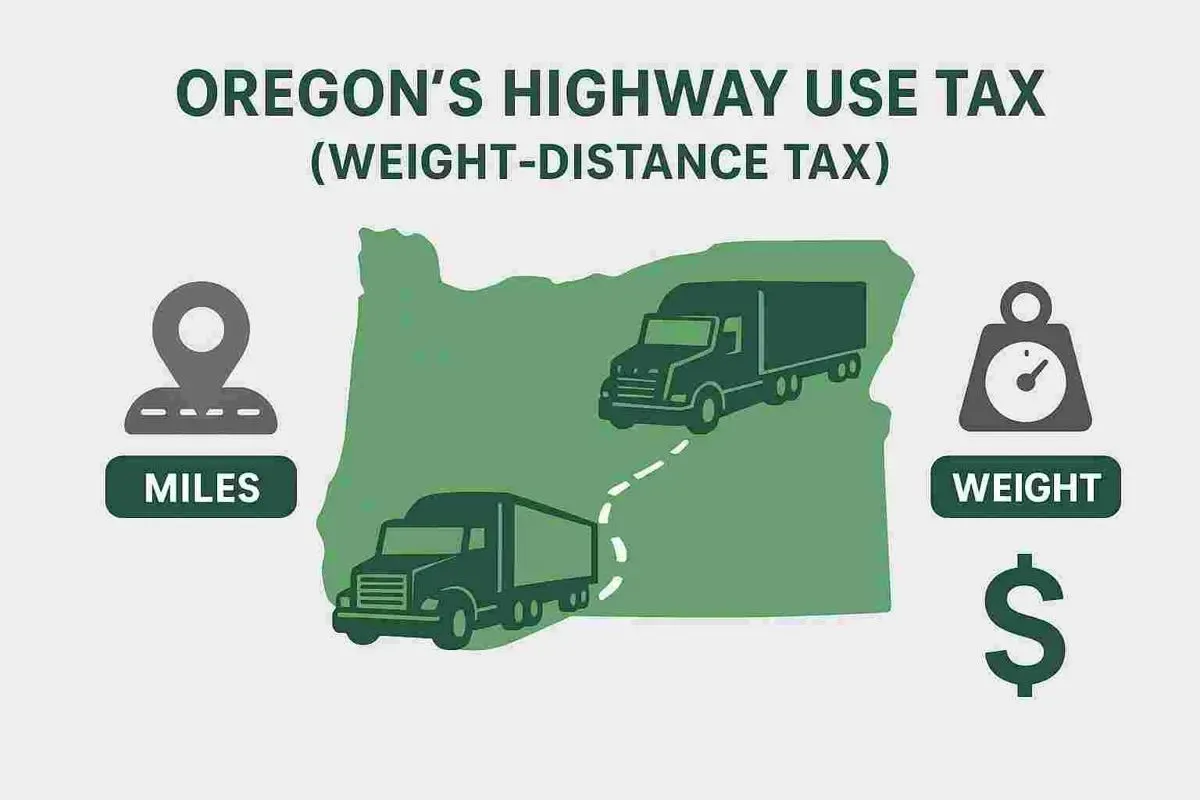
Oregon’s Highway Use Tax (Weight-Distance Tax) System Explained
Oregon stands apart from nearly every other U.S. state when it comes to trucking taxes. Instead of charging a traditional diesel fuel tax for heavy commercial vehicles, the state relies on a Highway Use Tax (HUT) — a weight-distance tax system.
This unique model means truck operators pay taxes based on how far they drive and how much weight they carry on Oregon roads.
1. What Is the Highway Use Tax (Weight-Distance Tax)?
The Oregon Highway Use Tax (HUT) is a road user fee applied to heavy trucks with a declared combined weight over 26,000 pounds.
Unlike most states that collect fuel taxes at the pump, Oregon’s system ensures that heavy trucks — which cause greater wear on roads — pay proportionally for their road usage.
The tax is calculated using:
-
Mileage driven on Oregon public roads, and
-
The declared maximum combined weight of the vehicle or combination (tractor + trailer).
2. Who Must Pay the Tax
Carriers that operate for-hire or private fleets in Oregon must pay the Highway Use Tax if their vehicles:
-
Have a declared weight over 26,000 pounds,
-
Operate within or through Oregon (even if based in another state), and
-
Are not paying per-mile taxes through flat annual fees under certain exemptions.
Out-of-state carriers must file before operating, or they risk penalties and delays at Oregon ports of entry.
3. Administering Agency
The tax is administered by the Oregon Department of Transportation (ODOT), specifically the Motor Carrier Transportation Division (MCTD).
All records, payments, and permits are managed through ODOT’s online Oregon Trucking Online (TOL) portal.
https://www.oregontruckingonline.org
4. How the Weight-Distance Tax Works
Step 1: Obtain a Motor Carrier Account
Carriers must open a Motor Carrier Account with ODOT. This account allows access to trip permits, tax reporting, and other compliance requirements.
Step 2: Record Mileage
Carriers must record the total miles driven in Oregon for each truck during the reporting period (usually monthly).
Accurate records are essential — GPS logs, trip sheets, or ELD data may be used.
Step 3: Calculate the Tax
The rate per mile is based on the vehicle’s declared combined weight (in 1,000-lb increments).
For example:
-
A 60,000-lb vehicle might pay $0.12 per mile,
-
An 80,000-lb vehicle could pay around $0.185 per mile.
(Exact rates are published by ODOT and updated periodically.)
Step 4: File and Pay
Carriers must file returns monthly using Oregon Trucking Online or by mail. Payments are due by the last day of the month following the reporting period.
5. Example Calculation
| Vehicle Weight | Miles Driven in Oregon | Tax Rate (Example) | Total Tax Owed |
|---|---|---|---|
| 80,000 lbs | 3,000 miles | $0.185/mile | $555.00 |
| 60,000 lbs | 2,000 miles | $0.12/mile | $240.00 |
6. Alternatives and Exemptions
Some carriers can opt for alternative programs if they qualify:
-
Flat Fee Option (Flat Weight Permit): Available for lighter commercial vehicles (under 26,000 lbs) that operate exclusively in Oregon.
-
Temporary Pass / Trip Permit: For out-of-state carriers who make occasional trips through Oregon (valid for 10 days).
-
Farm Vehicles: Certain agricultural operations may receive exemptions or reduced rates under specific rules.
7. Reporting and Recordkeeping Requirements
Carriers must maintain:
-
Oregon mileage logs (trip records, dispatch sheets, or ELD data)
-
Vehicle weight declarations and registration info
-
Tax return records and payment receipts for at least three years
ODOT may audit any carrier’s mileage or weight records to verify accuracy.
8. Penalties for Non-Compliance
Failing to register or pay the Oregon Highway Use Tax can result in:
-
Civil penalties up to $25,000 for intentional nonpayment
-
Suspension or revocation of motor carrier accounts
-
Out-of-service orders at Oregon weigh stations
-
Daily fines for missing or falsified mileage logs
9. Why Oregon Uses This System
Oregon first adopted the weight-distance tax in the 1940s — long before other states developed modern fuel tax systems.
The goal was fairness: ensuring that road maintenance costs were shared proportionally based on how much a vehicle contributes to highway wear.
This approach still allows Oregon to avoid double-taxing heavy vehicles (since it does not impose standard diesel fuel taxes on them).
10. How Carriers Can Simplify Compliance
-
Register for an online account via Oregon Trucking Online.
-
Install electronic logging or fleet management tools to track Oregon mileage automatically.
-
Keep backup trip sheets for all routes through the state.
-
Set reminders for monthly tax filing deadlines.
-
Consult with a tax compliance expert for multi-state fleets that include Oregon routes.
Summary
Oregon’s Highway Use Tax system is one of the most distinctive trucking tax structures in the U.S. It ensures road maintenance funding while distributing costs fairly across vehicle sizes and usage levels.
For carriers, compliance comes down to accurate recordkeeping, timely filings, and awareness of weight-based rates — key steps to staying legal and profitable on Oregon’s highways.