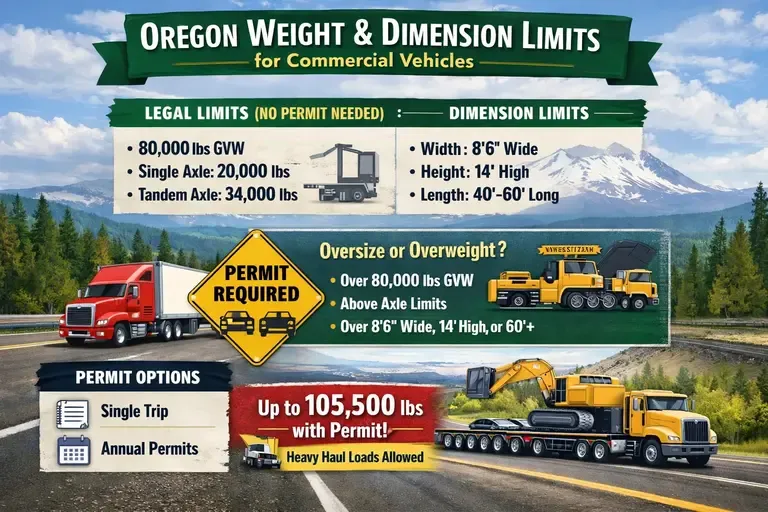
1. Legal Weight Limits (No Permit Needed)
Gross Vehicle Weight (GVW)
-
Maximum legal GVW: 80,000 pounds (standard interstate and most highways).
Axle Weight Limits
-
Single axle: Up to 20,000 lbs.
-
Tandem axle: Up to 34,000 lbs.
-
Steer axle: Limited both by tire rating and state formulas (often much less than 20,000 lbs).
Oregon uses weight tables and the Federal Bridge Formula (based on wheelbase/axle spacing) to determine total legal weight. If you meet these, no permit is required.
2. Legal Dimension Limits (No Permit Needed)
Width
-
Maximum width: 8 feet 6 inches (102 inches).
Height
-
Maximum height: 14 feet.
Length
-
Solo truck: Up to 40 feet.
-
Truck combinations (standard): Up to 60 feet.
-
Truck-tractor & semitrailer: Typically 53 feet trailer length, with overall limits depending on highway group maps.
Overhang
-
Front overhang: 4 feet maximum.
-
Rear overhang: Generally up to 5 feet beyond trailer, or up to 1⁄3 wheelbase under certain criteria.
3. When You Need a Trucking Permit (Oversize/Overweight)
If your truck or load exceeds the legal limits above, you must apply for an over-dimension or overweight permit before movement. Common situations include:
Weight exceeding 80,000 lbs GVW
Axle weights above the legal single/tandem limits
Unusual or heavy non-divisible loads
Dimensions beyond legal width, height, or length
Permits are issued through Oregon’s Oregon Routing Information Online (ORION) system, with both single-trip and annual options available.
4. Permitted Weight Extensions
-
Extended weights (with permit): Up to 105,500 lbs GVW (for divisible loads).
-
Heavy haul (with permit): Specialty heavy loads based on axle configuration and spacing — permits allow even higher weights depending on wheelbase and number of axles.
These heavier operations require detailed weight tables (Forms 8111 and up) showing allowable weights by configuration.
Key Takeaways
-
Stay within 80,000 lbs and standard size limits (8’6″ wide, 14′ high) to operate permit-free.
-
Follow axle weight limits and spacing rules for safe and legal operation.
-
Apply for permits if any dimension or weight is exceeded — late permits can result in fines or enforcement actions.