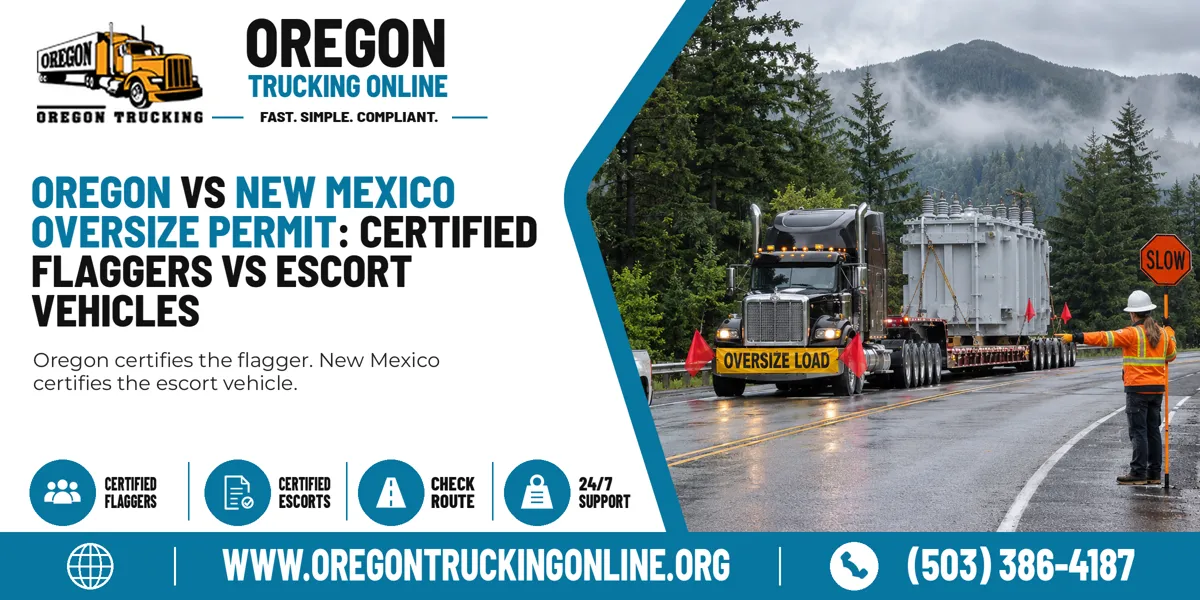
Oregon vs New Mexico Oversize Permit: Certified Flaggers vs Escort Vehicles
Table Of Contents
-
Introduction
-
The Short Answer
-
Where Each State's Rules Come From
-
Traffic Control: Flaggers in Oregon, Escorts in New Mexico
-
Who Must Be Certified in Each State
-
Side-by-Side Comparison
-
When Each State Steps Up the Requirements
-
Paperwork That Travels With the Load
-
Planning a Load Through Both States
-
Common Mistakes When Running Both States
-
Why Many Trucking Companies Choose Our Service
-
FAQ
Introduction
Oversize loads from the Southwest often head north to Oregon, and Oregon carriers send heavy equipment south to New Mexico job sites and oil fields. Both states protect traffic around big loads, but they do it in different ways.
Oregon relies on certified flaggers to stop traffic when a move needs it, alongside pilot vehicles. New Mexico relies on certified escort vehicles and, for the biggest loads, police escorts. This guide compares an Oregon Oversize Permit with a New Mexico Oversize Permit point by point, so your crew is ready on both sides.
The Short Answer
In Oregon, pilot vehicles may not stop traffic on superload moves. When traffic must be stopped, Oregon certified flaggers do it, and the permit lists that requirement.
On a New Mexico Oversize Permit, the main tool is the escort vehicle. Escorts are required for loads 14 feet wide or wider, and NMDOT may require a police escort for loads 20 feet wide or more.
Where Each State's Rules Come From
-
Oregon: ODOT's over-dimension operations rules and superload traffic control rules, with pilot vehicle needs set by highway in Route Map 2 and the Pilot Car Guide. Permits are ordered through ORION.
-
New Mexico: escort rules in 18.19.8.80 to 18.19.8.88 NMAC, applied through the New Mexico Oversize Permit issued by NMDOT.
Traffic Control: Flaggers in Oregon, Escorts in New Mexico
-
Oregon: An Oregon Oversize Permit may include a certified flagger condition when a move needs traffic control beyond pilot vehicles. ODOT's superload rules say the traffic control plan "shall include Oregon certified flaggers in conjunction with the carrier's pilot cars." Rolling stops need three pilot vehicles certified in the rolling stop method.
-
New Mexico: On a New Mexico Oversize Permit, escort vehicles do the main safety work. They must keep two-way radio contact with the truck, carry flagging equipment, and show an OVERSIZE LOAD sign. For loads 20 feet wide or more, NMDOT may call for a police escort.
What it means: in Oregon, plan for people on the ground who can stop traffic. In New Mexico, plan for the right number of certified escort vehicles.
Who Must Be Certified in Each State
-
Oregon: the flagger must hold a valid Oregon Certified Flagger card, or a card from Washington, Idaho, or Montana under a reciprocity agreement. Cards are valid for three years from the date issued.
-
New Mexico: the escort vehicle must be New Mexico certified before entering the state. Certification lasts one year or until insurance expires, whichever comes first, and the vehicle is inspected every year.
What it means: Oregon certifies the person holding the paddle. New Mexico certifies the vehicle that escorts the load.
Side-by-Side Comparison
| Feature | Oregon | New Mexico |
|---|---|---|
| Who stops traffic | Certified flaggers | Escorts and police, as the permit requires |
| What is certified | The flagger | The escort vehicle |
| Certification term | 3 years | 1 year or until insurance expires |
| Out-of-state cards | WA, ID, MT flagger cards accepted | Escort must be NM certified before entry |
| Big-load trigger | Superloads, such as over 16 ft wide on multi-lane highways | Escorts at 14 ft wide, police at 20 ft |
| Extra paperwork | Certified Flagger Attachment | NMDOT escort vehicle map in the escort |
When Each State Steps Up the Requirements
-
Oregon: superloads include loads over 16 feet wide on Interstate and multi-lane state highways, over 14 feet wide on two-lane state highways for most non-divisible loads, over 17 feet high, or longer than 150 feet. ODOT says a superload permit could take up to 10 days.
-
New Mexico: loads over 110 feet 1 inch need one escort, and loads over 120 feet 1 inch need two. Loads over 16 feet high may need an escort or an extra person to check clearances.
What it means: a 15-foot-wide load needs escorts in New Mexico and may be a superload with flaggers on an Oregon two-lane highway.
Paperwork That Travels With the Load
-
Oregon: whenever flaggers are required, the Certified Flagger Attachment must accompany the Oregon Oversize Permit.
-
New Mexico: each escort vehicle must carry the NMDOT escort vehicle map, a fire extinguisher, and its required safety gear.
Planning a Load Through Both States
-
Measure the Loaded Dimensions. Width, height, length, and overhang decide what each state requires.
-
Read the Oregon Permit for a Flagger Condition. If it's there, book certified flaggers.
-
Check Flagger Cards. Only Oregon, Washington, Idaho, and Montana cards work in Oregon.
-
Certify Escorts for New Mexico. Out-of-state escort vehicles must be certified before entry.
-
Allow Time for Superloads. Oregon may take up to 10 days to issue one.
Common Mistakes When Running Both States
-
Letting pilot cars stop traffic in Oregon. On superload moves, only certified flaggers do that.
-
Bringing a flagger card Oregon doesn't accept. Cards from other states are not on ODOT's list.
-
Using an uncertified escort in New Mexico. The vehicle must be certified first.
-
Leaving the Certified Flagger Attachment behind. It must travel with the permit.
-
Planning a superload at the last minute. Build in extra days.
Why Many Trucking Companies Choose Our Service
Oregon Trucking Online helps carriers read flagger and pilot car conditions and order the right Oregon Oversize Permit for the route, so the crew is ready before the load leaves the yard.
-
State admin fee (OS/OW permit): about $80 per permit
-
County admin fee: up to about $80 per county
-
Annual oversize permit: about $800 to $1,000+, depending on the load
We provide 24/7 support and work weekends and holidays.
or
FAQ
Does Oregon use flaggers or escorts for oversize loads?
Both. Pilot vehicles travel with the load, and certified flaggers stop traffic when the Oregon Oversize Permit requires it.
Does a New Mexico Oversize Permit require certified flaggers?
New Mexico's rules focus on certified escort vehicles, which must carry flagging equipment, and police escorts for very wide loads.
Can a Washington flagger card be used in Oregon?
Yes. Oregon accepts flagger cards from Washington, Idaho, and Montana.
Can an Oregon escort work under a New Mexico Oversize Permit?
Only if the vehicle is New Mexico certified before entering the state.
When does each state require more help?
Oregon steps up for superloads. New Mexico requires escorts at 14 feet wide and may require police at 20 feet.
For more information, visit the Oregon Department of Transportation and the New Mexico Department of Transportation.