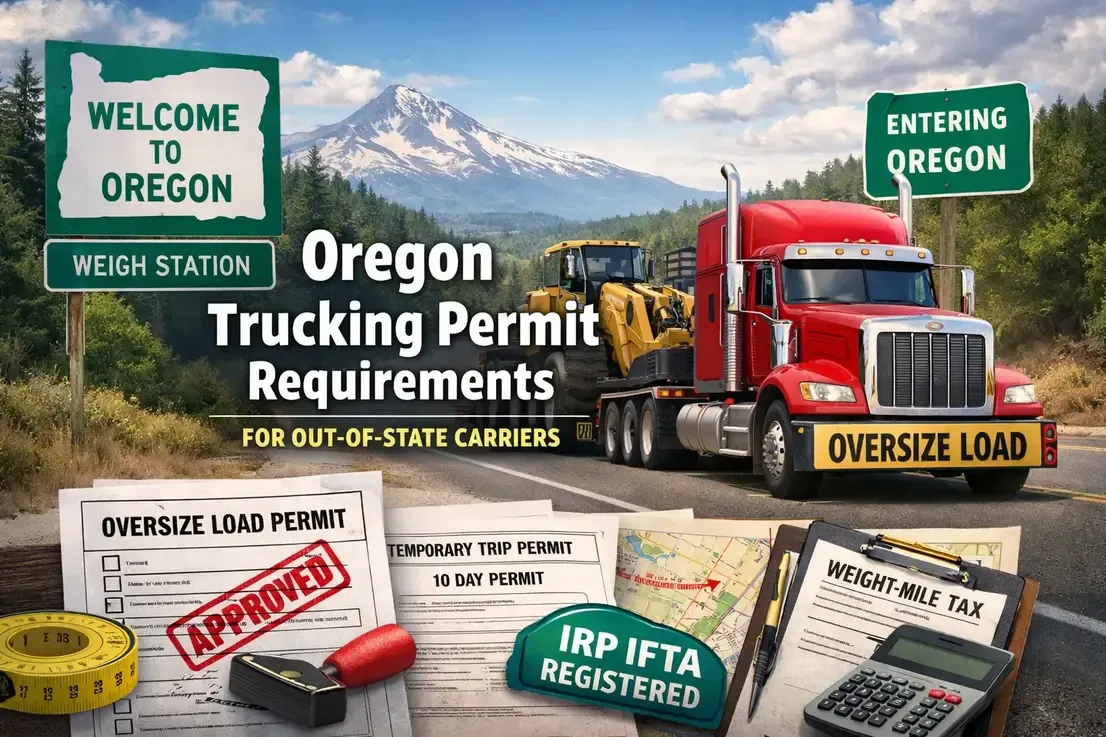
1. Operating Commercial Trucks in Oregon
Out-of-state carriers must meet Oregon’s regulatory requirements if their vehicles will be operating on public roads and exceed certain thresholds:
-
Commercial Vehicles over 26,000 pounds GVW generally must register and comply with Oregon’s motor carrier regulations.
-
Carriers hauling loads that exceed standard legal limits (size, weight, height, length) must obtain oversize/overweight permits before entering or moving in Oregon.
2. Temporary Trip Permits
If an out-of-state carrier doesn’t have Oregon IRP (International Registration Plan) or IFTA (International Fuel Tax Agreement) credentials, temporary permits are often required:
-
Temporary Trip Permit: Allows carriers without Oregon IRP to operate in the state for up to 10 consecutive days.
-
Temporary Fuel Permit: Required if the carrier does not carry an IFTA decal but will use fuel in Oregon.
These short-term permits help carriers legally operate without full state registration — useful for one-off or infrequent cross-state hauls.
3. Oversize & Overweight (OS/OW) Permits
Out-of-state carriers must obtain permits when loads exceed Oregon’s legal limits:
-
Oversize: Vehicles or loads wider than 8′6″, taller than 14′, longer than state limits, or heavier than gross limits require an OS/OW permit.
-
These permits are issued through Oregon’s online permitting system (ORION) and must be in hand before the load enters the state.
-
Superloads (extremely oversized/heavy) often have additional requirements and planning steps.
Permits may include route restrictions, pilot vehicle requirements, insurance obligations, and designated travel hours based on size/weight.
4. Registration & Tax Requirements
Out-of-state carriers operating frequently in Oregon often need to:
-
Establish an Oregon Motor Carrier Account.
-
Enroll in the Oregon Weight-Mile Tax (WMT) instead of IFTA for trucks over 26,000 lb.
-
Maintain filed liability and cargo insurance before operating intrastate.
These credentials demonstrate legal standing and tax compliance while operating in the state.
5. Compliance at Entry Points
Carriers must stop at Oregon weigh stations/ports of entry if required and show:
-
Valid permits,
-
Registration credentials, and
-
Proof of insurance or taxes (IRP/IFTA or WMT).
Failing to stop or produce documentation can result in fines, enforcement action, or being turned back.
6. County & Local Permits
In addition to state permits, some local roads and city streets (e.g., Portland) require extra oversize permits or approvals before traveling through them.