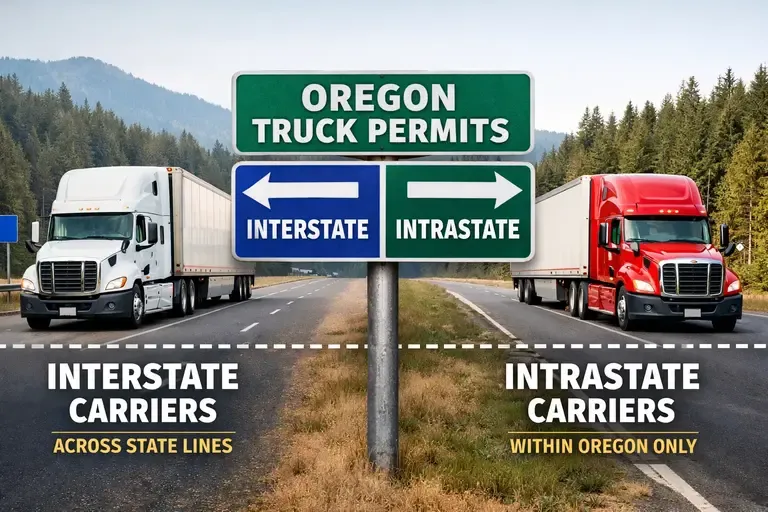
1. What Interstate vs Intrastate Means
-
Interstate carriers operate commercial vehicles across state lines — e.g., Oregon ↔ Washington or Oregon ↔ California.
-
Intrastate carriers operate only within Oregon’s borders — they never cross into another state.
These classifications affect which permits and compliance requirements apply.
2. Core Differences in Truck Permits
Interstate Carriers
Federal Requirements
-
Must comply with federal trucking rules and safety standards (e.g., FMCSA insurance requirements under 49 CFR Part 387).
Permit Requirements in Oregon
-
Oversize/Overweight Permits: Needed if you exceed Oregon’s legal size/weight limits — applies to both interstate and intrastate carriers (permits are issued via the https://www.oregontruckingonline.org/ ).
-
Heavy Motor Vehicle Trip Permits: Out-of-state trucks may need a trip permit if not properly registered in Oregon and exceeding 26,000 lbs.
-
Weight-Mile Tax: Oregon has its own weight-mile tax (instead of IFTA fuel taxes). Interstate carriers must enroll and pay if operating vehicles over 26,000 lbs — or purchase a temporary pass before travel.
-
Fuel/Tax Credentials: Non-IFTA interstate carriers may need temporary fuel permits if not IFTA-licensed.
Compliance at Ports of Entry
-
Officers may check USDOT number, Oregon trucking account, permits, and tax credentials at weigh stations regardless of whether the trip is interstate or intrastate.
Intrastate Carriers
State-Only Focus
-
These carriers operate solely inside Oregon, so they follow state permitting and registration rules rather than federal interstate certification.
Insurance and Registration
-
Proof of liability insurance may be required for certain intrastate permits (especially with Class 1A intrastate permits).
Oregon Permits
-
Oversize/overweight movements still require permits like interstate.
-
Must enroll in the weight-mile tax program for trucks over 26,000 lbs, just like interstate carriers — though reporting is within Oregon only.
Limitations
-
Intrastate credentials (including some permits or certificates) do not authorize vehicles to operate outside Oregon.
3. Specific Types of Permits Both Carriers May Need
| Permit Type | Interstate | Intrastate |
|---|---|---|
| Oversize/Overweight Permit | Required if dimensions/weights exceed legal limits | Required under the same conditions |
| Weight-Mile Tax Enrollment | Required for >26,000 lbs | Required for >26,000 lbs |
| Heavy Motor Vehicle Trip Permit | Often used for out-of-state vehicles | Not needed for Oregon-registered vehicles |
| Temporary Fuel Permit (non-IFTA) | If not IFTA licensed | If not IFTA licensed |
| Federal Carrier Insurance (49 CFR Part 387) | Required | Not federally required (state insurance rules apply) |
4. Why These Differences Matter
Compliance Avoids Fines: Operating without required permits can result in citations or forced stops at weigh stations.
Tax Implications: Oregon’s weight-mile tax is separate from fuel taxes like IFTA and must be paid by all heavy vehicles operating in the state.
Insurance Rules: Federal insurance requirements bind for interstate carriers, while intrastate carriers follow Oregon-specific state insurance mandates.
Summary
-
Interstate carriers must satisfy both federal and Oregon requirements — trademarks, weight-mile tax, trip permits, and oversize/overweight permits.
-
Intrastate carriers operate under Oregon state rules only — weight-mile tax, oversize permits, and state insurance requirements.
-
Some permits (like oversize/overweight) are the same for both types, but interstate operations have additional documentation and federal compliance aspects.