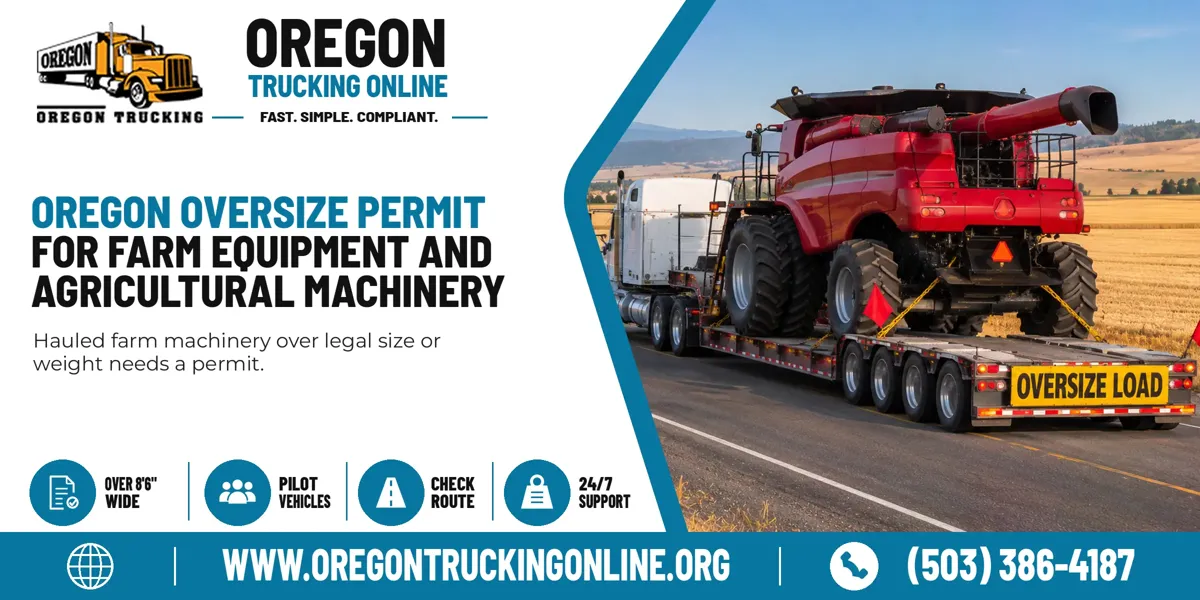
Oregon Oversize Permit for Farm Equipment and Agricultural Machinery
Table Of Contents
-
Introduction
-
When Farm Equipment Needs a Permit
-
Oregon's Legal Size and Weight Limits
-
Common Farm Loads That Go Oversize
-
Hauled Equipment vs Equipment Driven by a Farmer
-
Pilot Vehicles and Flaggers
-
Signs, Flags and Lights
-
Travel Time Rules
-
How to Get an Oregon Oversize Permit for Farm Equipment
-
Common Mistakes to Avoid
-
Why Many Trucking Companies Choose Our Service
-
FAQ
Introduction
Oregon is a major farm state. Wheat fields in the Columbia Basin, grass seed farms in the Willamette Valley, potato and onion farms near Ontario, orchards around Hood River and dairies along the coast all run on big machinery. That machinery has to move between farms, dealers and repair shops, and much of it is too wide, too tall or too heavy to haul without a permit.
This guide explains when farm equipment needs an Oregon Oversize Permit, which loads usually go over the limits, and what the permit requires once you have it.
When Farm Equipment Needs a Permit
A load needs an Oregon Oversize Permit when the vehicle and load together go over Oregon's legal size or weight limits. It doesn't matter whether the load is a bulldozer or a combine. If it's over the limits, it needs a permit.
Oregon's over-dimension rules are in OAR 734-082, and permits are issued by the Oregon Department of Transportation (ODOT) Commerce and Compliance Division through ORION.
Oregon's Legal Size and Weight Limits
These are the general limits most carriers plan around:
| Measurement | Legal Limit |
|---|---|
| Width | 8 feet 6 inches |
| Height | 14 feet |
| Semitrailer length | 53 feet |
| Gross weight | 80,000 pounds |
A load over any one of these limits generally needs an Oregon Oversize Permit. Axle weights and axle spacing can also make a load overweight, even when the gross weight looks fine.
Common Farm Loads That Go Oversize
Many farm machines are wider than 8 feet 6 inches by design. Common oversize farm loads in Oregon include:
-
Combines with headers attached
-
Large four-wheel-drive tractors with dual wheels
-
Grass seed swathers and windrowers
-
Potato harvesters and diggers
-
Sprayers with wide booms
-
Orchard platforms and wind machines
-
Grain bins, tanks and irrigation equipment
Removing the header, folding the wings or taking off the duals can sometimes bring a load back under the limits. When it can't, a permit is required.
Hauled Equipment vs Equipment Driven by a Farmer
Oregon treats farm machinery differently depending on how it moves.
-
Driven by a farmer: Oregon law has special rules for implements of husbandry moved by a farmer between fields or to a nearby dealer. These moves still need care, such as warning devices and safe timing.
-
Hauled on a trailer: Equipment loaded on a lowboy or step-deck and moved by a carrier is treated like any other load. If it's over the limits, it needs an Oregon Oversize Permit.
Dealers, custom harvesters and carriers delivering equipment should plan on a permit for any load over legal size or weight.
Pilot Vehicles and Flaggers
Wide farm loads often need pilot vehicles. In Oregon, the need for pilot vehicles depends on the width, height, length and overhang of the load and the highway it travels. ODOT uses Route Map 2 and its Pilot Car Guide to set the number of pilot vehicles.
-
Two-lane highways usually need pilot vehicles at narrower widths than multi-lane highways.
-
Over 14 feet wide on a two-lane state highway, most non-divisible loads are treated as superloads.
-
Certified flaggers may be required when traffic must be stopped. Pilot vehicles may not stop traffic on superload moves.
A wide combine on a two-lane road through the wheat country of eastern Oregon can need pilot vehicles even when it seems like there's little traffic.
Signs, Flags and Lights
Oversize farm loads must be clearly marked:
-
"OVERSIZE LOAD" signs to the front and rear, under OAR 734-082-0037
-
Red flags at least 18 inches square at the outer edges of an overwidth load
-
Warning lights above the cab when the load is over 10 feet wide on a two-lane highway or over 12 feet wide on a four-lane highway, under OAR 734-082-0036
Signs must be removed or retracted when they aren't required.
Travel Time Rules
Your Oregon Oversize Permit sets when the load may move. Travel times follow Attachment H, which comes with the permit. Oregon defines daylight as half an hour before sunrise to half an hour after sunset, and some movements are restricted over six holiday periods.
During harvest, rural roads get busy with farm trucks. Plan the move early in the day so the load reaches its destination before the permit's time window ends.
How to Get an Oregon Oversize Permit for Farm Equipment
-
Measure the Load. Get the exact width, height, length and weight with the equipment on the trailer.
-
Check if Parts Can Be Removed. A header or duals may bring the load under the limits.
-
Plan the Route. Check Route Map 2, bridges and any county roads.
-
Gather Truck and Trailer Details. Include VINs, plates, axle spacing and weights.
-
Submit the Permit Application. Include the load description and route.
-
Book Pilot Vehicles If Needed. Add certified flaggers if the permit requires them.
-
Mark the Load. Add signs, flags and lights before the move.
Common Mistakes to Avoid
-
Measuring without the trailer. Height is measured from the road, not from the deck.
-
Forgetting the header. A combine with the header attached is much wider.
-
Assuming farm loads are exempt. Hauled equipment usually needs a permit.
-
Leaving out county roads. Farm deliveries often end on county roads that must be on the permit.
-
Moving outside permitted hours. Attachment H sets the travel window.
Why Many Trucking Companies Choose Our Service
Oregon Trucking Online helps carriers, dealers and custom harvesters get the right Oregon Oversize Permit for farm equipment, with the correct measurements, route and pilot vehicle rules, so the machinery reaches the field on time.
-
State admin fee (OS/OW permit): about $80 per permit
-
County admin fee: up to about $80 per county
-
Annual oversize permit: about $800 to $1,000+, depending on the load
We provide support 24/7 and also work weekends and holidays.
or
FAQ
Does farm equipment need an Oregon Oversize Permit?
Yes, when the load goes over Oregon's legal size or weight limits.
What is the legal width in Oregon?
8 feet 6 inches.
What is the legal height in Oregon?
14 feet.
Does a wide farm load need pilot vehicles?
It depends on the width, length, height, overhang and highway. ODOT's Route Map 2 sets the number.
Can a farmer drive equipment between fields without a permit?
Oregon has special rules for implements of husbandry, but hauled equipment usually needs a permit.
For more information, visit the Oregon Department of Transportation.