What Is an Over-Dimension Permit in Oregon?
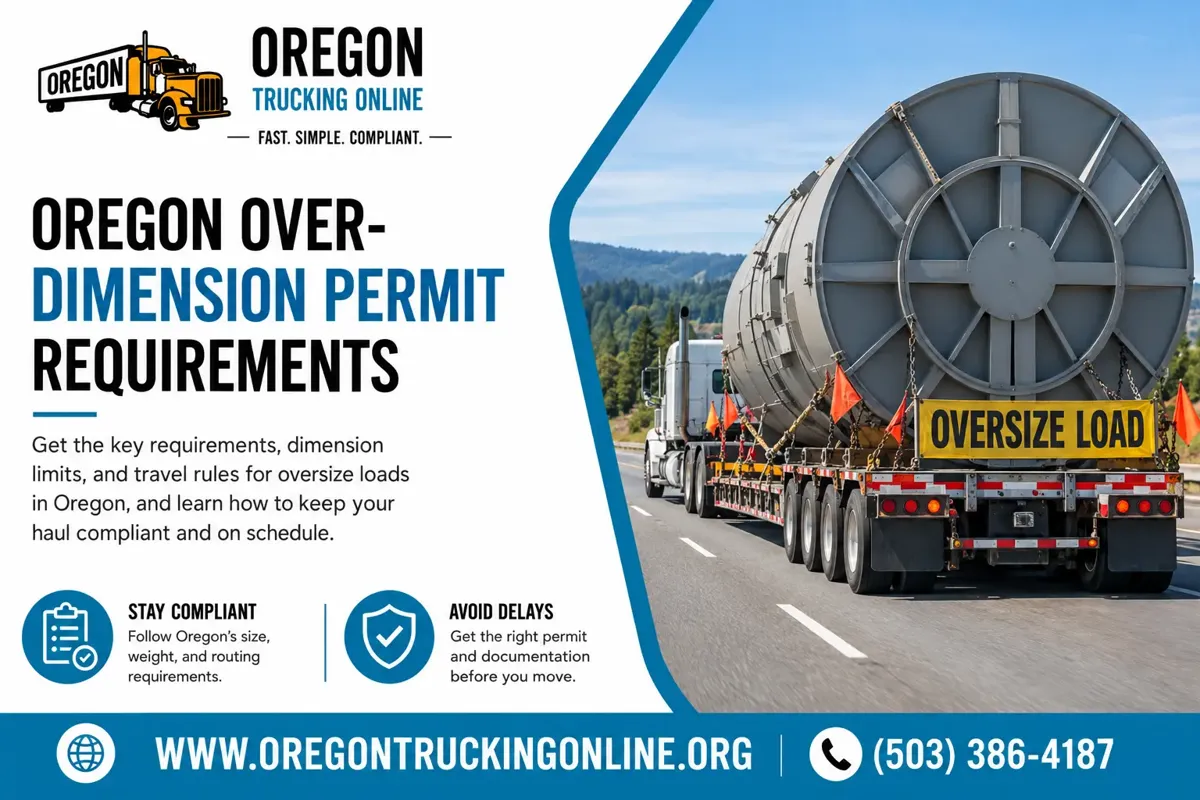
An Over-Dimension (OD) Permit is required when a commercial vehicle exceeds Oregon’s standard legal size limits:
-
Width: Over 8 ft 6 in (102 inches)
-
Height: Over 14 ft
-
Length: Depends on configuration (typically over 40–65 ft)
-
Overhang: More than 4 ft front or rear
Any load that exceeds these limits must obtain an appropriate ODOT oversize permit before operating on public roads.
Key Oregon Over-Dimension Permit Types
1. Single-Trip Over-Dimension Permit
Allows one-time movement from Point A to Point B.
Best for:
-
Construction machinery
-
Prefabricated structures
-
Specialized equipment
2. Annual Over-Dimension Permit
Allows repeated movements for qualifying loads over 12 months.
Common uses:
-
Logging operations
-
Utility companies
-
Heavy equipment fleets
3. Continuous Operation Permits
Available for certain equipment types (e.g., mobile cranes, well-drilling machinery) that frequently travel on Oregon highways.
Legal Dimension Limits Without a Permit
Width
-
Max: 8 ft 6 in
-
Mirrors and some safety devices may exceed by small allowances.
Height
-
Max: 14 ft
-
Loads over 14 ft typically require route restrictions due to bridges and power lines.
Length
Varies by vehicle type:
-
Straight truck: 40 ft
-
Truck + trailer: 65 ft
-
Semitrailer: 53 ft (some exceptions)
Longer combinations require a permit.
Pilot Car & Escort Requirements
Oversize loads may require escorts, depending on width, height, or route.
Typical thresholds:
-
Width over 12 ft: Usually 1 or 2 escorts
-
Height over 14 ft 6 in: May require a route survey and pilot car
-
Extreme lengths: More escorts may be needed
Escort vehicle certifications are mandatory in Oregon.
Travel Time Restrictions
Depending on size, certain restrictions apply:
-
Loads over 12 ft wide: Often limited to daylight hours
-
Holiday travel: Restricted for large loads
-
Inclement weather: Travel may be suspended based on wind or visibility
ODOT road conditions are updated frequently to manage oversize travel safely.
Required Information for an OD Permit
To apply, carriers typically must provide:
-
Vehicle configuration
-
Overall dimensions (height, width, length, weight)
-
Axle spacing and axle weights (if overweight)
-
Load description (divisible or non-divisible)
-
Requested route
-
Insurance and USDOT information
How to Apply for an Over-Dimension Permit
Carriers can obtain Oregon permits through:
1. www.oregontruckingonline.org
Allows registration, permit ordering, and WMT reporting.
2. ODOT Commerce & Compliance Division (CCD)
Permits may also be requested via:
-
Telephone (503) 386-4187
Special Route Restrictions
-
Many highways have height restrictions due to low bridges.
-
Mountain passes may be restricted in winter.
-
Certain roads prohibit loads over specific lengths or widths.
Route maps must be reviewed carefully to avoid violations.
Penalties for Operating Without a Permit
Penalties may include:
-
Heavy fines
-
Immediate vehicle shutdown
-
Required re-routing or off-loading
-
Suspension of Oregon account privileges
Compliance is essential to keep freight moving legally.
Summary
An Oregon Over-Dimension Permit is required anytime a commercial vehicle exceeds standard legal size limits. Understanding width, height, length, routing, escort, and travel-time rules ensures safe and compliant transport across the state. ODOT’s permitting system provides several options—single-trip, annual, and continuous—to support all types of oversize operations.