1. Regulating Authority & Permit Type
-
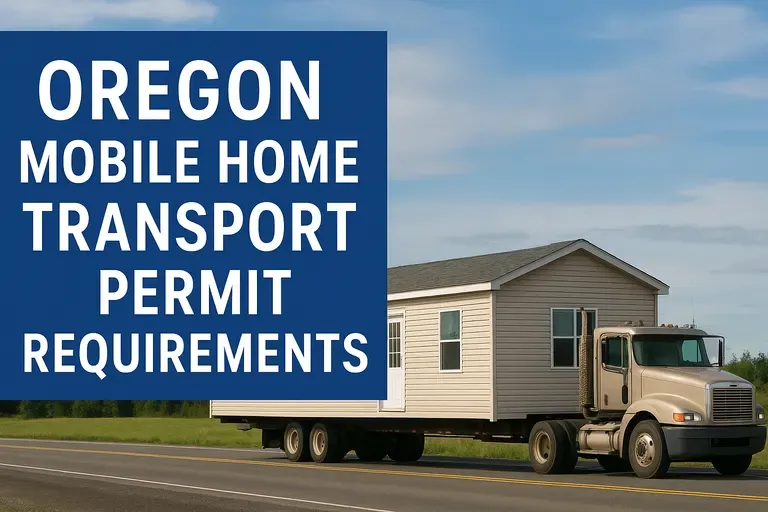
In Oregon, transporting a mobile home, modular building, or chassis unit requires a special transportation permit.
-
The relevant regulations fall under Oregon Administrative Rules (OAR) Chapter 734, Division 75 (“Over-Dimensional Mobile Homes and Modular Building Units”).
-
The permit form for mobile homes is referred to as Attachment 75A.
2. Registration and Weight Declaration
-
Even with the permit, the transporting vehicle must be properly registered and have declared tax/weight appropriately.
-
The permit does not override the vehicle’s registration weight — you cannot carry more than what the vehicle was declared to weigh for tax/registration.
3. Carrier & Driver Responsibilities
-
The permittee (the company or person who holds the permit) and driver are liable for any damage to persons, property, or highway structures due to the transport.
-
They must ensure adequate vertical and horizontal clearance, including contacting utilities (e.g., telephone, cable) if needed, to confirm there’s no risk of hitting wires or structures.
-
In the event of an accident (e.g., hitting a bridge or structure), Oregon requires the carrier to report to the Over-Dimension Permit Unit within 24 hours.
-
Drivers may be required to enter weigh scales when directed, even if they have a green light from a transponder.
4. Size Limits & Escort (Pilot Car) Requirements
-
Width: If the base width (the main body of the mobile home) exceeds 14 feet, or the overall width is more than 15 feet, there are stricter permit conditions.
-
According to Oregon’s Pilot Car Guide, for certain width thresholds, two-lane highways may require two front and one rear pilot (escort) vehicles, depending on the district.
-
When a mobile home exceeds 14 ft base width, it must travel only in the right lane on highways (unless permit or traffic conditions dictate otherwise).
-
ODOT may require a traffic control plan for very wide moves (for example, base width over 14 ft or overall width over 15 ft) on two-lane roads.
5. Lighting and Markings
-
Over-width mobile homes (beyond certain width) must have clearance lights: specifically, two flashing amber lights mounted on the rear corners of the eave (if the eave extends significantly).
-
These required lights must be:
-
On a horizontal plane at least 8 feet above the road, and
-
Visible from 500 feet.
-
6. Time, Day & Route Restrictions
-
The movement of mobile homes is subject to travel time restrictions as specified in “Attachment H” of the permit rules.
-
These restrictions exist to avoid conflict with local traffic patterns, construction, and seasonal conditions.
-
For very large or wide mobile homes, a pre-approved route is required, meaning the permit will specify exactly which highways or roads can be used.
7. Insurance, Bonding & Liability
-
Carriers may be required to provide proof of liability and property damage insurance, depending on the permit conditions.
-
In some cases, a surety bond or certified check is required to cover potential damages to highways or structures.
-
The permittee is wholly responsible for any damage to roadway or structures caused by the movement.
8. Reporting Requirements
-
If the load strikes a structure or utilities, the carrier must report within 24 hours.
-
This helps ODOT assess damage and enforce accountability.
9. Rule Changes & Updates
-
Oregon’s rules for mobile home transport are periodically updated. For example, recent changes to OAR 734-075-0037 and other provisions affect the requirement for traffic control plans and lighting.
-
It’s critical to check the latest version of ODOT’s rules and permit attachments when applying.
Best Practices for Carriers / Shippers
-
Consult early — Before committing to a move, speak with www.oregontruckingonline.org OR call (503) 386-4187
-
Do a route survey — Physically or virtually check the planned route for bridges, overhead obstacles, and narrow roads.
-
Arrange pilot cars — Depending on width, you may need front and rear escorts. Plan and book them in advance.
-
Ensure visibility — Install all required warning lights, including flashing amber clearance lights if needed.
-
Get proper insurance or bonding — Be ready to show proof of coverage or post a bond for permit issuance.
-
Have a contingency plan — Prepare for what to do if there’s a structure strike or unexpected obstacle; know how to report incidents quickly.