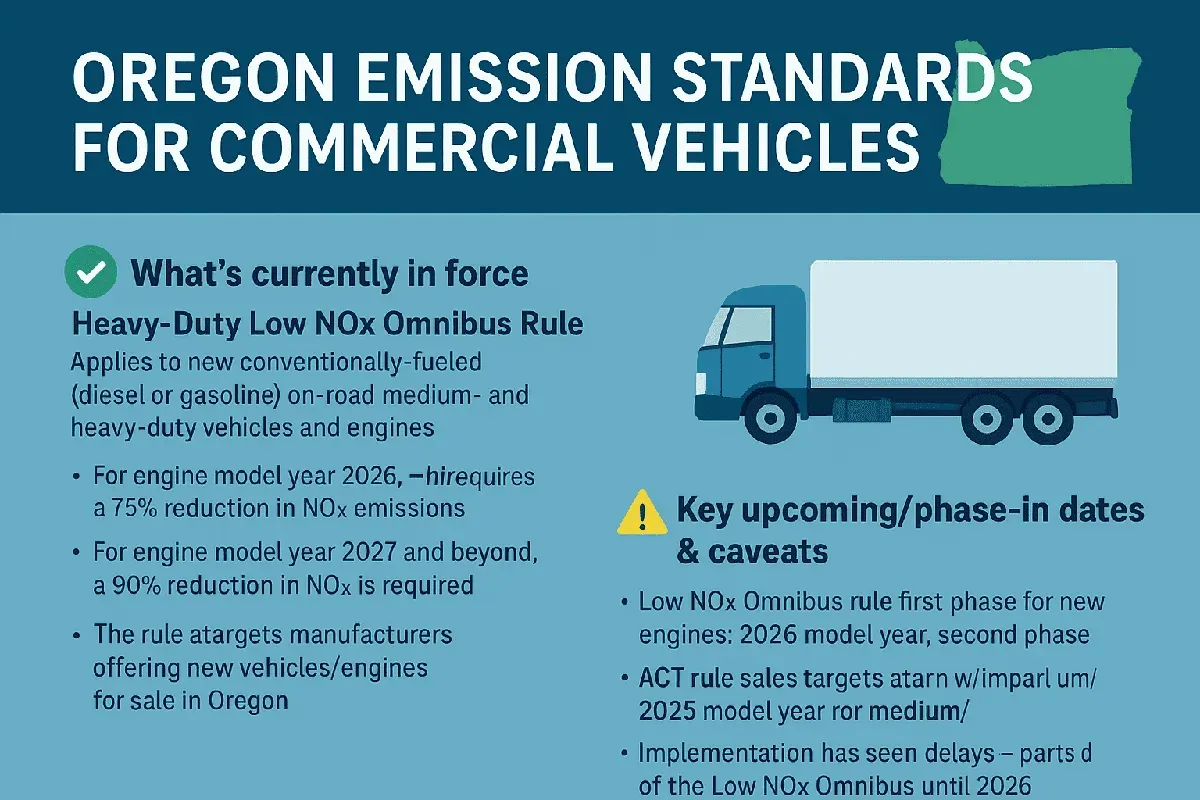
What’s Currently in Force
-
Under the Oregon Department of Environmental Quality (“DEQ”), the so-called Heavy‑Duty Low NOₓ Omnibus Rule (also sometimes called the “Low NOₓ Omnibus”) applies to new conventionally-fueled (diesel or gasoline) on-road medium- and heavy-duty vehicles and engines.
-
For engine model year 2026, this rule requires a ~75% reduction in NOₓ emissions and ~50% reduction in PM₂.₅ compared with 2023 engines.
-
For engine model year 2027 and beyond, a ~90% reduction in NOₓ is required.
-
The rule is targeted at manufacturers offering new vehicles/engines for sale in Oregon—i.e., those selling new medium- and heavy-duty vehicles.
-
-
The Advanced Clean Trucks Rule (ACT) applies to manufacturers of medium- and heavy-duty vehicles (Classes 2b–8).
-
The rule requires increasing percentages of zero-emission (ZEV) or near-zero vehicles in new sales starting with model year 2025.
-
Note: This rule does not ban the sale of diesel or gasoline trucks—it sets a sales target/quota for ZEVs.
-
-
There are also fleet-average greenhouse gas (GHG) and non-methane organic gas (NMOG) + NOₓ standards for certain vehicles (light/medium-duty) under Oregon regulations that adopt California standards.
Key upcoming/phase-in dates & caveats
-
The Low NOₓ Omnibus rule first phase for new engines: 2026 model year; second phase: 2027 model year.
-
The ACT rule’s sales targets begin with the 2025 model year for medium/heavy duty vehicles.
-
Implementation has seen delays/flexibility: e.g., temporary rule delaying parts of the Low NOₓ Omnibus until 2026.
-
Because these rules are built to align with California Air Resources Board (CARB) standards under Section 177 of the Federal Clean Air Act, changes in federal or California policy may impact how they are enforced in Oregon.
What this means for commercial vehicle operators / fleets
-
If you operate or purchase new medium- or heavy-duty trucks in Oregon (or sell them), you need to pay attention to the manufacturer’s offerings: as engine standards tighten, fewer conventional engines (diesel/gasoline) may meet the new emissions limits from 2026-27 onwards.
-
For fleet owners: even if you are not required to immediately purchase only ZEVs, the vehicle market will change as manufacturers shift to comply with the sales quotas for ZEVs.
-
Infrastructure and vehicle availability may lag behind the regulatory deadlines; flexibility and delays are already built in.
-
If you sell or import vehicles, you need to ensure that the vehicle or engine is certified to the requisite standard (especially for new vehicles) for sale in Oregon.