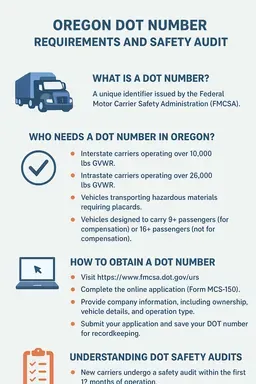
Oregon DOT Number Requirements and Safety Audits
1. What Is a DOT Number?
A U.S. Department of Transportation (USDOT) Number is a unique identifier issued by the Federal Motor Carrier Safety Administration (FMCSA). It tracks a carrier’s:
-
Safety record
-
Compliance with regulations
-
Vehicle inspections
-
Crash reports and audits
In Oregon, both interstate and certain intrastate commercial carriers must have a DOT number before operating legally.
2. Who Needs a DOT Number in Oregon?
You are required to have a DOT number if your vehicle or fleet meets any of these conditions:
✅ Interstate carriers (crossing state lines) operating commercial vehicles over 10,000 lbs GVWR
✅ Intrastate carriers in Oregon operating vehicles over 26,000 lbs GVWR
✅ Vehicles transporting hazardous materials that require placards
✅ Vehicles designed to carry 9+ passengers (for compensation) or 16+ passengers (not for compensation)
If your trucking company only operates within Oregon and does not meet these thresholds, you may not need a DOT number — but other state permits and registrations may still apply.
3. How to Obtain a DOT Number in Oregon
You can register for a USDOT number through the FMCSA Unified Registration System (URS):
Steps:
-
Visit https://www.fmcsa.dot.gov/urs
-
Complete the online application (Form MCS-150)
-
Provide company information — including ownership, vehicle details, operation type, and cargo
-
Submit your application and save your DOT number for recordkeeping
Processing Time: Most DOT numbers are issued immediately upon online submission.
4. Oregon’s State-Level DOT Rules
The Oregon Department of Transportation (ODOT) enforces federal DOT rules and may impose additional requirements for intrastate carriers.
-
ODOT’s Motor Carrier Transportation Division (MCTD) oversees vehicle registration, fuel tax reporting, and safety compliance.
-
Intrastate carriers must maintain their Oregon Motor Carrier Account with ODOT.
-
Oregon also monitors USDOT safety ratings to determine carrier eligibility for permits and renewals.
5. Understanding DOT Safety Audits
After receiving a DOT number, new carriers are subject to a New Entrant Safety Audit within the first 12 months of operation.
The audit checks:
-
Driver qualification files
-
Hours of Service (HOS) and ELD records
-
Vehicle maintenance logs
-
Drug and alcohol testing program
-
Insurance and accident reports
If issues are found, you’ll receive a Corrective Action Plan (CAP) and must resolve violations promptly to maintain your operating authority.
6. Common DOT Violations in Oregon
Carriers operating in Oregon often face penalties for:
Failing to update MCS-150 registration every 2 years
Incomplete driver qualification files
Operating without valid medical certificates
Hours-of-Service violations or falsified logs
Vehicle maintenance deficiencies
Repeated or serious violations can result in fines, out-of-service orders, or revocation of operating authority.
7. Maintaining Compliance and Safety Ratings
To protect your safety rating and stay in good standing:
✅ Update your MCS-150 regularly
✅ Conduct routine vehicle inspections and keep maintenance records
✅ Train drivers on HOS, ELD, and drug testing rules
✅ Monitor CSA (Compliance, Safety, Accountability) scores via FMCSA’s portal
✅ Respond promptly to any audit or violation notice
Staying proactive not only ensures compliance but also builds your company’s credibility with clients, insurers, and regulators.
8. Key Takeaway
Oregon’s DOT Number requirements and safety audits form the backbone of a safe, transparent, and efficient trucking system.
Whether you’re a new carrier or an established fleet, maintaining compliance with both FMCSA and ODOT standards is essential for long-term success on Oregon’s roads.