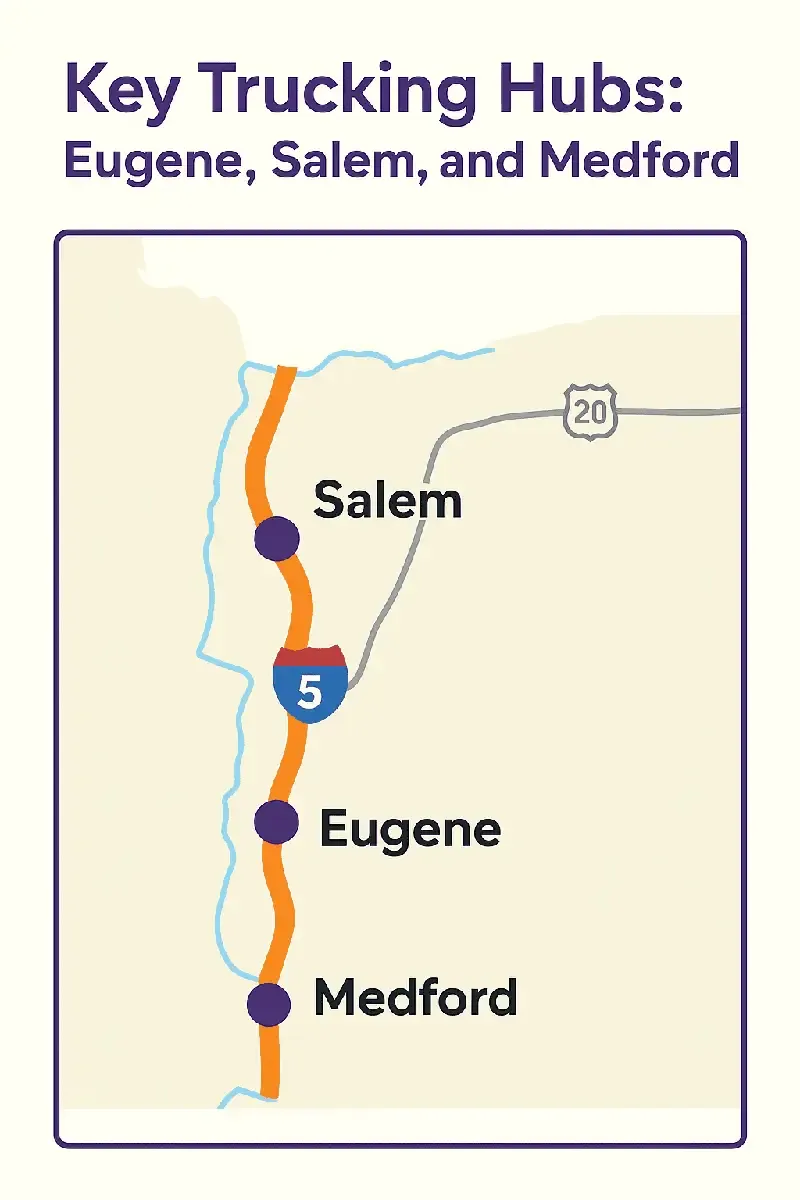
Key Trucking Hubs: Eugene, Salem, and Medford
Overview
Oregon’s trucking industry thrives on a strong network of regional hubs that connect agricultural, industrial, and retail sectors across the state.
Among them, Eugene, Salem, and Medford stand out as critical trucking and logistics centers, each serving unique roles in the state’s freight movement and regional economy.
Eugene: Central Distribution Gateway
-
Strategic Location: Situated along I-5, Eugene acts as a midpoint between Portland and Southern Oregon.
-
Industries Served: Timber, manufacturing, food processing, and technology.
-
Freight Facilities: Home to multiple distribution centers and third-party logistics (3PL) providers, offering warehouse and cross-docking services.
-
Access: Direct connections to I-105 and Oregon Route 126 provide efficient routes to coastal and central regions.
-
Economic Role: Supports freight movement between northern Oregon ports and California markets.
Salem: State Capital and Industrial Hub
-
Government & Infrastructure: As Oregon’s capital, Salem is a center for state freight planning and permitting.
-
Industries Served: Food processing, agriculture, construction materials, and public-sector logistics.
-
Connectivity: I-5 provides direct access north to Portland and south to Eugene, while Highways 22 and 99E expand east-west access.
-
Distribution Role: Serves as a major staging area for retail and wholesale distribution across the Willamette Valley.
-
Key Facilities: Several industrial parks and freight terminals handle regional deliveries and less-than-truckload (LTL) operations.
Medford: Southern Oregon’s Freight Lifeline
-
Geographic Importance: Located near the California border, Medford acts as Oregon’s southern freight entry point.
-
Industries Served: Agriculture, lumber, and healthcare supplies.
-
Freight Advantages: I-5 and Highway 62 link Medford to Northern California, Portland, and the Pacific Coast.
-
Regional Impact: Critical for cross-border trucking between Oregon and California; supports produce exports and interstate logistics.
-
Infrastructure: The Rogue Valley International–Medford Airport and nearby intermodal terminals enhance multimodal freight options.
Combined Importance
Together, Eugene, Salem, and Medford form a tri-hub trucking network that:
-
Connects rural production zones to ports and distribution centers.
-
Reduces freight congestion in Portland’s metro area.
-
Supports Oregon’s agricultural, timber, and manufacturing exports.
-
Strengthens Oregon’s role in I-5’s Pacific freight corridor.
Conclusion
Eugene, Salem, and Medford are not just cities — they are logistics engines driving Oregon’s trucking economy.
By linking local industries to regional and interstate markets, these hubs keep freight flowing smoothly across the Pacific Northwest and beyond.