How to Calculate and Record Miles for Oregon Weight-Mile Tax Compliance
Table of Contents
-
Introduction
-
What is the Oregon Annual Weight-Mile Tax Program?
-
How to Calculate Your Oregon Weight-Mile Tax
-
Step-by-Step: Keeping Accurate Mileage and Route Records
-
Common Mistakes That Trigger Audits (And How to Avoid Them)
-
Why Choose Our Service for Weight-Mile Tax Compliance
-
Frequently Asked Questions
Introduction
Operating a commercial motor vehicle across state lines requires balancing a lot of moving parts. Drivers must safely secure cargo, manage tight delivery windows, and keep up with state-specific regulations. If your routes take you through the Pacific Northwest, you quickly realize that Oregon does things a bit differently.
Unlike most states that collect fuel taxes at the pump through the International Fuel Tax Agreement (IFTA), Oregon relies primarily on a distance-and-weight framework. If your commercial vehicle operates on Oregon public highways, tracking every mile you drive within the state isn't just good business practice; it is a legal requirement.
Miscalculating your mileage or keeping sloppy records can quickly lead to costly fines, late fees, or stressful state compliance audits. This guide will walk you through exactly how the system works, how to calculate your taxes accurately, and how to maintain straightforward records that keep your fleet fully compliant.
What is the Oregon Annual Weight-Mile Tax Program?
The Annual Weight-Mile Tax Program is Oregon’s unique method for funding highway maintenance. The core philosophy is simple. Heavier vehicles cause more wear and tear on roads, so trucks pay a tax rate based directly on their configured weight and the number of miles they travel within the state.
Who Needs to Participate?
Any commercial vehicle with a combined gross weight of more than 26,000 pounds must pay for its road usage. Depending on how often you drive through Oregon, you have two primary options:
-
Temporary Weight-Mile Permits: Best for out-of-state carriers who only enter Oregon occasionally. These single-trip passes allow you to pay on a per-trip basis.
-
The Annual Weight-Mile Tax Program: Designed for carriers who regularly or permanently operate within the state. Instead of purchasing temporary permits for every single entry, enrolled carriers establish an account and file monthly or quarterly mileage tax reports.
It is important to understand that enrolling in the annual program does not exempt you from tracking your data. Rather, it shifts you into a system where accurate record-keeping is vital to your ongoing operations.
How to Calculate Your Oregon Weight-Mile Tax
Calculating your tax liability involves two core metrics: declared weight and Oregon taxable miles.
1. Determine Your Tax Rate (Declared Weight)
Oregon provides official tax tables that assign a specific cost per mile based on your vehicle's registered combined weight or the maximum weight you declare you will carry.
-
Rates start at 26,001 pounds and scale up incrementally.
-
Vehicles carrying standard configurations up to 80,000 pounds follow a standard rate table.
-
Heavy-haul setups or vehicles operating under special over-dimensional permits with weights exceeding 80,000 pounds use separate tables based on the number of axles on the ground.
2. Track Your Actual In-State Miles
The tax applies only to miles driven on public highways within the borders of Oregon. You do not pay Oregon weight-mile taxes for miles driven on private logging roads or private facility properties or while driving through neighboring states like Washington or California.
The Tax Calculation Math
Once you know your per-mile rate from the state table and your exact odometer distance for the reporting period, you can use this simple calculation formula:
Plaintext
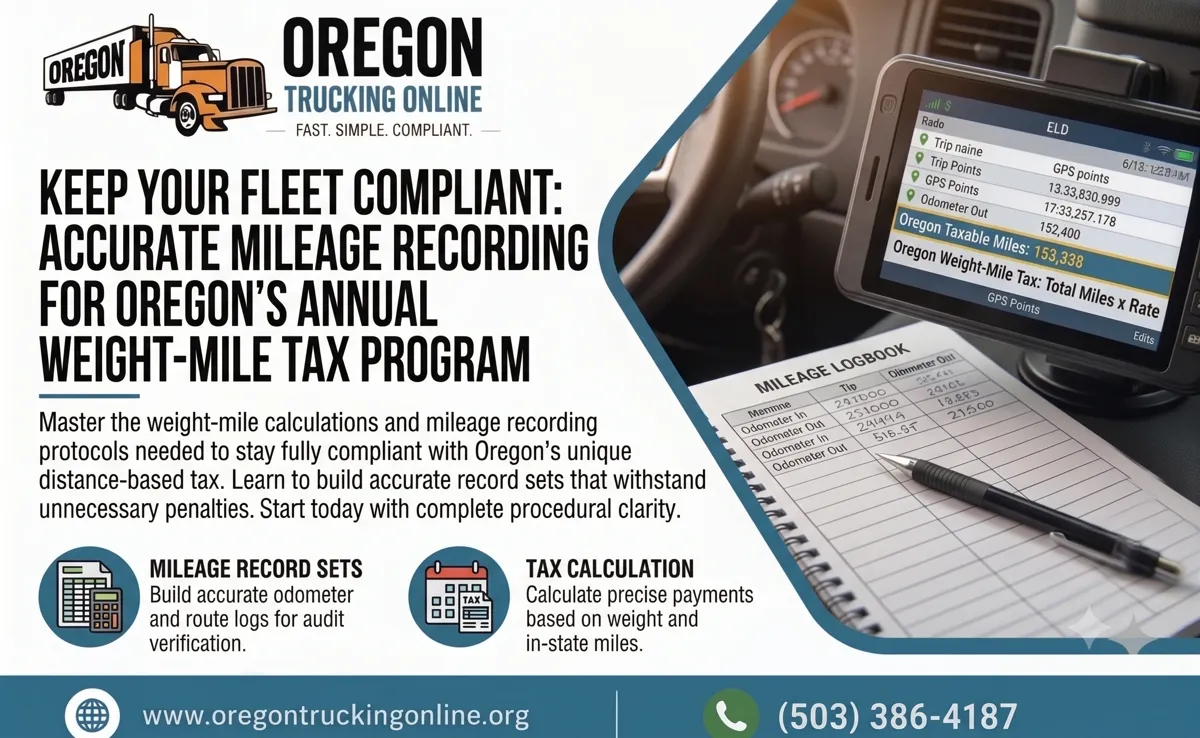
Total Oregon Miles x State Tax Rate per Mile = Total Weight-Mile Tax Owed
For example, if a standard 80,000-pound truck drives exactly 1,500 miles on public roads in Oregon during a month, the carrier multiplies those 1,500 miles by the corresponding per-mile rate set by the state to find the exact payment due.
Step-by-Step: Keeping Accurate Mileage and Route Records
To ensure your calculations hold up under state review, you need a structured workflow for gathering and storing trip data. Whether you manage a single truck or a large fleet, your documentation should follow these core steps:
1. Record Odometer Readings at the Border:
Every time a truck crosses the state line into Oregon, the driver must record the exact odometer reading, the date, the time, and the specific entry point, such as I-5 at the California border or I-84 at the Idaho border. The same protocol applies when exiting the state. These border points establish your base mileage envelope for the trip.
2. Log Daily Trip Details:
For every operational day inside Oregon, keep a detailed log containing the origin and destination of each trip segment; the specific routes traveled (e.g., I-5 North to Highway 20 East); beginning and ending odometer readings for the day; and the unique vehicle identification number (VIN) or fleet unit number.
3. Integrate ELD Data Wisely:
Electronic Logging Devices (ELDs) and GPS tracking systems are excellent tools for cross-referencing driver logs. However, automated systems can occasionally glitch or misattribute a border crossing point. Review your digital telematics weekly against physical driver logs to ensure the system accurately registers when a vehicle transitions from interstate to intrastate mileage.
4. Archive Your Documents:
Oregon law requires carriers to preserve their detailed mileage source documents, trip sheets, and tax reports for at least four years. Keep these files organized chronologically so they are easily accessible if the state requests a review.
Common Mistakes That Trigger Audits (And How to Avoid Them)
Most compliance issues do not stem from intentional tax evasion; they happen because of simple administrative errors. Avoiding these three common pitfalls will protect your business from unnecessary penalties:
-
Odometer Gaps: If the ending odometer reading of Trip A does not perfectly match the starting odometer reading of Trip B, it indicates untracked miles. Ensure personal use, maintenance trips, and empty deadhead miles are fully documented.
-
Mismatched Fuel and Weight Records: Oregon auditors frequently check weight-mile filings against IFTA reports and fuel receipts from neighboring states. If your IFTA report indicates you bought fuel right on the border but your weight-mile log claims you didn't enter Oregon until the next day, it creates an immediate red flag.
-
Confusing Declared Weight with Actual Weight: Your tax rate is determined by your declared operational weight, not what the scale house reads on a specific afternoon. If your truck is registered for 80,000 pounds but you run empty at 35,000 pounds on the return trip, you must still pay the 80,000-pound rate for those return miles.
Why Choose Our Service for Weight-Mile Tax Compliance
Navigating the unique rules of the Annual Weight-Mile Tax Program can feel overwhelming, especially when you are focused on keeping your trucks moving and managing daily logistics. One small clerical mistake can disrupt your business operations.
At Oregon Trucking Online, we simplify the entire compliance process for owner-operators and fleet managers alike. We cut through the red tape so you can focus on the road ahead:
-
Fast Registration: We handle the paperwork to get your business properly enrolled in the Oregon weight-mile system without delays.
-
Accurate Submissions: Our experienced team helps ensure your mileage data is processed cleanly, eliminating the guesswork that often leads to errors.
-
Comprehensive Support: From single-trip temporary permits to permanent annual accounts, we provide a single, dependable point of contact for all your Oregon compliance needs.
Let us manage the paperwork so you can manage your business.
FAQ
Who needs an Oregon Weight-Mile Tax permit?
Any carrier operating a commercial motor vehicle (or a combination of vehicles) with a combined gross weight exceeding 26,000 pounds on Oregon public roads must have a valid permit and pay weight-mile taxes. This applies to both local intrastate carriers and interstate trucks passing through the state.
How often do I have to file reports under the Annual Weight-Mile Tax Program?
Carriers enrolled in the annual program are automatically set up on a monthly tax reporting schedule. However, if you maintain twelve consecutive months of clean, on-time filings without account suspensions or payment issues, you can apply to switch your account to a quarterly reporting schedule.
Do I need to file a report if my trucks did not enter Oregon this month?
Yes. As long as your annual account remains active, you are legally required to file a report for every single period. If you had zero operations within the state lines, you must submit a zero-miles report. Failing to file a zero report will still result in automated system penalties and a potential account suspension.