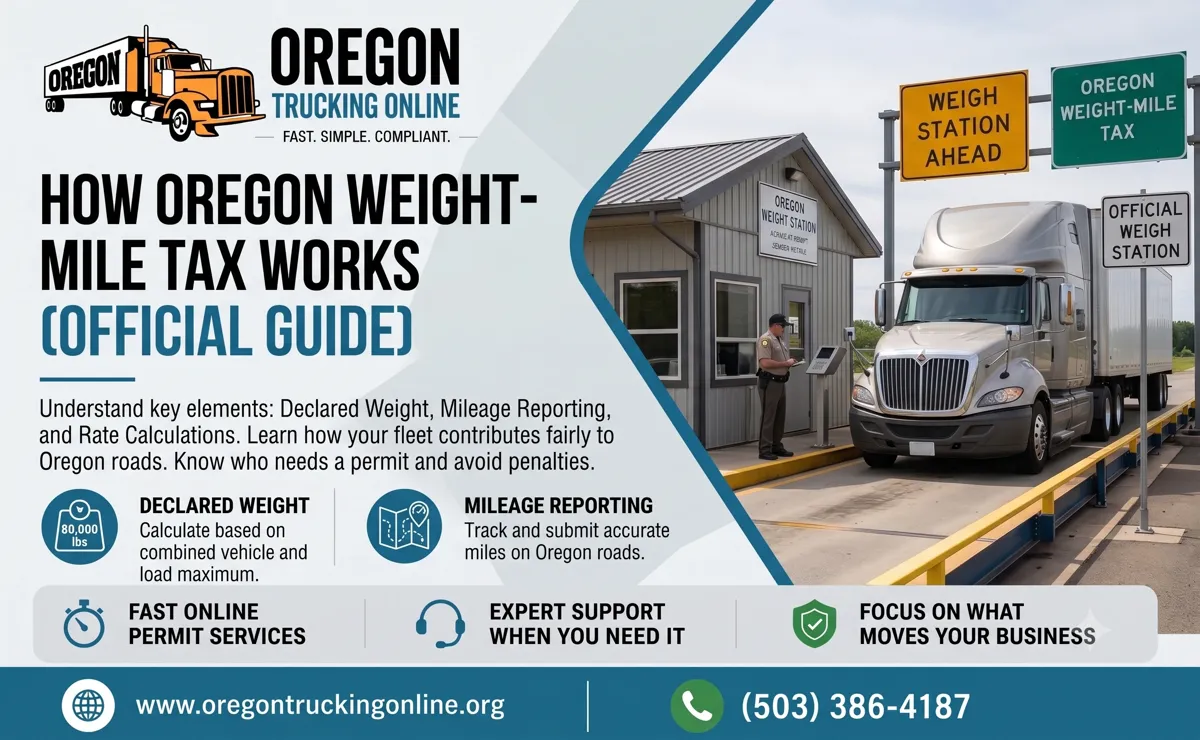
How Oregon Weight-Mile Tax Works (Official Guide)
Table of Contents
-
Introduction
-
What is the Oregon Weight-Mile Tax?
-
Who Needs to Pay Weight-Mile Tax?
-
How is the Tax Calculated?
-
Reporting and Filing Requirements
-
Why Accuracy Matters for Trucking Businesses?
-
Why Choose Oregon Trucking Online for Weight-Mile Tax Compliance?
-
Frequently Asked Questions (FAQ)
Introduction
Operating a commercial vehicle across state lines comes with plenty of administrative responsibilities, but Oregon handles its highway funding a bit differently from most other states. Instead of collecting standard fuel taxes at the pump for heavy vehicles, the state utilizes a distance-based tax system.
Navigating these regulations can feel overwhelming if you are new to the state or trying to keep your fleet compliant. This guide breaks down exactly how the Oregon weight-mile tax works, who needs to pay it, and how to keep your trucking business running smoothly without unexpected fines or confusion over your Oregon road tax obligations.
What is the Oregon Weight-Mile Tax?
The primary keyword to understand here is the Oregon weight-mile tax, often referred to as the Oregon highway use tax or Oregon road tax. This is a mileage-based fee assessed on commercial vehicles operating on Oregon public highways. The purpose of this system is to ensure that heavy vehicles contribute fairly to the maintenance and repair of the roads they use, as heavier trucks naturally cause more wear and tear on infrastructure.
Because Oregon relies on this distance-based system, commercial vehicles subject to this tax are exempt from paying state fuel taxes at the pump. When you fill up your truck within the state, you will notice that the fuel price does not include the standard state tax, provided you have a valid account and your vehicle qualifies.
Who Needs to Pay Weight-Mile Tax?
The rule of thumb for Oregon is straightforward: if your commercial vehicle or combination of vehicles has a declared combined weight of more than 26,000 pounds, you are subject to the tax. This applies whether you are an intra-state carrier operating solely within Oregon borders or an inter-state carrier just passing through.
However, there are a few nuances to keep in mind:
-
Regular Operators: If you frequently drive through the state, registering for the permanent Oregon annual weight-mile tax program is typically the most efficient route.
-
Occasional Visitors: If you only make rare trips into the state, you might want to compare your options. Looking at an Oregon 10-day trip permit vs. a weight-mile tax permit can help you decide if a temporary pass makes more sense for your specific route schedule.
-
Exemptions: Certain vehicles, such as those used for specific agricultural, government, or localized operations, may be exempt from these requirements. You can read a full breakdown in our guide to Oregon weight-mile tax exemptions.
How is the Tax Calculated?
The state determines your specific tax liability using two main metrics: the declared combined weight of the vehicle and the exact distance traveled within Oregon borders.
-
Declared Combined Weight: This is the maximum weight at which the vehicle will operate in Oregon, including the weight of the truck, trailer, and the heaviest load it will carry.
-
Miles Driven: You must track every mile your vehicle travels on public roads within Oregon.
The state provides a statutory chart assigning an Oregon mileage rate (a specific cost per mile) to different weight brackets. As your truck's declared weight increases, the rate per mile increases as well. To find your total tax owed for a reporting period, you simply multiply the total miles driven by the specific rate assigned to your vehicle’s weight class.
(Note: Sometimes carriers mistakenly look up terms like "Oregon weight-file tax" due to common clerical typos, but the calculation rules always lead back to the standard weight-and-mileage tables managed by the state.)
Reporting and Filing Requirements
Keeping up with paperwork is an essential part of compliance. Once registered, carriers receive an Oregon CCD account number (Commerce and Compliance Division number), which acts as their primary identifier for all tax filings.
Filing is typically handled every month. Carriers must submit a report detailing the exact mileage covered by each registered vehicle alongside the corresponding tax payment. Even if your trucks did not enter the state during a particular month, you are still required to file a "zero-activity" report to keep your account active and in good standing.
Why Accuracy Matters for Trucking Businesses?
Precision in your mileage logs and weight declarations is non-negotiable. The Oregon Department of Transportation (ODOT) regularly conducts audits to ensure carriers are reporting honestly and accurately.
Inaccurate records, whether accidental or due to poor tracking habits, can lead to severe consequences. If an audit reveals underreported mileage or incorrect weight declarations, your business could face hefty back taxes, penalties, and interest charges. Furthermore, serious or repeated compliance issues can result in the suspension of your operating authority, putting your entire business on hold.
Why Choose Oregon Trucking Online for Weight-Mile Tax Compliance?
Managing distance tracking, rate tables, and monthly deadlines can quickly drain time that you should be spending on the road or growing your business. That is where Oregon Trucking Online comes in.
We simplify the administrative burden of staying compliant. Our streamlined platform takes the confusion out of the process, helping you manage filings quickly without needing a degree in tax law. Whether you need to initiate a new permit application or access your existing records, everything is organized in one user-friendly space.
Ready to simplify your paperwork? Existing users can head straight to our sign-in page to update records, while new carriers can get started with us today to ensure their operations remain fully legal and audit-ready.
FAQ
Who needs an Oregon Weight-Mile Tax Permit?
Any carrier operating a commercial motor vehicle (or a combination of vehicles) with a declared combined gross weight exceeding 26,000 pounds on Oregon public highways needs this permit.
How do I apply for an Oregon Weight-Mile Tax Permit?
You can apply directly through our platform by completing the online permit application. We help guide you through the process to ensure all your truck and weight details are submitted accurately to the state.
How long is an Oregon Weight-Mile Tax Permit valid?
Permanent permits issued under the annual program remain active as long as the carrier maintains a valid Oregon CCD account number, files their mandatory monthly mileage reports on time, and keeps their account payments up to date.
How is the Oregon Weight-Mile Tax calculated?
The tax is calculated by multiplying the total number of miles a vehicle travels on Oregon roads by the specific fee rate assigned to the vehicle's declared combined weight bracket. Higher weights carry a higher cost per mile.
What happens if I drive in Oregon without a Weight-Mile Tax Permit?
Operating a qualified vehicle without a permit can lead to immediate roadside citations, significant monetary fines, and the potential impoundment of your vehicle. It can also flag your business for future DOT audits, disrupting your long-term operations.