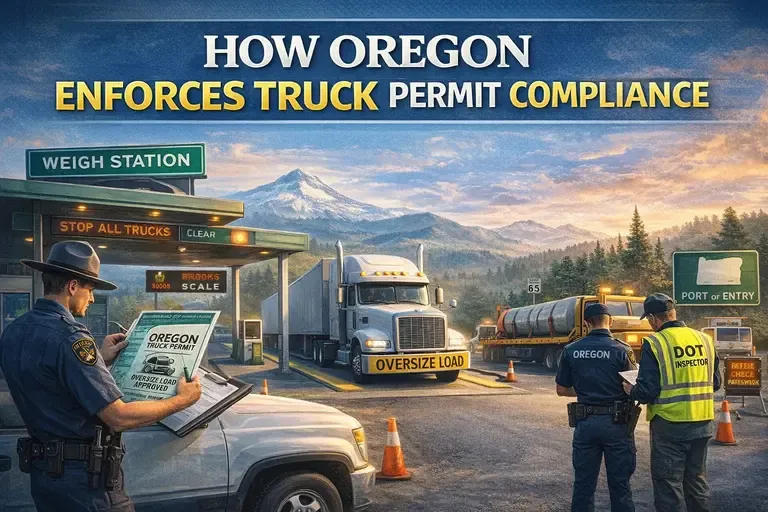
1. Primary Enforcement Agencies in Oregon
Truck permit compliance in Oregon is enforced by multiple agencies:
-
Oregon Department of Transportation (ODOT)
-
Issues oversize/overweight permits
-
Sets routing, travel time, and escort requirements
-
-
Oregon State Police – Commercial Vehicle Enforcement (OSP-CVE)
-
Conducts roadside inspections
-
Enforces permits, weights, and dimensions
-
-
Oregon Department of Revenue (ODR)
-
Enforces Weight-Mile Tax (WMT) compliance
-
These agencies often work together at fixed locations and during mobile enforcement operations.
2. Weigh Stations and Fixed Inspection Sites
Oregon operates numerous permanent weigh stations on major highways and freight corridors.
At weigh stations, officers verify:
-
Oversize/overweight permits
-
Axle, gross, and bridge weights
-
Proper permit routing
-
Required signage, flags, and lighting
-
Weight-mile tax credentials
Failure to stop or bypassing a weigh station can result in severe penalties.
3. Mobile Enforcement and Roadside Inspections
Oregon uses mobile enforcement units, meaning trucks can be stopped:
-
On highways
-
At rest areas
-
Near construction zones
-
On secondary or rural routes
Officers may check:
-
Permit validity and conditions
-
Escort vehicle compliance
-
Load securement
-
Safety equipment
-
Driver credentials
4. Permit Verification and Route Enforcement
Oregon permits are route-specific.
Enforcement officers actively check:
-
Whether the truck is traveling on the approved permit route
-
Compliance with bridge and road restrictions
-
Unauthorized detours
Being off-route—even unintentionally—can lead to:
-
Citations
-
Permit cancellation
-
Forced re-routing or unloading
5. Oversize / Overweight Permit Enforcement
For oversize and overweight loads, enforcement focuses on:
-
Dimensions (width, height, length)
-
Gross and axle weights
-
Time-of-day and day-of-week restrictions
-
Escort vehicle requirements
Loads exceeding permit limits may be:
-
Placed out of service
-
Required to reduce weight
-
Delayed until proper permits are obtained
6. Weight-Mile Tax (WMT) Enforcement
Oregon does not participate in IFTA fuel tax for in-state travel. Instead, it uses the Weight-Mile Tax system.
Enforcement includes:
-
Verification of active WMT accounts
-
Mileage reporting accuracy
-
Valid trip permits for non-registered carriers
Weight-mile tax violations often result in hefty fines, even if the truck is otherwise legal.
7. Escort and Safety Compliance Checks
For permitted loads requiring pilot cars, Oregon enforces:
-
Proper number of escorts
-
Certification of pilot car operators
-
Correct signage and communication equipment
-
Positioning of escort vehicles
Improper escort compliance can invalidate the permit.
8. Technology-Based Enforcement
Oregon uses advanced technology, including:
-
Electronic permit verification
-
Weigh-in-motion (WIM) sensors
-
License plate recognition
-
Data sharing between agencies
This allows enforcement officers to identify violations before a truck is stopped.
9. Penalties for Non-Compliance
Violations may result in:
-
Fines and civil penalties
-
Out-of-service orders
-
Load delays and missed deliveries
-
Permit suspension or revocation
-
Increased scrutiny for future permits
Repeat violations can significantly affect a carrier’s compliance history.
10. Best Practices to Avoid Enforcement Issues
-
Obtain permits before entering Oregon
-
Follow approved routes exactly
-
Verify weight-mile tax registration or trip permits
-
Ensure escorts meet state requirements
-
Keep permits accessible in the vehicle
-
Use a permit service for complex or heavy loads
Summary
Oregon enforces truck permit compliance through weigh stations, mobile inspections, permit route monitoring, and tax enforcement. The state’s approach is proactive and technology-driven, making it essential for carriers to fully understand and follow permit conditions.