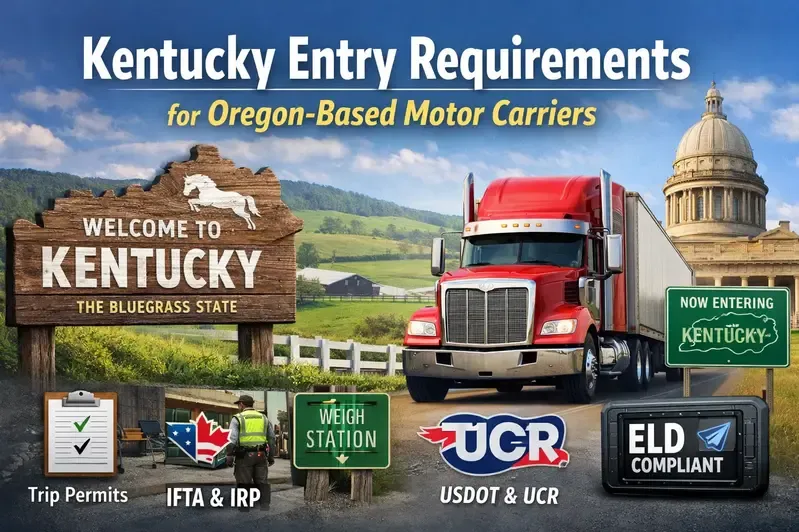
Kentucky Truck Permits Avaliable at https://www.kentuckytruckingonline.com/
1. Interstate Operating Authority (FMCSA – USDOT/MC Numbers)
If you transport goods across state lines, Oregon carriers must have:
-
A valid U.S. DOT Number
-
Interstate operating authority (MC/FF/MX number) from the Federal Motor Carrier Safety Administration (FMCSA)
This federal authority authorizes you to move freight into Kentucky and other states.
2. Kentucky Trip Permits (When Needed)
Kentucky requires out-of-state carriers to obtain trip permits when they are not registered for Kentucky fuel taxes under IFTA:
-
3-Day Trip Permits allow short entry (up to 3 consecutive days) without full registration.
-
Permits are typically required for vehicles not doing enough Kentucky mileage to justify full Kentucky IFTA/IRP registration.
-
They can be purchased online, at ports of entry, weigh stations, or via third-party permit services.
3. Kentucky Fuel Tax – IFTA
Kentucky is an IFTA member state (International Fuel Tax Agreement). Oregon carriers that operate in Kentucky must:
-
Be IFTA-registered in their base state (Oregon)
-
Report Kentucky miles and fuel use on quarterly IFTA returns
-
Pay Kentucky fuel tax due, unless using trip permits instead
IFTA registration simplifies fuel tax reporting across states.
4. IRP – Apportioning Registration
If your Oregon carrier will be regularly operating in Kentucky, you must:
-
Participate in the IRP (International Registration Plan)
-
Ensure Kentucky mileage and fleet vehicles are included in the apportioned registration
This allows you to legally display Oregon plates while serving multiple states.
5. Weight & Size Rules
Kentucky has its own vehicle weight, height, and length limits. While many align with federal standards, carriers must still:
-
Comply with Kentucky’s posted limits
-
Obtain oversize/overweight permits for loads exceeding legal dimensions
Check specific routes and local restrictions in advance.
6. Insurance Requirements
To operate legally in Kentucky, your carrier must maintain:
-
Minimum liability insurance meeting FMCSA and Kentucky standards
-
Proof of insurance must be available for enforcement officers
Insurance filings are typically done through FMCSA’s Safer System.
7. UCR (Unified Carrier Registration)
Oregon carriers entering Kentucky must be enrolled in the UCR program if operating interstate:
-
Annual registration must be paid
-
A UCR card should be carried in the vehicle
UCR ensures compliance across all states.
8. ELD & Record Compliance
Electronic Logging Devices (ELDs) and supporting records must comply with FMCSA standards and be accessible during inspections in Kentucky.
9. Enforcement & Inspections
When Oregon trucks enter Kentucky, they are subject to:
-
Scale house inspections
-
Weigh station checks
-
Roadside enforcement
Ensure your driver packets include all required permits, registration, and documentation.
Quick Checklist for Oregon Carriers Entering Kentucky
-
Valid USDOT + Interstate authority (MC number)
-
IFTA and quarterly reporting set up
-
IRP apportionment including KY (if regular operations)
-
Trip permits (if needed)
-
UCR registration
-
KY fuel tax obligations satisfied
-
Insurance filings meet KY/FMCSA standards
-
Driver documentation and ELD compliance
-
Permits for oversize/overweight loads