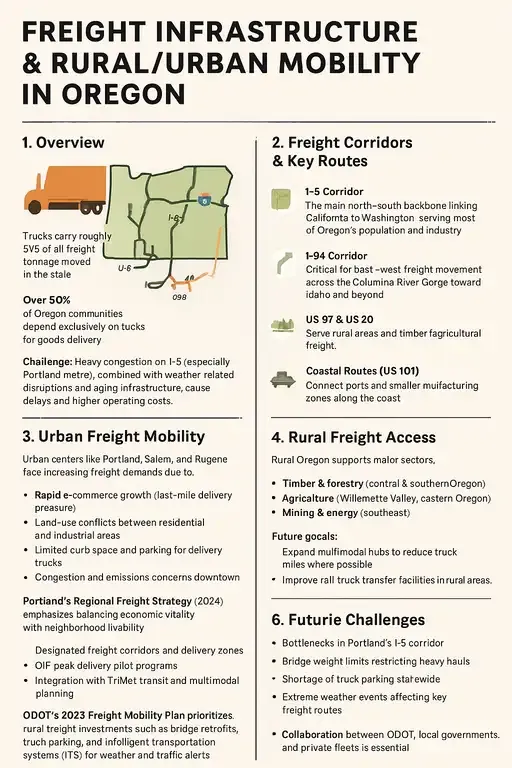
Freight Infrastructure & Rural/Urban Mobility in Oregon
1. Overview
Oregon’s trucking network is vital to both urban centers like Portland and Eugene and rural economies such as timber, agriculture, and manufacturing.
-
Trucks carry roughly 91% of all freight tonnage moved in the state.
-
Over 80% of Oregon communities depend exclusively on trucks for goods delivery.
(Source: Oregon Department of Transportation – Oregon Freight Plan, 2023)
2. Freight Corridors & Key Routes
The state’s freight system includes:
-
I-5 Corridor: The main north–south backbone linking California to Washington, serving most of Oregon’s population and industry.
-
I-84 Corridor: Critical for east–west freight movement across the Columbia River Gorge toward Idaho and beyond.
-
US 97 & US 20: Serve rural areas and timber/agricultural freight.
-
Coastal Routes (US 101): Connect ports and smaller manufacturing zones along the coast.
Challenge: Heavy congestion on I-5 (especially Portland metro), combined with weather-related disruptions and aging infrastructure, cause delays and higher operating costs.
3. Urban Freight Mobility
Urban centers like Portland, Salem, and Eugene face increasing freight demands due to:
-
Rapid e-commerce growth (last-mile delivery pressure).
-
Land-use conflicts between residential and industrial areas.
-
Limited curb space and parking for delivery trucks.
-
Congestion and emissions concerns downtown.
Portland’s Regional Freight Strategy (2024) emphasizes balancing economic vitality with neighborhood livability — for example:
-
Designated freight corridors and delivery zones.
-
Off-peak delivery pilot programs.
-
Integration with TriMet transit and multimodal planning.
4. Rural Freight Access
Rural Oregon supports major sectors:
-
Timber & forestry (central & southern Oregon).
-
Agriculture (Willamette Valley, eastern Oregon).
-
Mining & energy (southeast).
Challenges include:
-
Limited alternative routes — road closures can isolate areas.
-
Bridge weight restrictions on older rural routes.
-
Seasonal hazards: snow, landslides, and flooding in mountain passes.
-
Freight equity: ensuring small towns have access to reliable trucking services.
ODOT’s 2023 Freight Mobility Plan prioritizes rural freight investments such as bridge retrofits, truck parking, and intelligent transportation systems (ITS) for weather and traffic alerts.
5. Intermodal & Port Connectivity
Oregon’s freight infrastructure extends beyond highways:
-
Port of Portland: The only deep-draft port in Oregon, crucial for exports (grain, vehicles, containers).
-
Short-line rail connections: Serve rural industries feeding into the national rail network.
-
Air cargo: Portland International Airport (PDX) handles high-value shipments like electronics and perishables.
Future goals:
-
Expand multimodal hubs to reduce truck miles where possible.
-
Improve rail-truck transfer facilities in rural areas.
6. Future Challenges & Opportunities
Challenges
-
Bottlenecks in Portland’s I-5 corridor.
-
Bridge weight limits restricting heavy hauls.
-
Shortage of truck parking statewide.
-
Extreme weather events affecting key freight routes.
Opportunities
-
Use of freight technology (real-time data, route optimization).
-
Investment in zero-emission freight vehicles supported by Oregon DEQ.
-
Public-private partnerships for rural infrastructure improvements.
-
Off-peak and smart delivery systems in cities to reduce congestion.
7. Strategic Takeaways
Oregon’s freight economy depends on a resilient mix of rural and urban logistics.
The I-5 corridor is the economic spine, but rural road networks sustain local industries.
Addressing bridge upgrades, truck parking, and congestion will enhance statewide efficiency.
Collaboration between ODOT, local governments, and private fleets is essential to maintain safe and efficient freight mobility.