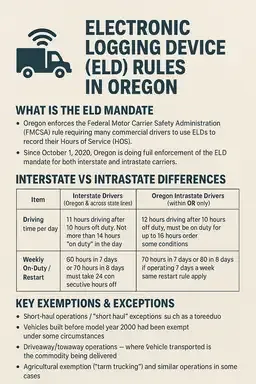
What Is the ELD Mandate
-
Oregon enforces the Federal Motor Carrier Safety Administration (FMCSA) rule requiring many commercial drivers to use ELDs to record their Hours of Service (HOS).
-
Since October 1, 2020, Oregon is doing full enforcement of the ELD mandate for both interstate and intrastate carriers.
Interstate vs Intrastate Differences
| Item | Interstate Drivers (Oregon & across state lines) | Oregon Intrastate Drivers (within OR only) |
|---|---|---|
| Driving time per day | 11 hours driving after 10 hours off duty. Not more than 14 hours “on duty” in the day. | Intrastate drivers are allowed a bit more: 12 hours driving time instead of 11, and may be on duty longer (up to 16 hours on duty instead of 14) under some conditions. |
| Weekly On-Duty / Restart | 60 hours in 7 days or 70 hours in 8 days; must take 34 consecutive hours off to restart. | Intrastate drivers: 70 hours in 7 days or 80 in 8 days if operating 7 days a week; same restart rule (34 consecutive off-duty) applies. |
Key Exemptions & Exceptions
Some drivers/operations are not required to use ELDs, or have modified requirements:
-
Short-haul operations / “short haul” exceptions. Drivers operating within certain radius limits and returning to their reporting location daily may be exempt.
-
Vehicles built before model year 2000 had been exempt under some circumstances.
-
Driveaway/Towaway operations where the vehicle transported is the commodity being delivered.
-
Agricultural exemption (“farm trucking”) and similar operations in some cases. Oregon has specific rules for farm trucking.
What Drivers/Carriers Must Do: Compliance Requirements
-
Use an FMCSA-compliant ELD which meets the technical specs and is registered.
-
Record duty status changes, driving time, rest breaks per the applicable hours of service rules.
-
Maintain supporting documents (e.g. fuel receipts, tolls) and logs. Oregon requires certain retention of records.
-
Be ready to present logs and ELD output during inspections: usually current day plus the previous seven days.
Violations & Penalties
-
Starting October 1, 2020, failing to comply with the ELD mandate could result in out-of-service (OOS) orders for intrastate drivers when required to have an ELD but not having one.
-
Some common violations in Oregon (for roadside inspections) include:
• No record of duty status when an ELD is required.
• ELD not being viewable or not properly mounted/fixed.
• Failing to provide required documents (like the user manual, transfer instructions, instructions for malfunction) upon request.
Things to Watch / Practical Tips
-
Make sure your ELD vendor is on the FMCSA certified list.
-
Training drivers is important: drivers need to know how to handle malfunctions, how to edit logs (within allowed rules), how to display or print logs when asked.
-
If an ELD malfunctions, there are rules about transitioning to paper logs or another compliant method until fixed.
-
Keep up-to-date with state regulations (Oregon Administrative Rules) because Oregon has slight variations for intrastate operations.