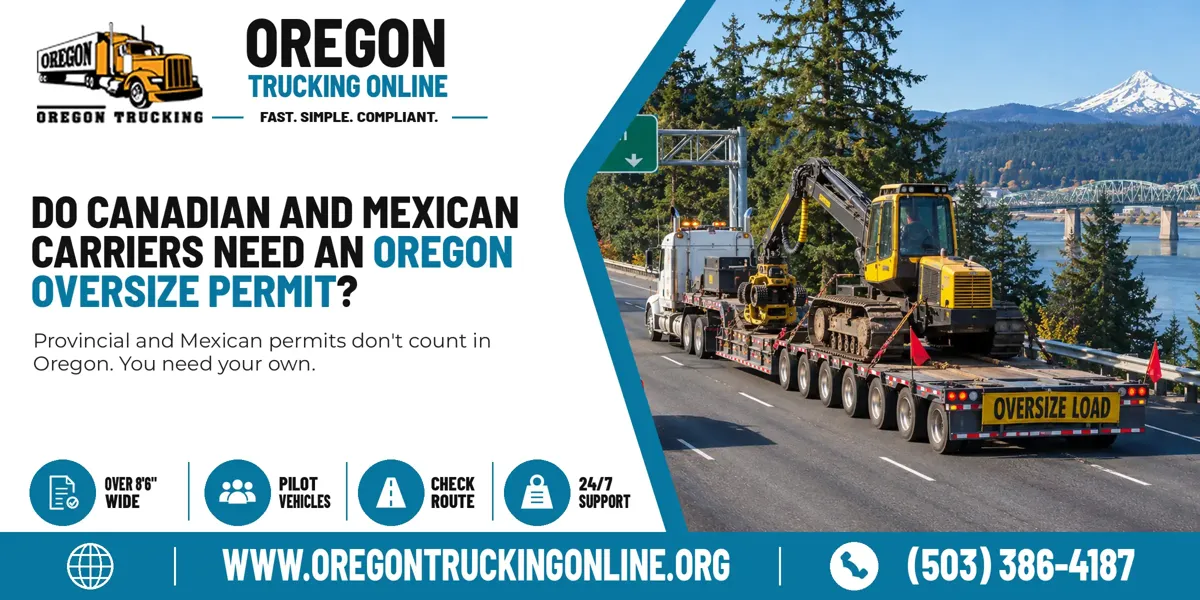
Do Canadian and Mexican Carriers Need an Oregon Oversize Permit?
Table Of Contents
-
Introduction
-
The Short Answer
-
Oregon's Legal Size and Weight Limits
-
Canadian Carriers Coming Into Oregon
-
Mexican Carriers Running to Oregon
-
Other Oregon Credentials Foreign Carriers Need
-
Converting Metric Measurements
-
Pilot Vehicles, Signs and Travel Times
-
How to Get an Oregon Oversize Permit as a Foreign Carrier
-
Common Mistakes to Avoid
-
Why Many Trucking Companies Choose Our Service
-
FAQ
Introduction
Oregon doesn't touch Canada or Mexico, but foreign trucks cross it every day. Canadian carriers from British Columbia and Alberta run down I-5 through Portland toward California, or come in on I-84 and US-395 from Idaho and eastern Washington. Mexican carriers with long-haul authority bring freight north on I-5 from California.
Many of these loads are heavy machinery, logging equipment, modular buildings and industrial parts that go over legal size. This guide explains when Canadian and Mexican carriers need an Oregon Oversize Permit and what else they need before the load reaches the state line.
The Short Answer
Yes. An Oregon Oversize Permit is required for any vehicle or load that goes over Oregon's legal size or weight limits, no matter where the carrier is based.
Oregon's over-dimension rules are in OAR 734-082, and permits are issued by the Oregon Department of Transportation (ODOT) Commerce and Compliance Division through ORION. A permit from British Columbia, Alberta, a Mexican state or another U.S. state doesn't count in Oregon.
Oregon's Legal Size and Weight Limits
These are the general limits carriers plan around:
| Measurement | Legal Limit |
|---|---|
| Width | 8 feet 6 inches |
| Height | 14 feet |
| Semitrailer length | 53 feet |
| Gross weight | 80,000 pounds |
A load over any one of these limits needs an Oregon Oversize Permit. Axle weights and axle spacing can also make a load overweight, even when the gross weight looks fine.
Canadian Carriers Coming Into Oregon
Canadian loads reach Oregon after crossing Washington or Idaho. Here is what Canadian carriers should know:
-
Provincial permits stop at the border. A B.C. or Alberta oversize permit covers only that province.
-
Every state needs its own permit. A load from Vancouver to Medford needs a Washington permit and an Oregon Oversize Permit.
-
Canadian limits can be higher. Some provinces allow heavier trucks and wider loads than Oregon. A load that is legal at home can be oversize or overweight in Oregon.
-
The route starts at the state line. The permit route usually begins at the Columbia River crossing on I-5, the I-84 crossing at Ontario, or another entry point.
Mexican Carriers Running to Oregon
-
Federal authority comes first. A Mexican carrier needs FMCSA long-haul operating authority to travel beyond the border commercial zones. Without it, the truck can't legally reach Oregon.
-
Each state on the route needs a permit. A load from the California border needs a California permit and an Oregon Oversize Permit.
-
A permit doesn't replace authority. The Oregon Oversize Permit covers size and weight only. It doesn't give a carrier the right to operate in the U.S.
Other Oregon Credentials Foreign Carriers Need
An Oregon Oversize Permit doesn't replace other Oregon credentials. A foreign truck may also need:
-
USDOT number for the carrier
-
IRP registration or an Oregon trip permit if Oregon isn't on the cab card
-
Oregon weight-mile tax coverage for trucks over 26,000 pounds, through a weight-mile account or a temporary pass
-
Proof of insurance that meets U.S. requirements
Oregon is different from most states. Heavy trucks pay weight-mile tax instead of fuel tax on diesel, so IFTA alone doesn't cover a heavy truck in Oregon.
Converting Metric Measurements
Canadian and Mexican carriers usually measure loads in metres and kilograms. Oregon permits use feet, inches and pounds.
-
Width: 2.6 metres is about 8 feet 6 inches.
-
Height: 4.27 metres is about 14 feet.
-
Weight: 36,287 kilograms is about 80,000 pounds.
Convert carefully and round up, never down. A permit that lists the wrong size or weight may not cover the load.
Pilot Vehicles, Signs and Travel Times
Once the permit is issued, foreign carriers follow the same rules as any carrier:
-
Pilot vehicles: The number depends on width, height, length, overhang and highway, using ODOT's Route Map 2 and Pilot Car Guide. Pilot vehicle operators must be certified.
-
Signs and flags: "OVERSIZE LOAD" signs under OAR 734-082-0037, and red flags at least 18 inches square at the widest points.
-
Travel times: Travel follows Attachment H, which comes with the permit. Some moves are limited to daylight and restricted over holiday periods.
How to Get an Oregon Oversize Permit as a Foreign Carrier
-
Measure the Load. Record width, height, length and weight in feet, inches and pounds.
-
Confirm Your Authority. Make sure your FMCSA authority allows the trip.
-
Check Your Other Credentials. Cover IRP and weight-mile tax.
-
Plan the Route. Start at the Oregon state line and check Route Map 2 and bridges.
-
Gather Truck and Trailer Details. Include VINs, plates, axle spacing and axle weights.
-
Submit the Permit Application. Include the load description and route.
-
Book Pilot Vehicles If Needed. Use certified pilot vehicle operators.
Common Mistakes to Avoid
-
Relying on a Canadian permit. It isn't valid in Oregon.
-
Assuming Washington's permit covers Oregon. Each state issues its own.
-
Getting the metric conversion wrong. Small errors can leave the load unpermitted.
-
Forgetting weight-mile tax. IFTA doesn't cover heavy trucks in Oregon.
-
Running beyond the commercial zone. Mexican carriers need the right federal authority.
Why Many Trucking Companies Choose Our Service
Oregon Trucking Online helps Canadian, Mexican and U.S. carriers get the right Oregon Oversize Permit, along with trip permits and weight-mile coverage, so the load crosses into Oregon without delays.
-
State admin fee (OS/OW permit): about $80 per permit
-
County admin fee: up to about $80 per county
-
Annual oversize permit: about $800 to $1,000+, depending on the load
We provide support 24/7 and also work weekends and holidays.
or
FAQ
Do Canadian carriers need an Oregon Oversize Permit?
Yes, when the load goes over Oregon's legal size or weight limits.
Is a B.C. or Alberta permit valid in Oregon?
No. Each state and province issues its own permits.
Do Mexican carriers need an Oregon Oversize Permit?
Yes, and they also need FMCSA long-haul authority to reach Oregon.
Does IFTA cover a heavy foreign truck in Oregon?
No. Trucks over 26,000 pounds need weight-mile tax coverage.
What is the legal width in Oregon?
8 feet 6 inches.
For more information, visit the Oregon Department of Transportation.