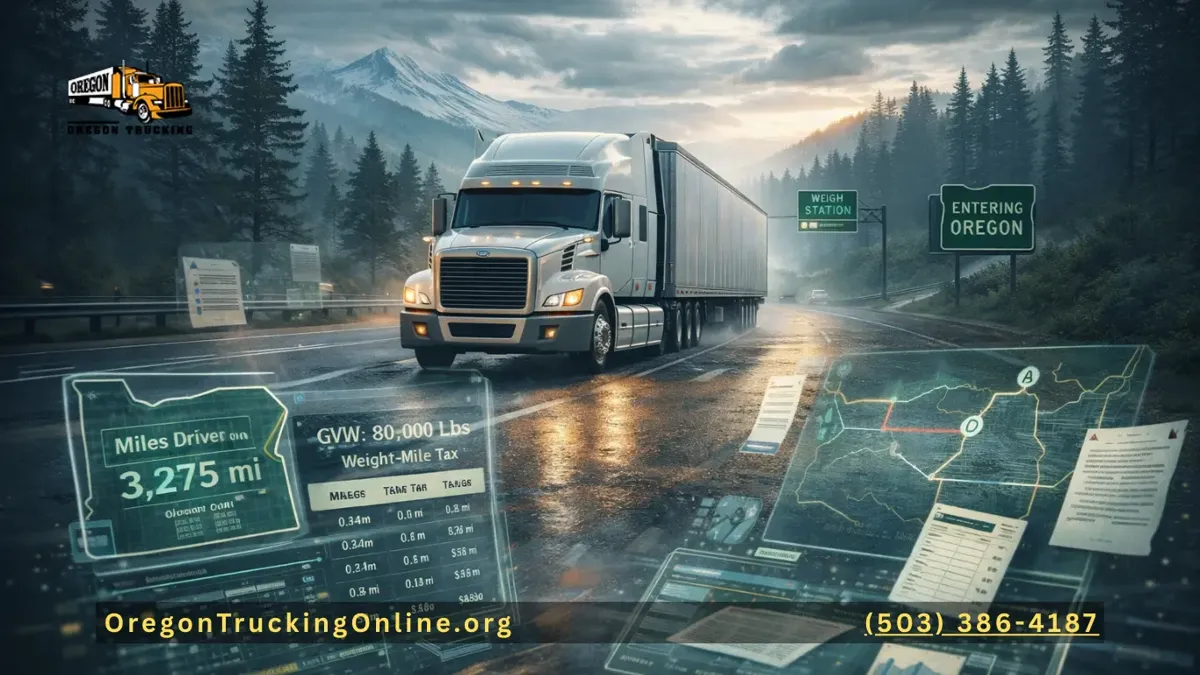
Why Oregon is Different: A Trucker's Guide to the Weight-Mile Tax
If you drive a commercial truck across the United States, you are likely familiar with the International Fuel Tax Agreement (IFTA). It's a standardized system that makes life relatively simple: you buy gas, track your miles, and taxes are divided among the states you visit. But then there's Oregon.
For both trucking companies and owner-operators, crossing into the Beaver State can feel like entering a different regulatory world. Oregon does not participate in IFTA's primary taxation of heavy vehicles. Instead, it uses a unique system known as the Weight-Mile Tax (WMT). If you drive a commercial vehicle with a gross weight of more than 26,000 pounds on Oregon public highways, you pay for every mile you travel.
How The Oregon Weight-Mile Tax Works
Unlike fuel taxes, which are based on how much diesel you use, Oregon's WMT is based on the wear and tear your vehicle causes on the infrastructure. The state's philosophy is straightforward: heavier trucks cause more road damage, so they should bear a greater share of maintenance costs.
The tax rate is determined by your vehicle's declared weight and number of axles. For an average 80,000-pound tractor-trailer, the rate is significantly higher than what you might pay in fuel taxes elsewhere, often exceeding $0.20 per mile. If you're hauling heavy loads (more than 80,000 pounds), the calculation shifts to "Table B," which accounts for axle counts to determine your rate.
This means that even if you drive a fuel-efficient truck, your Oregon tax bill will not decrease. You pay for the distance, not for the diesel.
Oregon vs. The Rest of the Country
Oregon is one of only a few states that have a weight-distance tax, along with New York, Kentucky, New Mexico, and Connecticut. However, Oregon's rates are typically the highest in this group.
Most other states charge fuel tax at the pump. If you buy fuel in a state but don't drive much, IFTA helps to balance things out. In Oregon, you can still pay fuel taxes at the pump, but they are separate from the WMT. While you can frequently claim credits for fuel taxes paid to avoid double taxation, the administrative burden falls on you to track everything perfectly. You must keep detailed records of exactly where you entered and exited the state, your odometer readings, and the specific routes taken.
The Compliance Headache
For many trucking companies, the biggest issue is not the cost of the tax but the paperwork. Oregon requires a $2,000 bond simply to open an account, and you must file monthly reports (or quarterly if eligible). A single mistake in your mileage logs or a lapsed bond can result in significant fines, audits, and even the impoundment of your truck at the scales.
Why Choose Oregon Trucking Online?
Here's where we come in. At Oregon Trucking Online, we understand that your job is to move freight, not get bogged down in spreadsheets and tax tables.
Navigating the Oregon Department of Transportation's requirements can be complicated and time-consuming. Our service is intended to take that burden off your shoulders. We handle the complex registration process, assist you in obtaining the necessary bonds, and ensure that your monthly reports are filed accurately and on time.
Whether you need a temporary pass for a one-time trip or a permanent account for regular routes, our platform makes it easy to avoid penalties and keep your trucks moving. Don't let Oregon's unique tax laws hold you back—let us handle the compliance so you can concentrate on the road ahead.