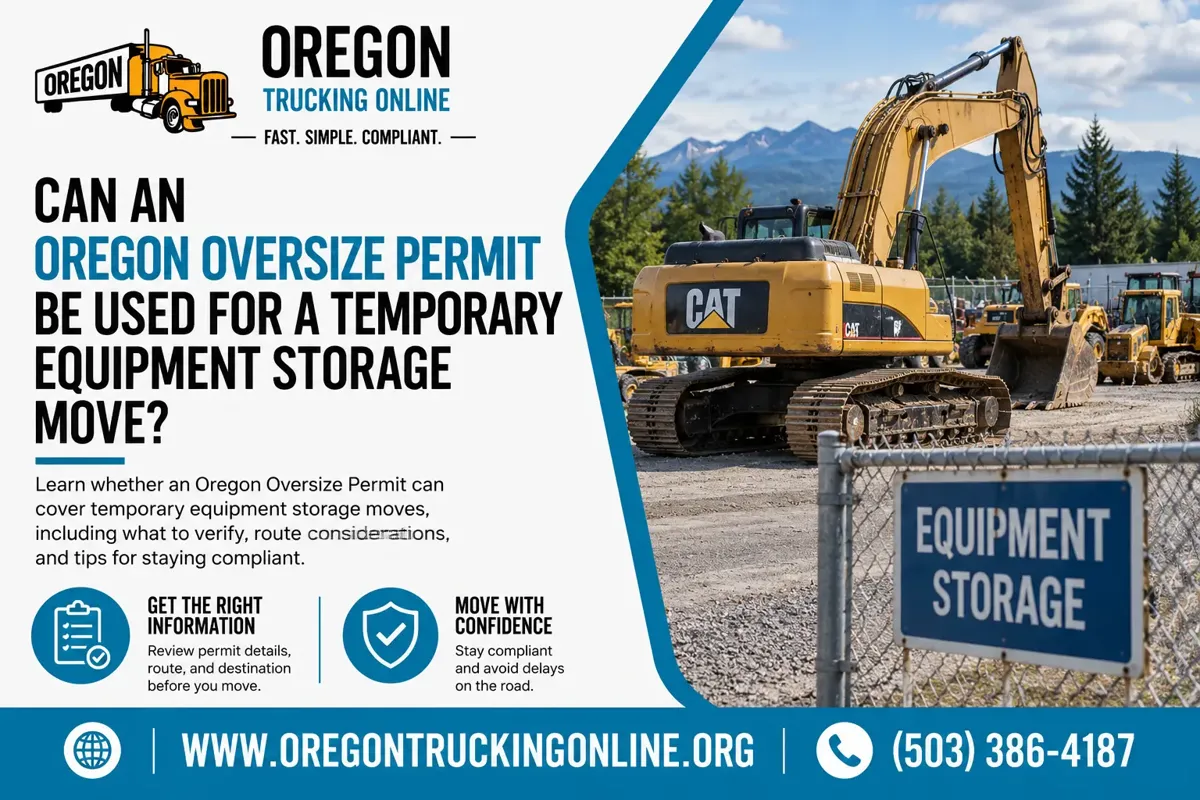
Can An Oregon Oversize Permit Be Used For A Temporary Equipment Storage Move?
Table Of Contents
-
Introduction
-
Can An Oregon Oversize Permit Cover A Storage Move?
-
What Does The Permit Actually Authorize?
-
Why The Destination Matters
-
Does Temporary Storage Change The Permit?
-
What If The Equipment Is Moved Again Later?
-
What Should Dispatch Verify Before The Move?
-
Common Storage-Move Mistakes
-
How To Plan A Temporary Storage Move
-
Why Many Trucking Companies Choose Our Service
-
FAQ
Introduction
Trucking companies do not always transport oversized equipment directly from a supplier to its final job site. A piece of machinery may need to be moved to a temporary storage yard, warehouse, contractor facility, or staging location before its final delivery.
This creates an important question: Can an Oregon Oversize Permit be used when the purpose of the movement is temporary equipment storage?
In many cases, yes. The fact that equipment is being moved into temporary storage does not by itself prevent an oversize or overweight movement from being permitted. The important issue is whether the vehicle or load requires an over-dimension permit and whether the planned movement meets the permit requirements.
Can An Oregon Oversize Permit Cover A Storage Move?
An Oregon Oversize Permit can potentially authorize the transportation of qualifying oversized or overweight equipment to a temporary storage location.
Oregon requires an over-dimension permit before an oversize load is moved on public roads. The permit is concerned with the movement of the vehicle or load, rather than whether the destination is a final customer location, construction site, warehouse, or temporary storage facility.
For example, a carrier may need to move an excavator from a supplier to a storage yard because the final job site is not ready. If the equipment exceeds Oregon's legal size or weight limits and qualifies for permitting, the storage movement can be planned as the permitted trip.
The carrier should still make sure the permit accurately reflects the actual movement.
What Does The Permit Actually Authorize?
An over-dimension permit authorizes the movement under specified conditions, including the dimensions and weight approved and the route identified for the trip.
This means the permit does not give the carrier unrestricted authority to move the equipment anywhere in Oregon.
The destination shown for the storage movement matters. The carrier should identify the actual facility where the equipment will be delivered and make sure the route is appropriate for the permitted load.
A temporary storage destination should therefore be treated as a real delivery point for route-planning purposes.
Why The Destination Matters
A storage yard may be located on an industrial road, county highway, or city street that creates additional routing considerations.
Oregon permits can include state highways and, when authorized, certain county roads or Portland city streets. A state permit does not automatically mean every local road leading to the storage facility is covered.
Dispatch should identify the exact storage address before the permit is requested and determine how the truck will reach the facility.
This is especially important when the final portion of the route includes narrow streets, low clearances, weight-restricted bridges, or other conditions that may affect an oversized movement.
Does Temporary Storage Change The Permit?
Temporary storage itself does not necessarily change the permit requirements for the initial movement.
The carrier should think of the operation as two separate stages when the equipment will eventually move again.
The first stage is transportation from the original pickup point to the temporary storage facility.
The second stage is a later movement from storage to another destination.
The second movement should not automatically be treated as covered by the first permit. A later move can involve a different route, date, destination, vehicle configuration, or permit conditions.
What If The Equipment Is Moved Again Later?
This is one of the most important considerations for temporary storage.
A carrier may store equipment for several weeks and later receive instructions to transport it to a construction site. The original storage-move permit should not simply be reused for that later movement.
The carrier should review the second trip separately and determine what permit is required for the new origin, destination, route, dimensions, and weight.
If the equipment is moved to a different trailer or the configuration changes while it is in storage, the carrier should also verify the new vehicle and load information before the next movement.
What Should Dispatch Verify Before The Move?
Before the truck leaves for the storage facility, dispatch should compare the actual operation with the permit information.
Important details include:
-
Pickup location
-
Storage facility
-
Vehicle configuration
-
Load dimensions
-
Gross weight
-
Axle configuration
-
Approved route
-
Travel dates
-
Applicable restrictions
Dispatch should also confirm that the equipment is loaded exactly as represented in the permit.
If the equipment is taller, wider, longer, or heavier than planned, the carrier should address the difference before beginning the movement.
Common Storage-Move Mistakes
One common mistake is assuming that a storage facility is exempt from normal permit requirements because the equipment is not being delivered to its final destination.
Another is treating the permit for the first movement as permanent authorization for the equipment.
Carriers can also overlook local-road requirements when the storage facility is located away from a major highway.
A further problem can occur when equipment is stored and later moved with a different trailer or vehicle configuration without reviewing the new movement.
How To Plan A Temporary Storage Move
The best approach is to plan the storage movement as its own permitted operation.
Start by confirming the equipment's current dimensions and weight. Then identify the exact storage facility, determine the appropriate route, and review the applicable permit conditions.
Before departure, dispatch should compare the permit with the actual vehicle and load.
When the equipment is eventually removed from storage, start a new review. The second movement may require a separate permit because its circumstances may be different from the original storage trip.
Careful planning can help prevent the carrier from relying on outdated trip information.
Why Many Trucking Companies Choose Our Service
Many trucking companies choose Oregon Trucking Online because oversized equipment moves can become more complicated when a delivery is temporarily redirected to storage.
Our service helps simplify the permitting process with fast processing, experienced permit specialists, secure online applications, and convenient customer support.
We help trucking companies prepare Oregon permit information for equipment movements and review the details needed before travel.
FAQ
Can An Oregon Oversize Permit Be Used For A Temporary Equipment Storage Move?
Yes, a storage movement can potentially be covered when the vehicle or load qualifies for an over-dimension permit and the movement meets the applicable requirements.
Does The Final Destination Have To Be A Customer's Job Site?
No. The destination can be a qualifying storage or staging location, but the actual destination should be identified for route planning and permit purposes.
Does A Storage Permit Cover The Equipment's Later Delivery?
A carrier should not assume that it does. The later movement should be reviewed separately based on its new origin, destination, route, vehicle, and load conditions.
Can The Storage Facility Be On A Local Road?
It can, but the carrier should verify whether separate local-road authorization is required for the portion of the movement outside the state permit's authority.
What If The Equipment Changes While In Storage?
If the vehicle, trailer, dimensions, weight, or configuration changes, the carrier should review the requirements before transporting the equipment again.
Does Temporary Storage Change The Permit's Purpose?
The storage purpose does not automatically prevent permitting. The permit still governs the qualifying movement on public roads and its stated conditions.
What Should Dispatch Verify Before The Storage Move?
Dispatch should verify the vehicle, load dimensions, weight, storage destination, route, travel dates, and permit conditions.
Can The Same Permit Be Reused After The Equipment Leaves Storage?
Carriers should not assume that it can. A later movement should be evaluated separately before the equipment is transported again.
For more information, visit the Oregon Department of Transportation.